Artificial Flowers

You can imagine, outside any pull of nostalgia, a time when the internet was just a novelty. Before companies began to dream about monetizing our personal data. Before political campaigns began to mine that data for habits and proclivities, before our vulnerability to having weaponized popularity used against us (if only for a few minutes)… you had, what? Techno-utopianism is perhaps the saddest kind: dry, unfulfilling, obviously not harmless. But the gamed-out essence of online anonymity maxed into inflated presence with no actual power behind it beyond its allure brags a special brand of nerdy cache. With computer technology we began trading in a kind of currency we had never considered before we were already doing so. That’s why it was new but felt so familiar.

It’s not old, or merely similar to other things, as some have suggested; being online was definitely new, again, if only for a few minutes. And it wasn’t just the DandD kids, it was everybody – work made use of it. And news! Watch videos, anytime! Buy stuff… uh oh. We just took to it so naturally, the sleight-of-our-own-hand felt redeemable. The ease itself took a natural form, comfit to the future that had yet to deliver flying cars or even dependable jetpacks.

I share books and records with certain friends, and I still think ‘virtual reality’ is a hilarious phrase. There are artificial flowers, have long been, and they still have no scent. All the stuff we used to be able to do with maybe the exception of spelling, we can still do. Yes, smart technology makes you dumb. If you get a little out of shape, you must exercise. If you get a little too far removed – from people, from politics, from real food, from ammunition that doesn’t come in a box – move back into town. Register to vote. Get a library card. Go to the bar.

Green is self-renewing, even our own cabbage-truck-just-fallen-ness. It’s still pouring, but postdiluvian world number TWO lay just steps outside of this ark. Now what’s that tapping? Oh, it’s just the Raven.

A trolley of Folly

Via the powder blue Satan, an instant classic in the emerging genre of parody far superior to the original:

I was reminded of this when—I can see certain readers rolling their eyes already—I read the news, last September, that numerous California cities, including Oakland and San Francisco, had filed lawsuits against Exxon, BP, and several other oil companies. The cities argue that rising sea levels, caused by global climate change, driven by fossil fuel consumption, will cause billions of dollars in property damage, and that “big oil” should foot the bill for costly infrastructure projects to shore up below-sea-level neighborhoods and oceanside communities.

If you believe the science is settled and the models are correct, of course it makes sense to take a page from the “Big Tobacco” lawsuit playbook. If it were the case that Exxon and the others were acting in ways that could ruin much of the California coastline, with full knowledge of the certain results of their conduct, it would indeed be just to ask them to foot the bill for protecting our cities and communities.

But I can’t help but think of those Navy prognosticators, who probably knew more about computers than just about anyone else in the United States government but didn’t know what Silicon Valley was up to right at that very moment.

The only real way to push back against the gratuitous provocations of the NYT editorial page or the dogsh*t political coverage at NPR is to send it up, up and away. Merely disagreeing only confirms their primary, fundamental fallacy: “Hey! If both sides are criticizing us, we must be right!” – a sweet spot only further plaqued with the appearance of even-handed contrarianism. This is more like transmitting articles through a ridicule device. One can only hope it embarrasses the other Stephens and his colleagues, if for nothing else the flimsiness of their shoddy talents.

Interrogating the Sabotage

Bon Dieu. Saltz catches us up on the techno-climactic imitation-felt confluence-peddling praxus-shuffling symbolically-metaphorical thrice-divorced yet still unimaginably and singly imponderable grammatically-scientific but geographically-sociological and revolution-intolerant latest art show:

The catalogue has words in it that I didn’t know. The show is about the “precariat” and “geontopower.” I looked them up. The first word is about a generation born during a period of the greatest accumulation of wealth in the history of the world but who nevertheless live in unstable economies. It’s worth pointing out that 99 percent of all artists have always lived like this. Needless to say most of the artists included here are relatively well-off —either schooled, degreed, living in more than one city (that’s a nice racket), recipients of important grants and residencies where they do “interventions with the local communities.” This is not to say, of course, that no beneficiary of art-world largesse should feel qualified to make work involving social critique. Quite the opposite. But I want to see them walking the walk, not just posing the pose.

To define the second word, “geontopower,” the catalogue offers a dodge: “a set of discourses.” You can’t win with these people! Words like “undercommons,” “hypercapitalism,” “networked mediascapes,” and “anarcho-syndicalists” are tossed off. There’s lots of usual art-speak about art that “interrogates,” leading us to conclude that in the last 15 years the art world has gone from being undertakers proclaiming mediums dead to becoming lawyers taking depositions. In an old neo-Marxist tip of the hat, the approved word for artists is now “cultural producer.” No artist can rise to these levels of activism. Especially not very very young ones. (And these are the same people who end up writing the histories, curating the shows, teaching the courses, editing out “impurities” from bibliographies, reviewing one another’s shows, hiring colleagues for jobs.) Meanwhile, a claque of critics lauds every show and demonizes all those who don’t. It’s airtight.

There is no joy in attending a gathering of people who [ostensibly] do what you think you do but all urgency is being discussed in a language you do not understand. It could be that the end-product of the eventual combination of art and business schools is to organize an end-of-the-world exhibition where nobody comes.

What does Eau de Nil mean?

Noted early twentieth century cultural signifier Eau de Nil wends it way from Flaubert in Egypt to Hitchcock to a fresh moment in the sun thanks to a cool president’s new portrait:
The term first entered our chromatic lexicon in the late nineteenth century, just as Egyptomania was hitting its peak. While in the British Isles talk of “the East” referred primarily to India, France had a particularly strong affinity for Egypt—due in part to Napoleon’s brief 1798 attempts at colonization and the influence of the savants. “If you were French,” Wall writes, “the east was Egypt, a place at the very limit of the European imagination … Egypt was the orient, a country of the mind, a grand theatre of sensuality, despotism, slavery, polygamy, cruelty, mystery and terror.” This Egypt of the mind had little reality outside the poetry of Keats and Shelley; the paintings of Jean-Léon Gérôme, Emile Bernard, and André Duterte (whose painting of the ruined temple at Thebes may have been the basis for “Oxymandias”); and the oddly popular theories of the occultist Helena Blavatsky and her follower, the “wickedest man in the world,” Aleister Crowley. For the French, Egypt as a concept was far more exciting than Egypt as an actual place. (Though not to Flaubert; to him, Egypt was where he bedded nubile young women after watching them dance the popular striptease, “the bee.”)

Image: the great portrait by Kehinde Wiley

The eve and the morrow

The great Colm Tóibín assembles and unfurls several aspects of Conrad in a review of a new book about the writer, sharing earlier appraisals by V.S. Naipaul and Chinua Achebe. How’s this for precision:

In his essay, Naipaul invokes Conrad as “a writer who is missing a society…. Conrad’s experience was too scattered; he knew many societies by their externals, but he knew none in depth.” And then he laments:

The great societies that produced the great novels of the past have cracked…. The novel as a form no longer carries conviction…. The novelist, like the painter, no longer recognizes his interpretative function; he seeks to go beyond it; and his audience diminishes. And so the world we inhabit, which is always new, goes by unexamined, made ordinary by the camera, unmeditated on.

And

Since Naipaul cannot detach himself as a writer from “the corruption of causes, half-made societies that seemed doomed to remain half-made,” he finds “that Conrad—sixty years before, in a time of a great peace—had been everywhere before me.” In rereading The Secret Agent, he discovers characters and phrases that strike him as “real” in a way they had not before. He notes a phrase—the “exasperated vanity of ignorance”—about one of the terrorists in the book who “took the part of an insolent and venomous evoker of sinister impulses which lurk in the blind envy and exasperated vanity of ignorance.”

As Naipaul grows to appreciate that phrase he sees something essential in Conrad: nouns that seemed muted or throttled by their adjectives, as though the impulse were merely to make a fine-sounding phrase or add impressively to the mystery, can, in fact, if studied carefully or read in a certain light, stand apart, become precise. He observes that Conrad, despite all his concern with ineffability, often meant business. “Words which at one time we disregard,” Naipaul wrote, “at another moment glitter.” Even though his “reservations about Conrad as a novelist remain,” still he cannot dismiss him: “Conrad’s value to me is that he is someone who sixty to seventy years ago meditated on my world, a world I recognize today. I feel this about no other writer of the century.”

Just go read it all. It’s Friday – what else are you doing? Plus you’ll be relieved of thinking about vulgarians for a while better for it.

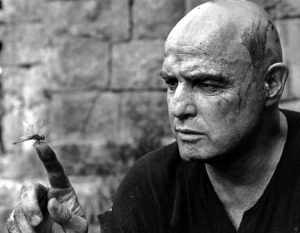
Image: Marlon Brando as Colonel Kurtz.

Slowed! to the Highest Bidder

Hilarity ensues as the Trump ministration launches a trial balloon for building a nationwide 5G network:

it was an unpleasant surprise to many when a draft proposal urging heavy federal involvement in the next generation of fast mobile networks emerged from the White House of Donald Trump — who won the presidency after promising massive cuts to regulations.

”We’re not Venezuela,” Representative Greg Walden, an Oregon Republican and the chairman of the House Commerce Committee, said at a policy gathering in Washington. “Government taking it over, controlling it, is probably — clearly — not the way to go.”

Federal Communications Commission Chairman Ajit Pai, a Republican chosen by Trump, was even more blunt: “I oppose any proposal for the federal government to build and operate a nationwide 5G network”

The proposal is rooted in concerns about China and cybersecurity, according to two administration officials familiar with the plans who were granted anonymity to discuss them. Unresolved questions include the extent of taxpayer funding, and whether a fifth generation, or 5G, network would be owned by the government, one of the officials said.

If the federal government directly participates in building a wireless network intended for commercial use, it would be a departure from the decades-long tradition of auctioning licenses to telecommunications companies to build their own networks. Phone service has been on a deregulatory path for decades, including legislation in 1996 that President Bill Clinton said “promotes competition as the key to opening new markets and new opportunities.”

Very observant of Representative Walden, but so many (and varied) plans are afoot and this is where they play the V card? So frightened are we of the massive, self-created Beowulf of ‘government-run _____’ that we are willing to abide any and all inferior services because THE MARKET! One might say it is cunning to introduce the security threat into this discussion until you remember who’s in charge and that you have every reason to be suspect even of unscheduled emptying of waste baskets. But the rending of garments about how great our competitive monopolies are at doing everything and the temerity to threaten them with a network built and own by Guhvuhmint is indeed tender and endearing.

Monuments and Moby Dick


There are a slew of metaphors in these border wall prototypes and the proposal to designate them a singular national monument, which one could argue they already are. And I don’t know quite what is the best of the ‘elegance from idiocy’ interpretations… or how many… oh, it’s America, we can choose all of them:

Which fittingly brings us back to Trump. As with much minimalism, these prototypes are hard-edged geometry and impervious materials brought into the American landscape of the West and arranged to impose order, inspire awe, and try to manage and align mystic political forces — and to make something that while instantly obsolete, like some useless Stalin Gulag project, meant to last forever. Trump has made something that evokes a real monument — one that may correctly be said to stand for everything he believes in. And I think mustn’t be forgotten. The structures represent a menacing presence that imparts brutal cruelty, fear, contempt, and coldhearted malice — something nihilistic and destructive that doesn’t believe in the substance of the American creed but only in the appearance of being cocksure, in theatricality, and manipulative statecraft.

It’s horribly unjust – to them – how each U.S. preznit seems to symbolize the country during his(!) time in office, and though at times it is beautiful, usually the truth only hurts. But this time it’s just stupid, ignorant, fearful, racist and depraved.

Great D.H. Lawrence quote at the end of the article. Nice going.

Terrifically Boring


The movements on the Green energy front (What does it mean?) have become complex, obscured tea-leaves reading exercises and here’s another one that will get little attention though it rolls disparate dynamics into one [silent] scream:

The Federal Energy Regulatory Commission on Monday unanimously rejected a proposal by Energy Secretary Rick Perry that would have propped up nuclear and coal power plants struggling in competitive electricity markets.

The independent five-member commission includes four people appointed by President Trump, three of them Republicans. Its decision is binding.

TL;DR – the commission endorses markets. ‘Sustainable’ was an iffy signifier until people. Started. Making. Money. Or put another way: Guy comes into his shrink’s office after a hundred sessions and the doc lays it all out. Everything comes down to: It doesn’t matter which green we’re talking about. They both point to the same place. Ugly, perhaps, and maybe not inevitable enough to happen in time. So parades and grandstanding will seem a little gratuitous and a kind of devolution at the hand of the money power. Again, hate the irony, not the player.

Image: future skate park?

Steps in Rome


Not to say ‘toward’ or ‘from.’ No need to be so speculative at the top of a New Year.
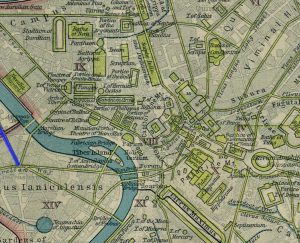
The Cavour is a neighborhood just to the north of the Coliseum. Steps leading down to a small street from the large excavation of the Imperial fora, backing up from the Trajan forum specifically.
The name Cavour seems to relate to the ancient neighborhood, Suburra, which has become kind of hothouse stand-in for over-charged criminality with new film and TV depictions. I had heard it was kind of red-light district in earlier times. Colleen McCullough mentions it as a densely-populated neighborhood of working people and perhaps a dozen or more different ethnicities where Gaius Marius bought apartments for his wife Julia. The area is still home to a lot people and not a few chic new restaurant of at least a dozen ethnicities.
But before you descend the steps down to the those places, or toward the metro stop of the same name, from the Via Cavour you can look back over those large holes of ruins and see Victor Emannuele and the remains of the Republican Forum and the Palatine Hill.
It was just that, turning around for another look prior to descent, which occurs now. We look up as we go down, even in the Eternal City. Remembering the way, learning, forgetting again old acquaintances, seeing them through the lens of the new.
Whether steps are old and cracked or well cared for, lead us forward or back, down or higher – they deposit on the fringe of a new space. There for decisions to then be made about joining the madness, skirting the trouble, perusing the menus or busting in and asking for a table. Reservations? Sure, you may have them. But don’t let that stop you.
Excelsior. And step lively.

Image: Plan of Rome and the area in question, approx. 350 A.D.

Eco Hustle, You’ll Tide edition

My Christmas column, originally published in Flagpole magazine in December 2008. Painfully, mostly still relevant.

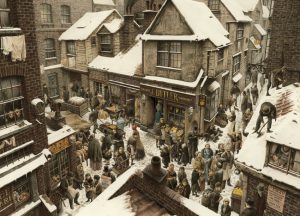
In December 1843, Charles Dickens did a hell of a thing. The son of a debtor, Dickens found himself drowning in debt as well and penned a Victorian morality tale in a desperate attempt to ease his financial burdens. The story we have come to know as A Christmas Carol was written in the span of six weeks. No publisher would touch it and so Dickens published it himself. The book was ready just before the holiday that it celebrated and all 6,000 copies sold out in the span of a week. It became a holiday institution immediately, its popularity serving to “redefine the importance of Christmas and the major sentiments associated with the holiday,” according to wikipedia.

Dickens’ hero, Ebenezer Scrooge, had lost all use for the human endowments of charity, community, friendship and love. In fact, he demonstrated contempt for anything but money – a pose that has been greatly admired in our own culture until rec… well, we have at least sought comfort in epithets like conspicuous consumption and luxury tax. The analogy brings up some uncomfortable comparisons to go with our holiday cheer.

With our ability to supply basic necessities at a zenith, we strain for meaning and stimulation, indebting ourselves to buy things for a holiday we swear is not about material objects. We accept gross inadequacies in national and local healthcare, energy use and environmental degradation; the plight of those beyond our borders reduced to fables. If the ghost of Jacob Marley returned tonight, what bleak landscape would he threaten us with as an eternal post-mortem walking tour? Wait. Don’t answer that just yet. Viewing the world through the lens of consumption, we interpret events in the language of commodities. We’re perfectly at home with these unimportant distinctions between consumers and citizens (neighbors?) yet the only thing that preoccupies us more at this time of year than Christmas are the moments of consternation at how crass and commercial it has become.

Instead of ghosts, perhaps our dreamscapes are inhabited with the representative elements that first appeared as improvements to daily life, only to become seeds for greed and short-sightedness as they gave rise to our modern society. Christmas Past might feature a child waking sweetly on a long drive with her parents to Grandma’s house. She might peer over the big backseat of a large automobile and ask, “Papa, are we there yet?’ and he might answer, “Yes, Angel. Thanks to the new Interstate road system we’ll be there in another few minutes!”

“If we only knew then what we know now,” we might say. But what would we do differently? If we could revisit critical junctures, would we choose to begin down a more sustainable path?

Christmas Future would surely take place in that green, green landscape of the BP and IBM commercials, where birds chirp and squirrels chase deer and all sorts of other nonsensical pastimes envelope us in open meadows while we pull on rainbow cigars. The future would have to be particularly incoherent and disorienting in order to be sufficiently post-whatever we’ll be over by then. To pull this off, the virtual reality rendering might crash into a smoky apocalypse to really get our attention. The idea that what we find would tug at our innocence enough to invoke a specter of regret is both the genius of the Dickensian cliché and wishful thinking. Scrooge was savvy for his day, but we have fourth graders who would have him for lunch.

It’s Christmas present that is the problem. How do we see ourselves at this particular juncture? More attention is being paid the loss and destruction of water, minerals, oil, trees, fish, soil and air than ever before. Yet the prices for most raw materials are near historical lows and continue to fall. Supplies are cheap and appear to be abundant as technology continues to stay just ahead of depletion. Richer on a more grand scale than ever before, the resources upon which civilization depends to create economic progress are declining at a rate proportional to the gains in material well-being. We are thriving and yet the quality of our finest moments seems diminished.

Do we admit the disjuncture about the way we live and all it takes to support it? How about the one that really makes a mockery of Wall Street, that the earth is a closed system? Would we be startled by a solution waiting just outside our reach, ready for us to take charge if we might dare?

A Christmas Carol is not known as irreligious text but note the lack of religion in Dickens’ tale. We get all exercised about presents but exchanging gifts was the birthright of the pagan holiday, Sol Invictus. Let’s give it back – or better yet, announce where it came from. Notwithstanding the nefarious ploys of being drawn away by the foolish errors of heathendom, do these not both attempt to consecrate the One and True Light?

Ah, the sun. Sol Invictus, the unconquerable sun god, had already made December 25 a holiday; the early Christians were chastised for being unobservant until they begged and borrowed and made the post-solstice feast their own. The Romans were just the next in a long line of people trying to remain in good stead with our main star. Perhaps we would do well to take our place in that procession. The moral hymn of our day is waiting to be written or perhaps we just need to re-read an older one to be reminded that we, too, need to change our ways. Dawn we now?