Always headed here

With a president suffering from main character syndrome coupled with a steadily deteriorating mental state,  so much ‘seems’ to be going on that keeping up with it in whole much less in part can itself feel maddening.

Two days ago, he gives a televised exposition of just how adrift he is, boxed in by an ill-considered military fiasco and hand-picked, grossly incompetent and corrupt underlings. Ardent, patriotic citizens try to keep up but mostly what’s on offer is the unwillingness to describe a massive, practically unimaginable strategic defeat.

In pondering what are we still wondering about, some well-framed context about some things we already know clicks a light bulb in a closet blocked behind an old armoire. It’s not reassuring but it is forward, and perhaps desperately needed correction against meaningless reassurances:

For more than a century, the political and moral imagination in much of the Persian ecumene was shaped by an urgent quest for alternatives to the pitilessly exploitative regimes of capitalist imperialism. For Gandhi, a historical experience that began in the late nineteenth century in South Africa made him see fascism and imperialism as inevitable features of capitalist states overdependent on violence—disguised and softened at home, extreme and explicit abroad. It was the fate of a later observer like Jalal Al-e-Ahmad, the twentieth-century novelist and essayist, to endure, while still analyzing, the insidiousness of neoimperialism: economic modernization under Western auspices that condemned postcolonial states to perpetual underdevelopment.

Given the religion-capitalism pairing that has defined the very essence of the American experiment since its inception (ask any Republican candidate for any office), it’s fair to ask whether we’ve always been headed here. Not karmically, though there is that; but just as a natural effect of the causes as they have hatched. Every other country and alliance has already figured out that dependence on the US is toxic to their national interests, while we try to make sense of the nonsensical. It feels sped-up, fast-forwarded, still a bit out front of our ability to conceive, believe. He is referred to as the American id. Maybe that’s it and this is all of the accumulated skullduggery, laid bare.

But I did learn a new word.

Of straits and traps

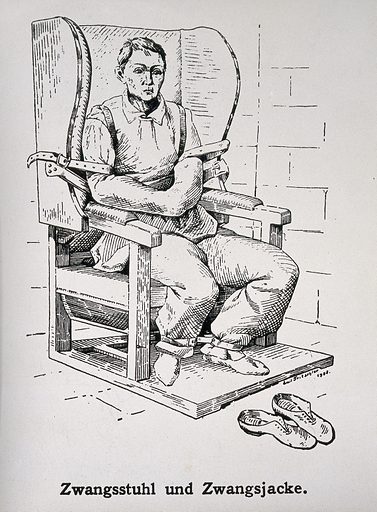
A mental ill patient in a straight jacket and strapped into a chair. Photograph after a wood engraving by E. Tritschler, 1908.

What if war isn’t viable? And rather than being merely hopeful or any nod to a peacenik Shangri-La at last, what would remain in the balance – TBD comme on dit – is somehow assuring that the entire globe doesn’t become a failed state. That we don’t default to a Hobbesian existence on a planetary scale – yes, very much including our bumblionaires who have so sagely guided marked the territory to this place. But as [this] war increasingly results in an escalation trap, can we must become dissuaded of ts benefits:

Once started, a major regional war with Iran was always likely to be something of a ‘trap,’ – not in the sense of an ambush laid by Iran – but in the sense of a situation that, once entered, cannot be easily left or reversed.

The trap, of course, is the Strait of Hormuz and the broader Persian Gulf. The issue is that an enormous proportion of the world’s shipping, particularly energy (oil, liquid natural gas) and fertilizer components (urea) passes through this body of water. The Gulf is narrow along its whole length, extremely narrow in the Strait and bordered by Iran on its northern shore along its entire length. Iran can thus threaten the whole thing and can do so with cheap, easy to conceal, easy to manufacture systems.

So once the strait was closed, the United States could not leave until it was reopened, or at least there was some prospect of doing so.

The result is a fairly classic escalation trap: once the conflict starts, it is extremely costlyfor either side to ever back down, which ensures that the conflict continues long past it being in the interests of either party. Every day this war goes on make both the United States and Iran weaker, poorer and less secure but it is very hard for either side to back down because there are huge costs connected to being the party that backs down. So both sides ‘escalate to de-escalate’ (this phrase is generally as foolish as it sounds), intensifying the conflict in an effort to hit hard enough to force the other guy to blink first. But since neither party can back down unilaterally and survive politically, there’s practically no amount of pain that can force them to do so.

I’ve mentioned multiple times how the brakes on the carbon-based economy have been located – No! Not that way! – and the screeching we hear is actually the metal backing plate contacting the metal rotor, recommending immediate inspection and repair.

A dumb, so very dumb war presents this metaphor for appraisal.

Image via Wellcome Collection..

Preventive Incantation

It doesn’t matter how one feels* about AI as a technological problem. It is much more of a financial problem, a threat similar to others that preceded it but special in its own special way. Purveyors already know the limits of the technology but dangle the potential profits as unlimited.

Because all the convenient confusion can be difficult to parse, a cultural interpretation of the crisis requires urgent attention. And thanks to Short Attention Span Theater – the single, unwavering truism threading society together – it needs to be brief and concise. Enter The Great Crash, 1929 by John Kenneth Galbraith into evidence:

…there is deep faith in the power of incantation. When the market fell many Wall Street citizens immediately sensed the real danger, which was that income and employment – prosperity in general – would be adversely affected. This had to be prevented. Preventive incantation required that as many important people as possible repeat as firmly as they could that it wouldn’t happen.  This they did. They explained how the stock market was merely the froth and that the real substance of economic life rested in production , employment, and spending, all of which would remain unaffected. No one knew for sure this was so. As an instrument of economic policy, incantation does not permit of minor doubts or scruples.

To the mighty extent that AI hype runs riot, our savvy age turns the power of incantation into cynicism verging on a new art form. Machine learning is so deeply ingrained into every sector that it simply must work and cannot fail, to coin a phrase. It must be powerful if important people are warning that it might take over.

Meanwhile, circularity: Tech giants investing in each other’s AI products and projects, driving valuation and demand for power, water, chips, and data centers, and inflating the perception of market consensus. We love the miasma of mortgage-backed securities in the morning.

Circularity > singularity.

Image: Screenshot from Bloomberg March 20, 2026

The plaiting of a rope

Revolution is a much more disorderly and much more difficult subject; and the very crowdedness and jaggedness of Michelet’s treatment of it are the signs of a determination to lay hold of a complex reality which had been simplified to make texts for many sermons, revolutionary and reactionary alike. It was with justice that Michelet claimed that, though there had been royalist and Robespierre histories of the Revolution—both “monarchist” versions, he insisted—he had written the first republican history. Yet in the volumes which deal with the centuries preceding, where Michelet has a clear stretch of slow developments, the great rhythmic recurrences of history are interwoven with a cumulative force and a symphonic effect which surely represent the extreme limit of the capacity of the artist to use historical fact as material. Michelet manipulates his themes, dropping them and picking them up at intervals, as if he were braiding a rope: the periodical assemblies of the States-General, gradually acquiring a new significance; the progressive sterilization and incompetence of the Court; the technical development of warfare; the books that mark the dawn of the Enlightenment; the episodes of the Protestant persecution; the series of witchcraft trials which show the decay of Catholicism in the convents. Yet the plaiting of a rope is too coarse an image. No image except that of life itself can convey the penetrating intelligence and the masterly skill of presentation with which, in the volumes on Louis XIV, for example, Michelet interrelates the intrigues of the Court, the subjects of Moliere’s comedies and the economic condition of France; or the completeness of the volume on the Regency—Michelet groans over his travail with this in his letters: “Nothing more difficult, more dispersed, more arduous to reconstructl”—in which the good intentions of the liberal Regent are so subtly shown to prove ineffective by reason of his inextricable entanglement with the dying class to which he belongs—a story ending with one of those sharp incidents which Michelet is so good at finding to nail down a situation: the Due d’Orffians, his reforms come to nothing and with only the solace of dissipation left, exclaiming bitterly, “Poor damned country, governed by a drunkard and a pimp!”

From To the Finland Station, by Edmund Wilson. There remains much ruin in a nation.

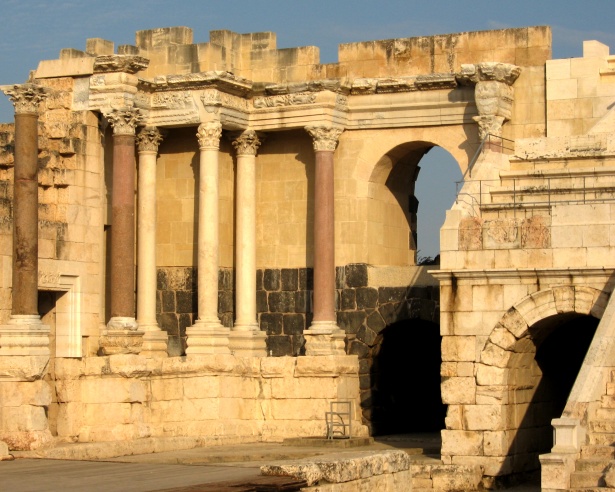
Image: Ruins of Roman amphitheater because, per Wilson, the plaiting of a rope is too coarse an image.

The big miss on individualism

I get to speak with a great variety of smart people, as a side benefit to a day job that is actually its true and most durable point. Anyway, I share.

Just recently, a conversation with a philosopher led in some interesting directions. He came of age in Thatcher-era Britain, when he began noticing things not present just few years earlier.

“Beggars on the street most notably. A great rise in homelessness, and great rise in public ugliness as well. It was something that called itself individualism but to me was a mistaken form of individualism, a supposed form of individualism where everything is just about possessing things.”

Real individualism, real individuality, is about being a unique person – it’s not about showing off the fact that you along with 45K other people have managed to afford a particular item, he said. My deeper attention had been gained. He continued.

“To me it was sort of a perversion of individualism, and in tandem with the ecological texts I was reading, the two things came together.  It just seemed clear to me even back in the 1980’s that you can’t ultimately have a society based on infinite economic growth on a finite planet. On the one side we were prioritizing the wrong liberties and taking away a lot of people’s meaningful economic liberties at the same time in order to give extra ones for other people.”

“All of these things seem to be misconceived. Looking at the rise of liberalism in the broad sense, the rise of forms of society which placed the liberty of the individual first, and then you have the question of which liberties matter, how they are sliced up and how they are arranged.”

“Since that time, my core interests have been the concepts of nature in terms of freedom. And the flourishing of the individual. While I think of myself politically as being very left – people react to the word ‘individualism’ because it immediately conjures this 1980s concept of ‘greed is good’  because that language has been so thoroughly taken over.* But it doesn’t need to be like that.”

He brings up Oscar Wilde and his 1891 essay, The Soul of Man under Socialism. “Wilde says socialism will be of value solely because it will lead to individualism. What he means by that is if you make sure everyone has enough to begin with, people can actually express themselves as individuals when they’re no longer just scrambling for the basics.”

This is the road to any discussion about ethics. Can you imagine?

*There have been so many corruptions of language of this nature. Before we can take back the night, we’ll need to reclaim the day.


Vitruvian man, MMXXV, seeks camaraderie, romance

I can get a couple of issues behind on the NYRB, but this a good recent-ish one for your Friday reading:

Because the practice of architecture requires such a store of knowledge, Vitruvius maintains that it is much more than a craft that depends on purely manual skill: it is a lofty liberal art, a pursuit that engages all the human faculties of imagination and reason no less than grammar, rhetoric, or poetry. His career included inspecting catapults for Julius Caesar and building a basilica at Colonia Julia Fanestris (modern-day Fano, on the Adriatic coast) with some radical innovations, such as gigantic two-story interior columns, that belie his popular reputation as a hidebound conservative. A man of strong, sometimes unpredictable opinions who thanks his parents in the preface to Book VI for having given him a first-rate Roman education, Vitruvius was bilingual in Greek and Latin and well read in Greek and Latin poetry, Cicero’s prose, Greek architectural pamphlets, and recent developments in natural philosophy and technology.

His proposed course of study for young architects continues Cicero’s recent efforts to create a system of Roman learning comparable to that of the Greek-speaking world (a world that notably included Alexandria as well as the eastern Mediterranean), and it participates fully in the contemporary effort, fostered by the emperor Augustus, to transform Rome into a capital of distinctively Latin culture. His ambitiously comprehensive treatise is almost certainly the first of its kind for the ancient Greco-Roman world, recasting architecture not only as a liberal art but also as a natural means to extend the reach of Rome’s expanding empire. Clear and precise, his remarks on education show how the Romans of the early Augustan era tried to define their place in a rapidly changing world—both native Romans and Romans newly absorbed into the Res Publica Romana, for Roman education followed swiftly on the legions to prepare young people in conquered territories for participation in the imperial state.

It seems likely that the connection between education, architecture, and empire inspired the creation of the earliest known manuscript of Vitruvius, copied on parchment in the ninth century, perhaps for Charlemagne, perhaps by the hand of his learned adviser Alcuin of York, almost certainly as part of the Frankish king’s project of resurrecting the glories of ancient Rome in a Christian spirit. It is through this same clever wedge, education, that Vitruvius has driven himself and his treatise into the very heart of the way the contemporary world still thinks about any number of things, from human scale to beauty to liberal education to the best methods of town planning. Whether you have read Vitruvius or not, his influence is still palpable in the fabric of modern urban life, and that is why he has been translated as recently as 2017 into Chinese.

Do not study marketing, kids.

Irrational gadgeteering

For reasons too dumb to reveal here, soi-disant AI has been coming up in my proximity. Yes, sure, we’re all hearing about it and maybe you are even using it – whatever you think that means. And yet when feeding [whatever it is] into an computer model to get some version of [wii] back is proffered as an acceptable work solution, it opens up to a much broader question: What is even work?

If parts or all of what you think you do can be so ‘taskicized’, what ever was work to begin with – to you?

And here I’ll yield the floor to Theodor Adorno:

Labor-saving devices … are invested with a halo of their own. This may be indicative of a fixation to a phase of adolescent activities in which people try to adapt themselves to modern technology by making it, as it were, their own cause… It seems that the kind of retrogression highly characteristic of persons who do not any longer feel they are the self-determining subjects of their fate, is concomitant with a fetishistic attitude towards the very same conditions which tend to be dehumanizing them. The more they are gradually being transformed into things, the more they invest things with a human aura. At the same time, the libidinization of gadgets is indirectly narcissistic in as much as it feeds on the ego’s control of nature: gadgets provide the subject with some memories of early feelings of omnipotence.

From the essay Work and Pleasure in THE STARS DOWN TO EARTH

Image: Anselm Kiefer, Aurora, 2015–17, oil, emulsion, acrylic, shellac, and sediment of an electrolysis on canvas, 110¼ × 149⅝ × 3⅝ inches.

The Unplan

Or, strength vs. weakness, as the case may be presents.

Imagine a wall to which things thrown may stick, but only for a short time. Enter the policy entrepreneurs.

In a most unfortunate mashup, the MBA ethos (?) has been paired with a kind of cribbed international politics model in a cache of people who pride themselves on not understanding anything about what they are doing. When David Brooks calls you stupid (no NYT link) you’ve won the golden calf.

There is something refreshing (refreshingly horrifying is a KIND of refreshing) about squeezing modern America and all its exceptionalisms into a new, middling third world country. We’ll update a lot corruptions and make them worse. We’ll crash many calcified industries and norms – universities, the law, farming. The notion that people should feel sorry for recent college graduates has it exactly backwards – they were the last ones to get a vintage education without all the sides and intellectual pestilence of acquiescent fascism. Especially if you went to small liberal arts or other well-regarded institution. Congratulations. Well done. We’re going to need you. Tune up your language and get ready to use it.

Commodification of everything in a society that worships it can be difficult to see – though many Europeans look at the U.S. and see nothing else. We suspect envy; they allow for the cautionary tale.

A$ it happened to visual art and what’s left to work with leaves a lot of space for making thinking grappling – which is to say space that goes greatly under-used. But it leaves a great place to lean in, to see it, to see this:

Artists are rarely moral heroes and should not be expected to be, any more than plumbers or dog breeders are. Goya, being neither madman nor masochist, had no taste for martyrdom. But he sometimes was heroic, particularly in his conflicted relations with the last Bourbon monarch he served, the odious and arbitrarily cruel Fernando VII. His work asserted that men and women should be free from tyranny and superstition; that torture, rape, despoliation, and massacre, those perennial props of power in both the civil and the religious arena, were intolerable; and that those who condoned or employed them were not to be trusted, no matter how seductive the bugle calls and the swearing of allegiance might seem. At fifteen, to find this voice-so finely wrought and yet so raw, public and yet strangely private-speaking to me with such insistence and urgency from a remote time and a country I’d never been to, of whose language I spoke not a word, was no small thing. It had the feeling of a message transmitted with terrible urgency, mouth to ear: this is the truth, you must know this, I have been through it. Or, as Goya scratched at the bottom of his copperplates in Los desastres de la guerra: “Yo lo vi,” “I saw it.” “It” was unbelievably strange, but the “yo” made it believable.

A European might not have reacted to Goya’s portrayal of war in quite this way; these scenes of atrocity and misery would have been more familiar, closer to lived experience. War was part of the common fate of so many English, French, German, Italian, and Balkan teenagers, not just a picture in a frame. The crushed house, the dismembered body, the woman howling in her unappeasable grief over the corpse of her baby, the banal whiskered form of the rapist in a uniform suddenly looming in the doorway, the priest (or rabbi) spitted like a pig on a pike. These were things that happened in Europe, never to us, and our press did not print photographs of them. We Australian boys whose childhood lay in the 1940s had no permanent atrocity exhibition, no film of real-life terror running in our heads. Like our American counterparts we had no experience of bombing, strafing, gas, enemy invasion, or occupation. In fact, we Australians were far more innocent of such things, because we had nothing in our history comparable to the fratricidal slaughters of the American Civil War, which by then lay outside the experience of living Americans but decidedly not outside their collective memory. Except for one Japanese air strike against the remote northern city of Darwin, a place where few Australians had ever been, our mainland was as virginal as that of North America. And so the mighty cycle of Goya’s war etchings, scarcely known in the country of my childhood, came from a place so unfamiliar and obscure, so unrelated to life as it was lived in that peculiar womb of nonhistory below the equator, that it demanded special scrutiny. Not Beethoven’s Muss es sein-“Must it be so? It must be so”-written at the head of the last movement of his F Major String Quartet in 1826. Rather, “Can it be so? It can be so!”-a prolonged gasp of recognition at the sheer, blood-soaked awfulness of the world. Before Goya, no artist had taken on such subject matter at such depth. Battles had been formal affairs, with idealized heroes hacking at one another but dying noble and even graceful deaths: Sarpedon’s corpse carried away from Troy to the broad and fertile fields of an afterlife in Lycia by Hypnos and Thanatos, Sleep and Death. Or British General Wolfe expiring instructively on the heights of Quebec, setting a standard of nobly sacrificial death etiquette for his officers and even for an Indian. Not the mindless and terrible slaughter that, Goya wanted us all to know, is the reality of war, ancient or modern.

From Goya by Robert Hughes.

What does thought-terminating cliche mean?

We think we like being turned on, but it’s apparently much, much easier to turnoff. How familiar is this? An essay from the Guardian, resurfaced by like minds:

Thought-terminating cliches exist, of course, in every language. In China, some government officials are known to exploit the phrase “Mei banfa”, meaning “No solution”, or “There’s nothing to be done” to justify inaction. The saying “Shouganai”, a linguistic shrug of resignation similar to “It is what it is”, is similarly weaponised in Japan. The Polish idiom “Co wolno wojewodzie, to nie tobie, smrodzie” roughly means “People in positions of power can get away with anything” (hence, don’t bother putting up a fight). According to Walter Scheirer, author of A History of Fake Things on the Internet, thought-terminating cliches commonly carry a defeatist flavour. It’s hard work, involving psychological friction, to figure out the best way to think about complex subjects such as climate policy or geopolitics. Any licence to give up the struggle is going to be appealing.

Tobia Spampatti, a decision scientist at the University of Geneva, argues that such phrases become especially problematic when wielded by politicians with decision-making power. In 2023, Australian conservatives used the rhyming slogan “If you don’t know, vote no” to discourage citizens from supporting a constitutional amendment that would have afforded Indigenous people representation in parliament. Spampatti, who studies the relationship between information processing and beliefs about climate change, says disinformation tends to spike around major events, like elections and climate deals. That’s when thought-terminating cliches do their wiliest work. Examples used to squash environmental efforts range from “Climate change is a hoax” and “Scientists have a political agenda” to “Climate change is natural” (or the related “The climate has always changed”), “Humans will adapt” and “It’s too late to do anything now”.

Unfortunately, mere awareness of such tricks is not always enough to help us resist their influence. For this, we can blame the “illusory truth effect” – a cognitive bias defined by the unconscious yet pervasive tendency to trust a statement simply because we have heard it multiple times. Memory scientist Lisa Fazio has found that we are so primed to confuse a statement’s familiarity with veracity that the bias persists even when listeners are warned to look out for it, even when they are explicitly told the source was untrustworthy. “Some of these cliches catch on not necessarily because we believe them to be true but because they feel comfortable and are easy to understand,” she says.

Do continue reading (also operative as a general admonition). We are all decision scientists now.

Image: Boat Racer, from the Occupations for Women series for Old Judge and Dogs Head Cigarettes, Metropolitan Museum of Art

Petty Persuasion

Repeat, rhyme. Third verse, same as the first.

The Eighteenth Brumaire of Louis Napoleon, an essay written by Karl Marx originally published in 1852 under the title Die Revolution, focuses on the 1851 French coup d’état, by which Louis-Napoléon Bonaparte, president of the Second Republic and Napoléon Bonaparte’s nephew, became emperor of the Second French Empire as Napoleon III. It seeks to explain how capitalism and class struggle created conditions which enabled “a grotesque mediocrity to play a hero’s part.”

The English title simply refers to the date of the Coup of 18 Bromaire, per the French Republican calendar. From page 45 of Part III in my hymnal:

As against the coalesced bourgeoisie, a coalition between petty bourgeois and workers had been formed, the so-called Social-Democratic party. The petty bourgeois saw that they were badly rewarded after the June days of 1848, that their material interests were imperiled, and that the democratic guarantees which were to insure the effectuation of these interests were called in question by the counterrevolution. Accordingly they came closer to the workers. On the other hand, their parliamentary representation, the Montagne, thrust aside during the dictatorship of the bourgeois republicans, had in the last half of the life of the Constituent Assembly reconquered its lost popularity through the struggle with Bonaparte and the royalist ministers. It had concluded an alliance with the socialist leaders. In February, 1849, banquets celebrated the reconciliation. A joint program was drafted, joint election committees were set up and joint candidates put forward. The revolutionary point was broken off and a democratic turn given to the social demands of the proletariat; the purely political form was stripped off the democratic claims of the petty bourgeoisie and their socialist point thrust forward. Thus arose social-democracy. The new Montagne, the result of this combination, contained, apart from some supernumeraries from the working class and some socialist sectarians, the same elements as the old Montagne, but numerically stronger. However, in the course of development it had changed with the class that it represented. The peculiar character of social-democracy is epitomized in the fact that democraticrepublican institutions are demanded as a means, not of doing away with two extremes, capital and wage labor, but of weakening their antagonism and transforming it into harmony. However different the means proposed for the attainment of this end may be, however much it may be trimmed with more or less revolutionary notions, the content remains the same. This content is the transformation of society in a democratic way, but a transformation within the bounds of the petty bourgeoisie. Only one must not get the narrow-minded notion that the petty bourgeoisie, on principle, wishes to enforce an egoistic class interest. Rather, it believes that the special conditions of its emancipation are the general conditions within whose frame alone modern society can be saved and the class struggle avoided. Just as little must one imagine that the democratic representatives are indeed all shopkeepers or enthusiastic champions of shopkeepers. According to their education and their individual position they may be as far apart as heaven and earth. What makes them representatives of the petty bourgeoisie is the fact that in their minds they do not get beyond the limits which the latter do not get beyond in life, that they are consequently driven, theoretically, to the same problems and solutions to which material interest and social position drive the latter practically. This is, in general, the relationship between the political and literary representatives of a class and the class they represent.

Directing history from the grave, indeed.