
The great Colm Tóibín assembles and unfurls several aspects of Conrad in a review of a new book about the writer, sharing earlier appraisals by V.S. Naipaul and Chinua Achebe. How’s this for precision:
In his essay, Naipaul invokes Conrad as “a writer who is missing a society…. Conrad’s experience was too scattered; he knew many societies by their externals, but he knew none in depth.” And then he laments:
The great societies that produced the great novels of the past have cracked…. The novel as a form no longer carries conviction…. The novelist, like the painter, no longer recognizes his interpretative function; he seeks to go beyond it; and his audience diminishes. And so the world we inhabit, which is always new, goes by unexamined, made ordinary by the camera, unmeditated on.
And
Since Naipaul cannot detach himself as a writer from “the corruption of causes, half-made societies that seemed doomed to remain half-made,” he finds “that Conrad—sixty years before, in a time of a great peace—had been everywhere before me.” In rereading The Secret Agent, he discovers characters and phrases that strike him as “real” in a way they had not before. He notes a phrase—the “exasperated vanity of ignorance”—about one of the terrorists in the book who “took the part of an insolent and venomous evoker of sinister impulses which lurk in the blind envy and exasperated vanity of ignorance.”
As Naipaul grows to appreciate that phrase he sees something essential in Conrad: nouns that seemed muted or throttled by their adjectives, as though the impulse were merely to make a fine-sounding phrase or add impressively to the mystery, can, in fact, if studied carefully or read in a certain light, stand apart, become precise. He observes that Conrad, despite all his concern with ineffability, often meant business. “Words which at one time we disregard,” Naipaul wrote, “at another moment glitter.” Even though his “reservations about Conrad as a novelist remain,” still he cannot dismiss him: “Conrad’s value to me is that he is someone who sixty to seventy years ago meditated on my world, a world I recognize today. I feel this about no other writer of the century.”
Just go read it all. It’s Friday – what else are you doing? Plus you’ll be relieved of thinking about vulgarians for a while better for it.
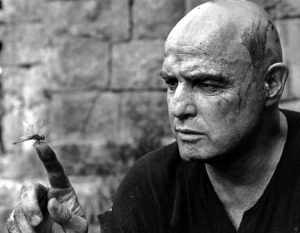
Image: Marlon Brando as Colonel Kurtz.



 Since everything seems to be
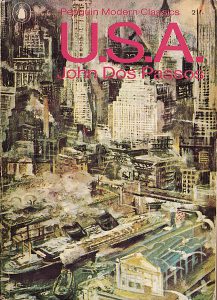 Published in 1938 as USA, the trilogy recounts the evolution of American society during the first three decades of the 20th century. The jazz age had been engulfed by the stock market crash, the depression, and the rise of fascism. Dos Passos was still a communist, mindful of the gaps between rich and poor in America. The first volume,
 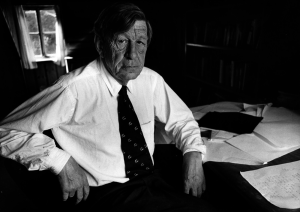 No need to resist this. From an interview with W.H. Auden, published in