Upside down capitalism

Or right-side up, as the case may be.

Are there herds of socially conscious investors, or be these merely unicorns –  a mythical breed, product of minds who wish to conjure a next, more hospitable capitalism, yet unseen in the wild?

Given the inherent cynicism of speaking these players into existence if they do not exist, let’s posit that they do. Pension funds, family foundations, high-wealth individuals who have re-gained sight or never lost heart. It would be just as cynical to discount these.

One thing the so-called ‘disruptors’ do not want or take any shine to, is in fact disruption. That is, positive outcomes from new products to stock price to IPO feeding frenzies are all predicated on business as usual. However, re-ordering the calculus toward a triple bottom-line – people, planet, profit – will only occur with a fight. Several, many, multiple that will enter the courts but not end there.

Public opinion can not only be swayed, it cries out for persuasion. So this star is not fixed, despite the claims of those who deny priority to human rights, who cannot countenance paths to a renewable energy future that is already here, who beg patience for big data schemes but preach urgency for dismantling social safety nets that protect and educate.

The unicorns need to speak out. They need to speak out about how capitalism ends by not ending, not by changing but by being changed.

Whether it is capital allocation or your HVAC, from time to time broken systems must be replaced. Socialize yourself to country-ownership – alternately be prepared to live in someone else’s country. The someone being an oligarchy. This is how the oligs imagine the scenario.

Also: get rested up for the fight.
Let’s Have the Debate

galileo_galileiThere is no silver lining for what’s coming down the pike, so don’t mistake this for any semblance of that. The lining is all sh*t, with 5,000-count sh*t thread lapels and sh*t-stuffed pockets and 5-karat, sh*t-gilt buttons.

Atrios is surely correct: there is no real reason for climate denial at this point other than tribalism and pissing off liberals. Apocalypse Cult, check. But they don’t even believe the denial. It’s a classic shakedown.

Scientists are incredibly careful, despite the alarmist rhetoric with which they are tarred. If anything, they are too careful and measured. With so many colleagues among their ranks, I understand why. But here’s a prediction. The ascendance of fake news is going to force them to become less so. There is no answer to irrationality and scientists will be forced to become less afraid as a consequence. The tone, like the planet, is going to become hotter. It’s time.

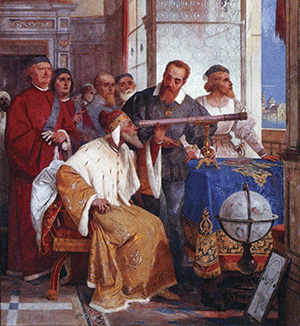
Image: Galileo showed the Doge of Venice how to use the telescope (Fresco by Giuseppe Bertini)

The Boutique Age of journalism

Not my phrase. From a podcast between Neil DeGrasse Tyson and Miles O’Brien where they cast CNN as the Wal-Mart of journalism:

They then discussed the notion of “fair and balanced” reporting, with O’Brien recounting an occasion in which he brought his producers a story that 95 percent of the scientific community agreed on. “Is it fair in a story about climate change,” O’Brien said, “which is clearly what I’m talking about, to do this journalistic convention of equal time for both sides. This is a huge mistake for journalism.”

Tyson agreed, saying that the conventional solution means that you get “one person to represent that 5 percent, but then he gets 50 percent of your time.”

They went on to discuss the use of a Jessica Yellin hologram during the 2008 election, which is not that far off from my assertion that actors will begin to be portrayed by avatars, instead of humans, in the not to distant future.

Dystopia? How would we know?

Themes on a Variation

Apologies – fun but very busy day yesterday. Two good things not to miss. Okay, good is not the word.

Sandy was devastating to scientific research on a scale that we probably can’t imagine:

Flooding and blackouts caused by super storm Sandy have had a devastating impact on scores of scientists in the Big Apple, with one research center losing thousands of lab mice as well as precious reagents—a situation that could set some researchers back years.

At New York University’s Smilow Research Center, on the eastern edge of Manhattan, which lost power shortly after Sandy struck on Monday night, hundreds of biological samples were destroyed as freezers thawed and refrigerators warmed. And as animal care facilities in the basement flooded, hundreds of mice and rats were killed—animals that had been painstakingly genetically engineered for use as disease models.

And, some people aren’t going to take it anymore, and we need more of them. Mainstream media types have actually no constituency beyond their own sake and that of their corporate super-structures that exist because of the 24-7 need for news vacuum that is their own creation. This has to change:

And I told them that I was there, in that room, because the national conversation we’re having about this situation, this emergency, is utterly inadequate —or, really, nonexistent. And I looked Peter in the eye, and told him that I’m sorry, but that’s completely unacceptable to me. If we can’t speak honestly about this crisis — if we can’t lay it on the line — then how can we look at ourselves in the mirror?

Since I had requested the meeting, I told Peter that I hoped to frame the discussion around two points:

First: We need to see a much greater sense of urgency in the media’s coverage of climate change, including in the Globe‘s editorial and opinion pages. This is more than an environmental crisis: it’s an existential threat, and it should be treated like one, without fear of sounding alarmist, rather than covered as just another special interest, something only environmentalists care about. And it should be treated as a central issue in this election, regardless of whether the candidates or the political media are talking about it.

Move on

Earth, smaller

The original idea behind the name of the group Moveon.org was aimed at Congress to get past nominal indiscretions perpetrated by Bill Clinton in the Oval Office and deal with more pressing issues. Balance on climate change is largely the same problem for PBS, which cannot seem to accept global climate change as settled science and so must continually provide denialists a counterpoint to…? I don’t know what but it’s very annoying.

Last night, PBS NewsHour turned to meteorologist and climate change contrarian Anthony Watts to “counterbalance” the mainstream scientific opinions presented by the program. This false balance is a disservice to PBS’ viewers, made worse by the program’s failure to explain Watts’ connection to the Heartland Institute, an organization that receives funding from some corporations with a financial interest in confusing the public on climate science.

While PBS mentioned that 97 percent of climate scientists agree that manmade global warming is occurring, it did not reflect this consensus by giving significant airtime to Watts’ contrarian views. The segment presented Watts as the counterbalance to scientists that believe in manmade global warming — every time a statement that reflects the scientific consensus was aired, in came Watts to cast doubt in viewers’ minds.

As Revkin explains and is mentioned in the MM piece, the goal of groups like the Heartland Institute is segments just like this. They don’t exist to further the science, but to distract from solving the problem. That’s a story; that the fossil energy industry doesn’t buy AGW is not. I’ll soon be hosting an interview show on  PBS affiliate and so don’t know whether this makes my criticism more or less valid. But come on.

And this is the rubber-glue Romney strategy as employed by Watts in the PBS piece, accusing global warming of becoming a big business as Watts does when it’s denial that has actually become an industry in its own right, funding astro think tanks and employing former TV weathermen to further a controversy that serves the interests of more of the same, in terms of polluting, non-renewable energy.

Conservatives versus Science

Sometimes the most important news isn’t breaking, isn’t something you learn about in 140 characters or between baby photos on fB (God love ’em), but a reality that you become acquainted with over time, are in danger of forgetting – or worse – forgiving as some kind of difference of opinion. WMD in Iraq, for example, a lie that we used to justify the murder of many, many innocent people. The reason that we couldn’t find the WMD in Iraq was because they didn’t have any. QED.

Another example, Republicans, at all levels, construct a distrust of science when they don’t like its conclusions. This is the reason there is still a debate about climate change.

The research is by Gordon Gauchat of the University of North Carolina at Chapel Hill, and published in the prestigious American Sociological Review. In the study, Gauchat uses a vast body of General Social Survey data to test three competing theses about the relationship between science and the U.S. public:

1) the cultural ascendancy thesis or “deficit model” view, according to which better education and engagement with science lead all boats to rise, and citizens across the board become more trusting of scientists and their expertise;

2) the alienation thesis, according to which modernity brings on distrust and disillusionment with science (call it the “spoiled brat” thesis if you’d like); and

3) the politicization thesis—my thesis—according to which some cultural groups, aka conservatives, have a unique fallout with science for reasons tied up with the nature of modern American conservatism, such as its ideology, the growth of its think tank infrastructure, and so on.

Then you have this Pew Report from 2008.

Someone had sent me a 2008 Pew report documenting the intense partisan divide in the U.S. over the reality of global warming.. It’s a divide that, maddeningly for scientists, has shown a paradoxical tendency to widen even as the basic facts about global warming have become more firmly established.

Those facts are these: Humans, since the Industrial Revolution, have been burning more and more fossil fuels to power their societies, and this has led to a steady accumulation of greenhouse gases, and especially carbon dioxide, in the atmosphere. At this point, very simple physics takes over, and you are pretty much doomed, by what scientists refer to as the “radiative” properties of carbon dioxide molecules (which trap infrared heat radiation that would otherwise escape to space), to have a warming planet. Since about 1995, scientists have not only confirmed that this warming is taking place, but have also grown confident that it has, like the gun in a murder mystery, our fingerprint on it. Natural fluctuations, although they exist, can’t explain what we’re seeing. The only reasonable verdict is that humans did it, in the atmosphere, with their cars and their smokestacks.

Basically, you can read all you want and see that intransigence on this issue is one-sided, systematic, on-going and most of all, deliberate. But based on nothing but not liking the results of what we have done, plus a fear of losing something they have decided to destroy anyway? It’s incoherent as ideology and contemptible as policy. Subservient politicians need to pay a price for this willingness to just blow the whole thing up.

Birth of a Myth

Leo Hickman in the Guardian explains how climate deniers roll:

Such is the viral nature of information flow on the internet, we can sometimes see myths and memes developing before our very eyes. Just such an example has occurred over recent days with the rather irresistible news that windfarms can “increase climate change“.

The article that really gave this idea a push online was published on Sunday evening on the Daily Mail’s website. It was delivered with the headline: “Wind farms can actually INCREASE climate change by raising temperatures and causing downpours, warn academics.

Somewhat predictably, that headline quickly attracted attention and was being disseminated with particular gusto on climate sceptic sites such as Climate Depot and JunkScience. The news was also reported on Dallasblog.com (“Wind Farms Cause Global Warming, some Scientists say”)

This is all of a piece with Krugman’s dictum, but there’s even more here, how a scientist’s research gets re-purposed, as they say. It’s stupid, really – giant wind farms can alter the weather. But the deniers don’t care about the stupid if it smells like proof; add the possibility of fantastic headlines and presto: a meme is born.

via LGM.

Fracticality

Too much of some things and not enough of others. Why do we lose the feel for and sight of the sensations we hold most dear? Are we misusing the words and concepts? The battle for our own personal attention spans, for example, in which to play is to lose, doesn’t do anyone much good. What do those words even mean that we allow this ‘span’ (do we need an attention suspension bridge?) to be up for grabs The degree to which we allow almost anything to pass into our heads, refusing to rule and watch over this domain as we might a plot of land where our children sleep, contributes to the loss. As well, connectivity; we’ve bought lock-and-stock the idea that we should never (much less need to) be out of the reach of electronic beeps and chirps. Then there’s the wireless scourge. Harmless and helpful on its own, though at essence and by definition opposed to any efforts at moderation. So, how do you pan out, and if we manage, how do we make sense of what see?

One place to start making sense again, this essay on the misunderstandings of art and science by James Elkins, The Drunken Conversation of Chaos and Painting

Within mathematics, there is no question of the importance of the new discoveries. The “new geometry”
knows itself to be fundamental: “Euclid,” Benoit Mandelbrot announces in The Fractal Geometry
of Nature, will be “used in this work to denote all of standard geometry.” The unexpected efflorescence
of geometry, so difficult to follow through its growing associations with physics, biology, astronomy,
geology, medicine, and economics, already has wide experimental support and applications as diverse
as the threebody problem, population dynamics, the neurobiology of hearing, and the contractions
of heart muscle. It has, in addition, serious philosophic and experimental implications for the scientific
method itself.
In this context the “new geometry” is most interesting because it knows itself to be beautiful,
though the nature and extent of that knowledge are open to question. Mandelbrot quotes an article in Science
that makes a parallel between cubism, atonal music and modern mathematics beginning with “Cantor’s
set theory and Peano’s spacefilling curves.” He sees a rococo phase in mathematics before the modern
era, followed by a visual austerity. When it comes to art, he makes a poorly articulated and unconvincing
historical and aesthetic reading of his own fractal inventions, according to which the extravagant,
ebullient forms he has visualized are “minimalist art”—a most unlikely identification. There is also an
unwillingness on Mandelbrot’s part to mix art and science: when computer printouts are to be judged aesthetically,
he gives them selfparodistic titles such as “The Computer ‘bug’ as artist, Opus 1,” thereby publishing
aesthetic results as mistakes, “bugs” in programs. Part of the meaning of such titles resides in
Mandelbrot’s mimicry of contempory painting styles; “Opus 2” is like an angular Clifford Still or Franz
Kline. He also thinks his polychromic computer printouts are “austere.” The reason is they have simple
mathematics behind them, and so his misidentification with minimalism is an example of non-visual
thinking—what a mathematician would call “analytic” rather than “synthetic” reasoning. More plausibly,
he thinks a Mies van der Rohe building is a “scalebound” throwback to “Euclid” since it has only certain
classes of forms, while—in a particularly strange juxtaposition of cultures—“a high period Beaux Arts
building is rich in fractal aspects.”

Download and the read the whole thing. On purpose.

Brought To You By

Scienceblogs.com agrees to have a nutrition blog written by PepsiCo.

Much consternation over at the home of science bloggingScienceBlogs. The forum for the brilliant OracPharyngulaMolecule of the Day, and countless other insightful, funny and informative blogs has decided upon a bizarre new strategy in sourcing new posts. As of yesterday, the platform will host a new blog written by food giant PepsiCo, all about the company’s specialist subject of refreshing sugary drinks and their benefits for dental and dietary health.

Is nothing sacred? Of course it isn’t – nothing at all. We’re as far past that as the Gagosian Gallery on its worst day might imagine. What is a bad day for them? What is the first thing BP did when they learned about the Deepwater Horizon problem? What was their actual problem? The whole reality of human habitation, its need for sustenance and breathable air, not to mention sufficient amounts of intellectual clutter, means not the same thing for the Limited Liability Companies among us. Sure we exist on the same planet and sign all manner of agreements, in principle, on paper gleaned from that planet’s perennial woody plants. But that may be where the common dimensions begin and end. A tear in one man’s time-space continuum is but a sub-bullet point in another man’s standard operating procedure (SOP) handbook.

Pace William Faulkner, the sacred is not dead and buried, it’s not even sacred.