
Not complicated

Complexity abounds. Our current politics, however, are dumbed down for their intended audience of us. Even then, we don’t seem to get the clarity staring us in the face: the country is being spoken for and to by a demented lunatic. There is no plan, only impulse, neediness, and corruption. We don’t want to reckon with this, but the sooner we realize that we must, that we don’t know how it ends, the sooner begins the work – and work it will surely be.

All signs point in the same direction. Despite all of the conversational satire to which we have grown accustomed, the hubris of a powerful society has done its work.

But here’s your bedtime story: the amount of lost oil supply is already equal to the reduction in oil consumption during the covid pandemic.

The world has lost over $50 billion ​worth of crude oil that has not been produced since the Iran war began nearly 50 days ago and ‌the . aftershock of the crisis will be felt for months and even years to come, according to analysts and Reuters calculations.

Since the crisis began at the end of February, more than 500 million ​barrels of crude and condensate have been knocked out of the global market, according to Kpler data – the ⁠largest energy supply disruption in modern history.
Put differently, 500 million barrels of oil lost to the market is equivalent to:
  • Curtailing aviation demand ​globally for 10 weeks; no road travel by any vehicle globally for 11 days; or no oil for the global economy for five days, ​said Iain Mowat, principal analyst at Wood Mackenzie.
  • Nearly a month of oil demand in the United States, or more than a month of oil for all of Europe, according to Reuters estimates.
  • Roughly six years of fuel consumption for the U.S. military, based on annual usage of about 80 million barrels from fiscal ​year 2021.

The Reuters piece concludes with a short section under the subhead FULL RESTORATION COULD TAKE YEARS.

About this restoration… what if we don’t go back – and choose to move forward instead? It’s an outrageous proposition but, knowing now full well what do, having destroyed what we have – facilities, lives, and relationships, alliances – the accidental test case for moving beyond oil is no longer a test.

The seemingly scariest part of this (scary to the world’s most frightened populace of rich and coddled) is already underway for seemingly unrelated reasons [not at all unrelated]. Auditions are over. Thank you all for coming. We’ve found our man.

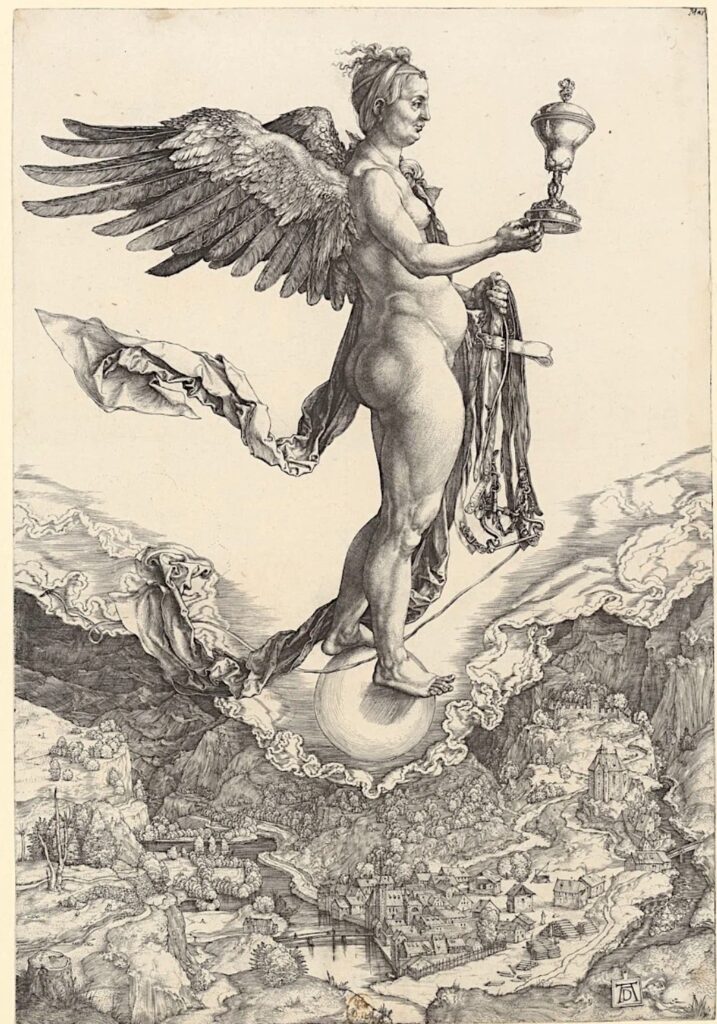
Image: Nemesis by Albrecht Dürer (1501-1502); Albrecht Dürer, via Wikimedia Commons

Sacco and Vanzetti

Don’t forget this:

On August 23, 1927, the state of Massachusetts executed two Italian immigrant anarchists by the names of Nicola Sacco and Bartolomeo Vanzetti for the murder of two men in a 1920 armed robbery in South Braintree. Although the two men may or may not have been involved in the crime, as Italian anarchists, they were on trial for their beliefs as much as the murder. Despite the lack of concrete evidence and international outrage over the miscarriage of justice, the state of Massachusetts railroaded them into the electric chair.

Sacco and Vanzetti were anarchists, men deeply affected by the terrible labor and social conditions of the early 20th century. Both immigrated from Italy in 1908, though they didn’t meet for nearly a decade. The seeming inability for the capitalist system to treat working people with dignity and respect drove many to desperation. By the 1890s, anarchism was a growing threat in the United States, perhaps most personified by Leon Czoglosz’s assassination of President William McKinley in 1901. Although that and other incidents convinced enough upper and middle-class Anglo-Saxons to enact limited reforms during the Progressive Era, the fundamental conditions of working-class urban life had changed little by 1920.

Sacco and Vanzetti both followed the teachings of Luigi Galleani, an anarchist theorist who advocated violence to overthrow the state. The Galleanists did in fact use violence in the United States. They were believed to be the group behind the bombing of Attorney General A. Mitchell Palmer’s home in 1919. Palmer, already cracking down on radicalism with the help of his young eager assistant by the name of J. Edgar Hoover, built upon this incident to intensify the Red Scare, that nation-wide crackdown on radicalism in all forms during and after American entry into World War I.

It was in this atmosphere that men like Sacco and Vanzetti were suspects in murders like that which took place on April 15, 1920, when armed robbers attacked a company payroll, killing two men. Although the evidence was indirect, the police suspected the greater Boston anarchist community, which was suspected in a series of other robberies to fund their activities. The police also discovered that one anarchist, Mario Buda had worked in two shops subjected to similar robberies. Upon questioning, Buda let slip that the local anarchist community had an automobile under repair, leading police to stake out the repair shop. The police convinced the garage owner to notify them when the anarchists arrived to pick up the car. When 4 men did, including Buda, Sacco, and Vanzetti, they sensed a trap and fled, but Sacco and Vanzetti were soon picked up. Both had guns at their homes; Sacco having a loaded .32 Colt similar to that used in the killings.

and that’s a great series on the history of Labor by Loomis. Check it out.