Fascination with numbers

It’s no stretch to suggest that quantifying life as we know it not in terms of quality but economic growth leaves everyone a bit empty, a bit lesser for the experience, such as it is.

Numbers are fine, can be fun, even. Inspiring. Take Clairaut’s Theorem, as just one example. Among the heights of the Enlightenment – there were several – the eighteenth-century French mathematicians/philosophers Alexis Clairaut and Pierre Louis Maupertuis led an expedition to Lapland in the Arctic Circle (in the 1730’s) in order to measure a single degree of the median arc. The goal was to calculate the shape of the Earth, and validate whether Newton was correct in his Principia where he theorized it was an ellipsoid shape.

In disagreeing with Newton’s theory, Clairaut suggested not only that the Earth is of an oblate ellipsoid shape, but it is flattened more at the poles and is wider at the center. You can imagine the controversial this unleashed among scholars of the day, and Clairaut leaned in, full tilt. He courted the fight and published work in the 1740’s that promoted Clairaut’s Theorem, which connects the gravity at points on the surface of a rotating ellipsoid with the compression and the centrifugal force at the equator.

Under the assumption that the Earth was composed of concentric ellipsoidal shells of uniform density, Clairaut’s theorem could be applied to it, and allowed the ellipticity of the Earth to be calculated from surface measurements of gravity. This proved Sir Isaac Newton’s theory that the shape of the Earth was an oblate ellipsoid. In 1849 George Stokes showed that Clairaut’s result was true whatever the interior constitution or density of the Earth, provided the surface was a spheroid of equilibrium of small ellipticity. [wikipedia]

Provides interesting context to our jokey notion about “views differ on the shape of the Earth.” There’s an amazing book about all of this and more that centers on Madame Du Châtelet, erstwhile mistress of Voltaire who translated Newton’s Principia.

Fascination may be in the eye of the beholder. However, a focus on economic growth beyond the point where it may be healthy, productive, even possible, disassociates us from even the power of numbers themselves. Growth becomes its own ends and we, captive to the destruction its portends, stand idly by and make nervous jokes about issues long settled, amidst our intellectual withering and spiritual decay.

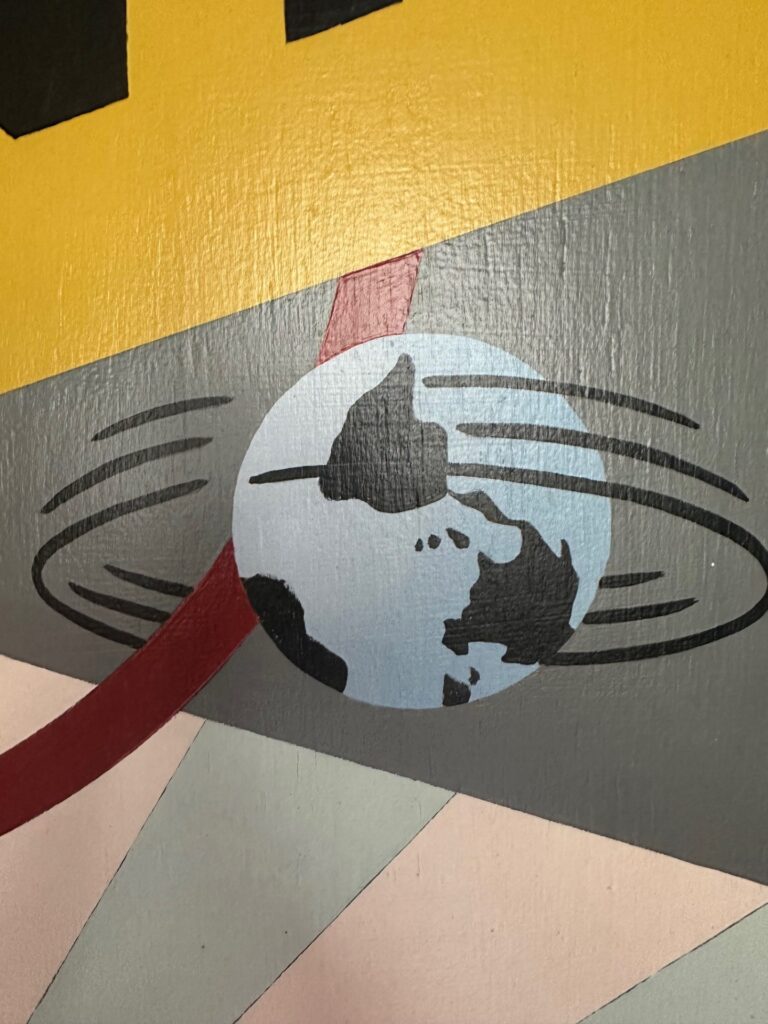
Image: [shiny)Detail of a painting by Lou Kregel.
Multi-state Cabbage truck pile-up

I’ll admit this is one collision of green I had not [truly] considered, but Is the human race too dumb to survive?

Rep. Mo Brooks (R-AL) questioned Duffy on the factors that contribute to sea-level rise, pointing out that land subsidence plays a role, as well as human activity. Brooks then said that erosion plays a significant role in sea-level rise, which is not an idea embraced by mainstream climate researchers. He said the California coastline and the White Cliffs of Dover tumble into the sea every year, and that contributes to sea-level rise. He also said that silt washing into the ocean from the world’s major rivers, including the Mississippi, the Amazon and the Nile, is contributing to sea-level rise. “Every time you have that soil or rock or whatever it is that is deposited into the seas, that forces the sea levels to rise, because now you have less space in those oceans, because the bottom is moving up,” Brooks said.

Most everyone who has reckoned with the possibilities seems to understand that, whatever the fate of humans, the planet will eventually survive. So when we talk about the destruction of the planet, we’re thinking of our own, rather than that of the 3rd Rock itself. I’ve been grappling with this in a different but very related context recently – that is, how to best communicate with the public (industry, citizens, local governments) about the solutions to the challenges wrought by climate change, when the posture of state leaders more resembles that of Congressman Brooks. The stock response is: Stop talking about that! Despite the best efforts of Rembrandt, Descartes, Heisenberg, Jessie Owens and Emily Dickinson, maybe we’re just too dumb. Perhaps we can set a date at some point in the [near] future when we can begin talking about sea level rise, erratic weather, internal displacement, clean water, energy… but maybe that’s just negotiating with stupid. In which case, stupid has already prevailed and Groundhog Day is a truck that drives around town all day, picking up the same cabbages that fell from it earlier this morning.

Closed (Collision) Course

How close do you have to get to being a doomsayer to get the point across about resource depletion without seeming like a kook and therefore being easily marginalized? It seems like we are on a collision course with finding out. The idea filters down (or up, depending on your orient) to every sort of green advertising, book selling, and opinion writing you can find by opening your iLid. To even get in the door to policy discussions, the apocalyptic ends must be sufficiently trimmed to keep the discussions civilized (i.e. potentially profitable) to the corporate nervous Nellies who control everything. But any serious steps to alter the trajectory of planetary ruination will be absolutely predicated on a series of disasters, sufficiently devastating as to be impossible to iSleep through. It’s an indelicate path between catastrophe and optimism. Joe Romm quotes little Tommy Friedman, channeling Paul Gilding:

This is not science fiction. This is what happens when our system of growth and the system of nature hit the wall at once. While in Yemen last year, I saw a tanker truck delivering water in the capital, Sana. Why? Because Sana could be the first big city in the world to run out of water, within a decade. That is what happens when one generation in one country lives at 150 percent of sustainable capacity.

The need for crises; the will to avert them.

Closed (collision) course. Amateur driver.

A Sense of Scale

What is 2,500 square miles really like? Via Fallows, I guess you’re gonna want to see this extraordinary utility that uses Google Earth (plug-in at the link) to let you see what the oil spill would look like superimposed on NYC, Paris, Syros, your neighborhood or wherever.

Hint: you’re not going to feel better. It is a reminder, however, that abstraction is a very special brand of information.