
Energy diversification

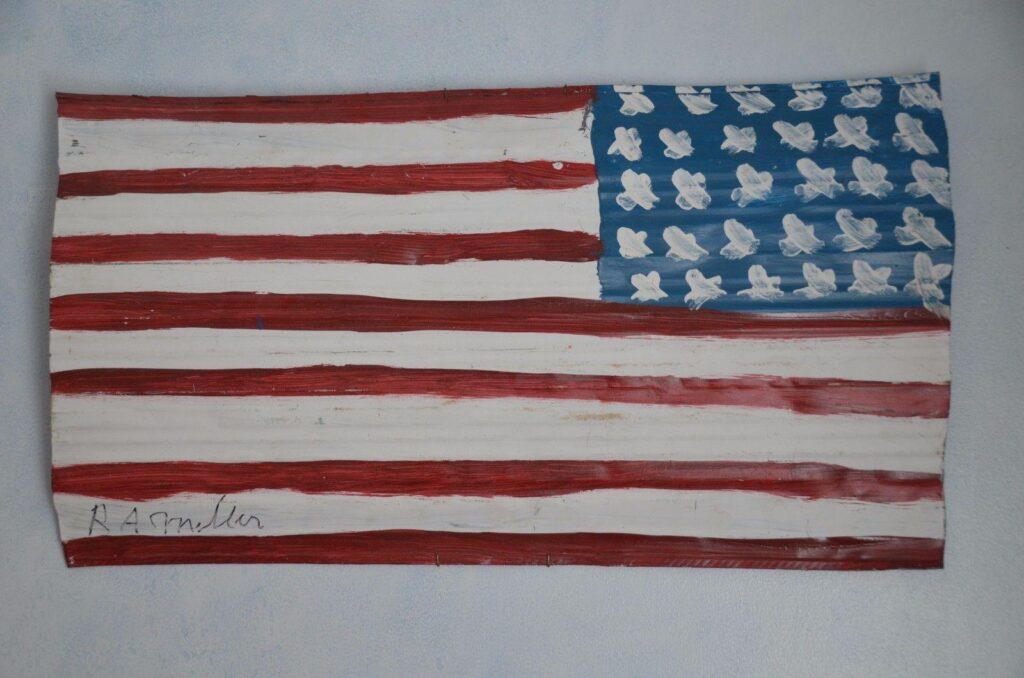
photo of flag painted on tin

Yours, mine, ours.

I recently finished reading a book about being trapped in the same day over and over again, which presented the concept of a rift in time in the context of complex minutiae and how we factor small events into larger ones. Even our best sense of recall leaves out quite a bit. The actual route between kitchen and bath, for example; or what happens on the other side of the switch that allows our betting apps to re-charge.

The low and slow approach to movement or reading by candlelight dispenses a luster all its own. We are free to partake, understand its nourishing powers, and to ignore these in lieu of better light and quicker options, to relegate them to novels and the pity of grateful authors.

Legs may tire and the candle burns down, marking progressive time very distinctly in ways that are only typically confusing. And these methods share something else: a hovering sense of the immediate. We declaim poetry in the same manner that we accept a holiday, earned or not, observant of its nature or not. That is, gladly. Attuned to bare arms and all they may evoke, how they interrupt our struggle for productivity with suggestion. Seen in this light, the need to produce, develop, accrue is as unnatural as time travel. The many dumb reasons behind events of note and other current happenings dumb us down, so be wary. Be suspect, call out. Use fancy old words if you so choose. Declaim.

Baudelaire was unsparing and left so much popcorn on the forest floor it can be hard to discern the trail. But discern we must. Find your way. Write your music and play it.

Happy Holiday.

Image: American Flag by R. A. Miller

Wet Behind the Turnip Truck Yesterday

Pierce calls this the Dare to be Ignorant Protection Act of 2013 and I’ll have a hard time swimming up the Nile on that one:

In biology class, public school students can’t generally argue that dinosaurs and people ran around Earth at the same time, at least not without risking a big fat F. But that could soon change for kids in Oklahoma: On Tuesday, the Oklahoma Common Education committee is expected to consider a House bill that would forbid teachers from penalizing students who turn in papers attempting to debunk almost universally accepted scientific theories such as biological evolution and anthropogenic (human-driven) climate change.

Gus Blackwell, the Republican state representative who introduced the bill, insists that his legislation has nothing to do with religion; it simply encourages scientific exploration. “I proposed this bill because there are teachers and students who may be afraid of going against what they see in their textbooks,” says Blackwell, who previously spent 20 years working for the Baptist General Convention of Oklahoma. “A student has the freedom to write a paper that points out that highly complex life may not be explained by chance mutations.”

Stated another way, students could make untestable, faith-based claims in science classes without fear of receiving a poor mark.

HB 1674 is the latest in an ongoing series of “academic freedom” bills aimed at watering down the teaching of science on highly charged topics. Instead of requiring that teachers and textbooks include creationism—see the bill proposed by Missouri state Rep. Rick Brattin—HB 1674’s crafters say it merely encourages teachers and students to question, as the bill puts it, the “scientific strengths and scientific weaknesses” of topics that “cause controversy,” including “biological evolution, the chemical origins of life, global warming, and human cloning.”

Eric Meikle, education project director at the National Center for Science Education (NCSE) in Oakland, California, says Oklahoma has proposed more anti-evolution legislation than any other state, introducing eight bills with academic freedom language since 2004. (None has passed.) “The problem with these bills is that they’re so open-ended; it’s a kind of code for people who are opposed to teaching climate change and evolution,” Meikle says.

You don’t say, Eric. Friday reading, indeed.

Gasoline Monoculture

Could you get to work if gas became unaffordable? To get groceries? Get the kids to school?

What is obvious is that the kind of monocultural economy that we have, based on gasoline, is unsustainable and vulnerable to price increases not to mention availability.

So many of the “controversies” we have in planning really come down to building a land use and transportation paradigm that is resilient, one that is less dependent on external inputs.

Hello? The extraordinarily limited (~1) diversity of options is not something we can suddenly retro-fit to our society in the face of skyrocketing transportation costs. And so we’ll be left to simply not go to school and work, and spend our days trekking from suburban enclaves to the grocery store and back. Well, what? Why not consider it that way? Do you actually have a perception of how far two miles is? Five? We rigidly ignore any possibility that our way o’ life will ever be interrupted. People have internalized the idea that transportation alternatives are some kind of antagonistic socialism meant for depraved urban scum or hippies or the poor (commutative property could be in order here). Now what?

link via.

What does (a) Green (card) mean?

Do you know any illegal immigrants? Your kids go to school with their kids. And if they don’t, well I think this begins to explain a great deal of the antipathy expressed toward them and their fates. Reminder: They = We.

A local situation came up over dinner a couple of nights ago and I had to (try to) explain to les enfants vertes the whys and hows of said situation. A  bright, local girl who had excelled in school and won the notice of several teachers along the way had gained attention again because she, now a h.s. graduate, was cleaning houses for a living instead of going to college. Some of these teachers are my kids teachers now, so we’re all increasing cognizant of the situation. And now the kids know, too, that some of their friends at school will, upon gradation, not be availed to entry – much less any financial aid that would make it possible – to continue their education, to continue on any path they may have devised under the strain of all the pressure to success we put them under. These kids will be, in fact, consigned to a future of menial labor, inconsistent and under-employment and less overall income (and tax contributions) than their classmates, all because someone who brought them to this country was undocumented.

Suddenly, I’m having a conversation with my kids about birthright citizenship and why it is crucially important to be that country that people want to come to, want to bring their kids to, want to sneak into, if necessary, and become a part of… I was suddenly defending the nobility of a country – a country that would and does force some of its own school children into that situation that started the conversation.

There are all flavors of examples of this kind of exclusion going on – NPR just this morning. Whether its anti-Islamism or don’t-take-our-jobs hysteria, nothing is more pernicious than the proclivity to cut off access to the future that runs through this country. Hint: Future arrives anyway.