Of straits and traps

What if war isn’t viable? And rather than being merely hopeful or any nod to a peacenik Shangri-La at last, what would remain in the balance – TBD comme on dit – is somehow assuring that the entire globe doesn’t become a failed state. That we don’t default to a Hobbesian existence on a planetary scale – yes, very much including our bumblionaires who have have so sagely guided marked the territory to this place. But as [this] war increasingly results in an escalation trap, can we must become dissuaded of ts benefits:

Once started, a major regional war with Iran was always likely to be something of a ‘trap,’ – not in the sense of an ambush laid by Iran – but in the sense of a situation that, once entered, cannot be easily left or reversed.

The trap, of course, is the Strait of Hormuz and the broader Persian Gulf. The issue is that an enormous proportion of the world’s shipping, particularly energy (oil, liquid natural gas) and fertilizer components (urea) passes through this body of water. The Gulf is narrow along its whole length, extremely narrow in the Strait and bordered by Iran on its northern shore along its entire length. Iran can thus threaten the whole thing and can do so with cheap, easy to conceal, easy to manufacture systems.

So once the strait was closed, the United States could not leave until it was reopened, or at least there was some prospect of doing so.

The result is a fairly classic escalation trap: once the conflict starts, it is extremely costlyfor either side to ever back down, which ensures that the conflict continues long past it being in the interests of either party. Every day this war goes on make both the United States and Iran weaker, poorer and less secure but it is very hard for either side to back down because there are huge costs connected to being the party that backs down. So both sides ‘escalate to de-escalate’ (this phrase is generally as foolish as it sounds), intensifying the conflict in an effort to hit hard enough to force the other guy to blink first. But since neither party can back down unilaterally and survive politically, there’s practically no amount of pain that can force them to do so.

I’ve mentioned multiple times how the brakes on the carbon-based economy have been located – No! Not that way! – and the screeching we hear is actually the metal backing plate contacting the metal rotor, recommending immediate inspection and repair.

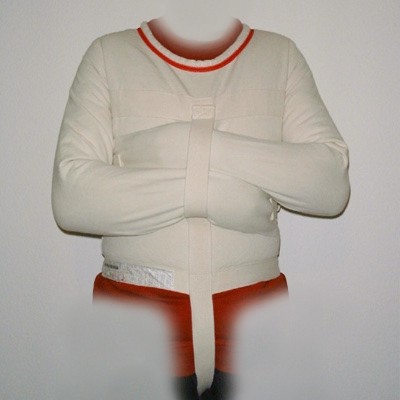
A dumb, so very dumb war presents this metaphor for appraisal.

Image: Straitjacket via wikimedia commons.

M’aider, a century on

At least for organized labor, that’s how May Day should have been celebrated this week. But for today, this awesome bit of history from the Rude Pundit on the Paterson Silk Strike Pageant of 1913:

However, employers refused to negotiate with the organized workers, primarily because they were Wobblies. As John Fitch points out, while the employers were against any kind of union, they might have negotiated with the AFL, but because of the reputation of the Wobblies as “hoodlum, radical, un-American unionists,” they would not sit at the bargaining table with the union. Interestingly, the public had a more violent reaction to the IWW than any violence the Wobblies ever committed. In an article unsympathetic to the Wobblies, Fitch cites several cases of such vigilantism. In Lawrence, two Wobbly leaders were charged with a murder they did not commit, while a soldier who openly bayoneted a striking worker was never even arrested. In San Diego, the IWW was banned from speaking on street corners. When the Wobblies kept returning, they engendered open hostility from the citizens who “tortured,” beat, and sent the defiant Wobblies into the desert. The events at Paterson followed much the same pattern: the Paterson Press implored its readers to help rid the town of the IWW “no matter how it is accomplished.” Others called more explicitly for violence, including one Civil War veteran who urged that new cemeteries “be filled with just such people as those who are now making this disturbance — the first graves to be filled with Haywood and his crowd.” Strikebreakers beat and killed Wobblies yet were never arrested. Only strikers were arrested and their leaders, like Quinlan, were brought to trial. Reed was radicalized even more when he was jailed by police for refusing to clear the streets. In jail with Tresca and others, he was impressed by the way the Wobblies kept up their spirits by singing and educating themselves.

The city officials of Paterson tried to get the AFL to come in once again to organize the workers because the larger union would presumably lead the strikers to a more peaceful and more accommodating resolution of the situation. In a meeting that was already filled with a sense of the theatre that would come later, the AFL organizers arrived and attempted to hold a rally in Turner Hall; they hoisted an American flag, an act that was booed by the workers who, in response, all thrust their red union cards into the air.

This theatricality would, of course, lead to the Pageant, which came into being, according to the memoirs of both Mabel Dodge Luhan and Hutchins Hapgood, when, at a gathering at the apartment of his mistress, Haywood complained to Mabel Dodge about the lack of publicity for the strike outside of the immediate area. Dodge suggested, “Why don’t you bring it to New York and show it to the workers?” Haywood liked the idea but had no concept of how to do so until Reed stepped forward and said, “I’ll do it! My name is John Reed. We’ll make a Pageant of the strike! The first in the world!”

If you don’t know the Rude Pundit, well, I say you should get on over there more oftener. And if there are any terms or people in that passage with whom or which you’re unfamiliar, well, don’t complain about me not giving enough homework.