Artificial Everything

[Too] many conversations about encroaching technology and artificial everything – we should just call it that, as we have no real definition for intelligence, much less understand what it means – compel further examination. Let’s go in.

First off, let’s acknowledge a basic premise.

We’re edging along a process of abdicating our personal sovereignty by our own choosing. I can’t tell you not to install a front door camera and spy on your neighbors or not to let slopGPT be your therapist. But let’s at least acknowledge how much we submit to all of this voluntarily. It’s not the illusion of choice, but still actual choices that we make continually. All the while creeps a sort of helplessness about what is being done to us. It is imperative to maintain our wits at such a time – such as a time as may come, such a time as now.

It is necessary to demonstrate how modern imagination is captured – and defended. Among the multitude of familiar arguments on which to draw, public and private liberties, civic duty and overwhelming loss of self esteem among our fellow citizens compel a checklist on the rescue mission should one be required.

There is extraordinarily powerful hype and propaganda supporting the inevitability of artificial everything. The laziness of corporate media has made this so much easier; excellent at completing PR circles, not so very good or interested in explaining things, rewarded for the combination with diminished honor and loss of prestige. Though a quite visible slight of hand, effort to acknowledge this process reminds us that we remain far from powerless. The sheer vastness of all we’re not thinking about and discussing enough also require some work on our part, to investigate, to understand, but first just to care about. When we get to the place where this work is not optional – and hey, we like work. It’s one our fears about AE, that it will take work away from us –  we’ll be well on our way to better places. If you’re already there, congratulations. You’ve got plenty of work to do.

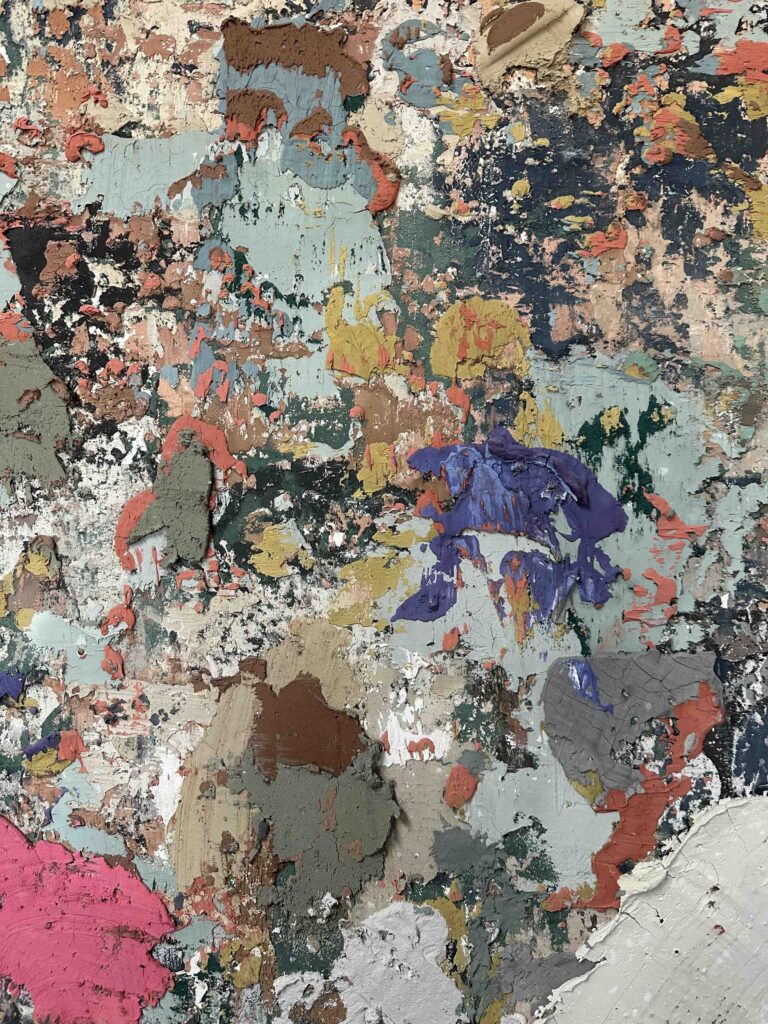
Image: Author photo of work on a wall.

Hughes in peace

Not the first man you might imagine when it comes to peace, but rest now he does. The rough week continues, and while this one isn’t strictly personally, it certainly feels personal. Our favorite art critic Robert Hughes (1938-2012).

When he reached a mass audience for the first time in 1980 with his book and television series The Shock of the New, a history of modern art starting with the Eiffel Tower and graced with a title that still resounds in 100 later punning imitations, some of the BBC hierarchy greeted the proposal that Hughes should do the series with ill-favoured disdain. “Why a journalist?” they asked, remembering the urbanity of Lord Clark of Civilisation.

He gave them their answer with the best series of programmes about modern art yet made for television, low on theory, high on the the kind of epigrammatic judgment that condenses deep truths. Van Gogh, he said, “was the hinge on which 19th-century romanticism finally swung into 20th-century expressionism”. Jackson Pollock “evoked that peculiarly American landscape experience, Whitman’s ‘vast Something‘, which was part of his natural heritage as a boy in Cody, Wyoming”. And his description of the cubism of Picasso and Braque still stands as the most coherent 10-page summary in the literature.

And that’s some Hughes we can always use.

Mahagonny

In my continuing quest to put together a grand unified theory of everything, I was reading part of the introductory essay in Robert Hughes’ Nothing if Not Critical, The Decline of the City of Mahagonny. Here, he talking about the nefarious influence of mass media (on humans) and you can easily extrapolate this onto our difficulties in moving past now-obsolete notions of growth and expansion. To wit:

This has not been a matter of choice, let alone fault. The power of television goes beyond anything the fine arts have ever wanted or achieved. Nothing like this Niagara of visual gabble had even been imagined a hundred years ago. American network television drains the world of meaning; it makes reality dull, slow and avoidable. It is our “floating world.” It tends to abort the imagination by leaving kids nothing to imagine: every hero and demon is there, raucously explicit, precut – a world of stereotypes, too authoritative for imagination to develop or change. No wonder it has predisposed American artists toward similar stereotypes. It is stupidly compelling, in a way that painting and sculpture, even in their worst moments of propaganda or sentimentality, are not.

Always difficult to figure out what’s wrong with one thing without stumbling onto what’s wrong with another.

More Hughes you can Use

I had another work dialed up for today, but I’m not quite finished with it. So, in lieu, here’s some more Robert Hughes we can always all use. Consider the fact that it comes from the 9/10/01 issue of Time a sort of time-encapsulated bonus.

When Americans interested in art are asked what they have heard of from South America, the answer tends to be pretty much the same: two dead Mexicans and one live Colombian. The Mexicans are, of course, Diego Rivera, a great artist by any standard, and his wife Frida Kahlo, not a great painter by any reasonable judgment, but a tough and gifted woman who, owing to her hagiographic suffering (not to mention being ardently collected by the likes of Madonna), has become Exhibit A, by now somewhere above Artemisia Gentileschi in the pantheon of feminist art-saints. The live Colombian is probably the richest artist alive, the unbearably repetitious and banal Fernando Botero, 69, who has made millions, millions and millions of dollars painting and sculpting mountainously fat people over and over and over again. These sleek, bloated lumps of cellulite have the same appeal to the international nouveau riche that the semi-skeletal poor of Picasso’s Blue Period used to.

Clearly, that can’t be the whole story from the vast continent, and Harvard’s Fogg Museum is filling in at least some of the gaps with a show of its diametric opposite: geometric abstraction, drawn from a distinguished and systematic collection made by Patricia Phelps de Cisneros, who lives in Caracas, Venezuela, and is an ardent evangelist for South American abstract painters and sculptors. Cisneros has a severe and finely tuned eye, and her collection is remarkably free from nationalist bias. This is a very catholic collection. Of course, some of the artists in it, such as the Venezuelan Jesus Rafael Soto, 78, have exhibited quite often in the U.S. But most of them are not all that familiar, and the show makes a strong case that some of them–including Brazil’s Helio Oiticica (1937-1980) and Lygia Clark (1920-1988), Venezuela’s Gertrude Goldschmidt (1912-1994, a sculptor who worked under the name of Gego) and Carlos Cruz-Diez, 78, and of course that long-dead Uruguayan father figure of South American abstraction, Joaquin Torres-Garcia (1874-1949)–emphatically ought to be.

There are practically no generalizations to be made that hold true across the whole spectrum of art activity in South America. How could there be? The histories of the countries that constitute it are so totally different, especially in the 20th century. What could a country like Argentina, long ruled by a semi-fascist dictator like Peron, intensely conservative in its cultural orientation, have in common with a long-running, more or less liberal democracy like Venezuela’s? In the real world there is no unified entity called South America. What this show presents is not some fiction of a general cultural ethos but rather the work of a number of talents underknown by norteamericanos, some of whom have some things in common.

The rest at the link.

Hughes You Can Use

I was reading a damning indictment of the ‘art market’ by Robert Hughes the other night, about how financial speculation in art has been more important and had more impact than any other ‘ism’, movement or development in art over the last forty-plus years. He was talking about it in the context of L’Affair Rothko – the court case for fraud against Rothko’s gallerists immediately following his suicide in 1970. We’re like frogs in slowly boiling water in that this is so difficult to bring attention to or even notice anymore. Or we would be, except that it’s more like man bites frog in slowly boiling water submerged in 100 gallons of formaldehyde, shown for the first time pre-sold for $8.1 million, of course. And we don’t notice anything amiss about it.

But that essay didn’t seem to be anywhere in the Comcastiverse intertubes and since I have no time to type it out, here’s another Hughes article from Time magazine, The Sacred Mission, from 1997.

The first thing the colonists in the New World saw, the stuff they had to define themselves against, was nature. A sense of the wilderness, promising or oppressive, was one of the chief shared signs of American identity, and it became a prime subject of the country’s art. “In the beginning,” wrote John Locke in the 17th century, “all the world was America.” It was not necessarily a reassuring thought, for America seemed very strange to its first European settlers, particularly the Puritans in New England. To them, its rocky coast and tangled woods were–in the expressive phrase used by one of them–“the Lord’s waste,” an unowned biblical desert full of strange beasts and savage half-men. However, although America produced no significant landscape painting or religious art during the 17th or 18th century, by the mid-19th century, landscape was the national religious symbol.

The artist who began this process was Thomas Cole (1801-48), a transplanted Englishman from the “dark Satanic mills” of the industrial Midlands. Cole’s clients were mainly from the rich Federalist “aristocracy,” whose members, offended by Jacksonian populism, wanted pastoral images of a pure American scene unsullied by the marks of getting and spending. Skeptical of progress, Cole painted the landscape as Arcadia, which served to spiritualize the past in a land without antique monuments. He loved the freshness of primal mountains and valleys–unpainted, unstereotyped, the traces of God’s hand in forming the world. America’s columns were trees, its forums were groves, and its invasive barbarian was the wrong sort of American, the developer, the Man with the Ax.

When Cole left on a trip to Italy, his friend William Cullen Bryant, nature poet and editor, urged him in a sonnet not to be seduced by the humanized, picturesque Europe–to “keep that earlier, wilder image bright.” After Cole’s early death, that image was to get wilder and brighter still in the work of his only pupil, Frederick Edwin Church (1826-1900). Descended from six generations of Yankee ministers and merchants, patriotic and deeply religious, Church inherited Cole’s belief in a style of landscape suffused with “a language strong, moral and imaginative.” His paintings–mostly of the Hudson Valley and vistas of South American grandeur–were greeted as both religious icons and triumphs of observation, fusing piety and science in one matrix. Church hit a peculiarly American vein of feeling: Romanticism without its European component of alienation and dread, a view of the universe in which God was in heaven and all was basically right with the world.

But for all the grandeur of its pictorial rhetoric, Church’s work didn’t fully express the hot idea of westward expansion within North America–the belief in Manifest Destiny. To convey the image of the Western landscape as glorious and triumphal, the Cinerama devices first used by Church were taken up by other painters, notably Albert Bierstadt (1830-1902) and Thomas Moran (1837-1926).

The German-born Bierstadt made a hugely successful career on the insight that the landscapes beyond the Missouri made America unique among nations. His style was superdetailed, bombastic and almost obnoxiously grand, intended to knock your socks off with spectacle. In Emigrants Crossing the Plains, 1867, his most extravagant anthem to Manifest Destiny, the covered wagons roll forward into a sunset of such splendor that it’s obvious God is beckoning them on, flooding their enterprise with metaphorical gold. Moran, the son of poor immigrant handweavers, was virtually self-trained as an artist but was a devotee of the great English landscapist J.M.W. Turner. He created the all-time Big American Painting, the climactic panorama of America’s years of Western expansion, The Grand Canyon of the Yellowstone, 1893-1901.

There was another strand in American landscape painting, much less extroverted, equally meaningful. Later, it would be called Luminism, because it suppressed the physical exuberance of painting (texture, big strokes, dramatic contrast) in favor of calm, almost anonymous radiance. The Luminists–Martin Johnson Heade (1819-1904), Fitz Hugh Lane (1804-65) and John Frederick Kensett (1816-72)–looked east, not west: toward the eternal frontier of the Atlantic, not the receding one of the wilderness. The mood of their work fitted perfectly with Emerson’s description of his own ecstatic merging with nature, when “all mean egotism vanishes. I become a transparent eye-ball; I am nothing; I see all; the currents of the Universal Being circulate through me; I am part or particle of God.”

After the turn of the century the Western superview, the spectacular landscape, migrated into movies: Thomas Moran lurks behind every stagecoach chase through Monument Valley. It was the more contemplative Luminist tradition that kept going, in altered forms, into 20th century painting, from Georgia O’Keeffe to Mark Rothko. The most compelling new lease on life that the sublime West got in the late 20th century was from earth art, done in the desert spaces themselves and thus, being hard to reach, known to its aficionados mainly through reproduction. One hundred ten miles southwest of Albuquerque, New Mexico, for example, is Walter de Maria’s peculiar masterpiece The Lightning Field, 1977: 400 glittering stainless-steel spikes in an empty valley, their tops forming a level rectangle like a fakir’s bed of nails one mile by one kilometer. The metal poles invite lightning strikes, which rarely happen; but this use of art to invoke the presence of Jehovah in the landscape is very much in the 19th century tradition.

Hughes You Can Use

Krugman is on his game today (who knew a banal term like securitization was Orwell-ifiable?); Obama has been on his game all week. But today I want to turn to another connection, by way of an ongoing conversation around my house and among near associates. Green also means inexperienced, wet-behind-the-ears, and our general lack of critical acumen and ability is not unrelated to the tumultuous economic straits in which we presently tread, much less the ecological shoals upon which we are likely to founder.

The Australian art critic Robert Hughes has cut his widest swath using the cudgel of Time magazine, believe it or not. Books and films by and about him are easy to find and you should find and devour them, notably his collection of essays, Nothing if Not Critical. Below is a speech he gave in England in 2004, ostensibly about the Royal Academy, but by implication it is most certainly also a transposition of the ‘royal’ as in We.

Many years ago, when I was still cutting my first pearly fangs as an art critic, one thing used to be taken for granted by me and practically everyone I knew in what is so optimistically termed the “art world”.

That thing was that all Academies were bad, the enemies of progress – and though nobody knew how to define that slippery notion of progress in the arts, we were all in favour of it, that went without saying.

What, you didn’t like progress? You and Sir Alfred Munnings, fella. And the Royal Academy excited our particular scorn. It seemed to stand for everything that was most retrograde and irrelevant. No serious artist could gain anything from having the tarnished letters RA tacked on to their name, so redolent of boardroom portraits, cockle-gatherers at work or sunny views of Ascot.

Now, historically, this was an odd situation. For, as it was originally set up in 1768, the Royal Academy was only one of a number in Europe: unlike those in Paris, Madrid and elsewhere, it was probably the least official, a product of the English genius for structured informality.

Despite its name, it did not get subventions from the monarch. It enjoyed no government support and no guarantees of private patronage. It supported itself with annual shows, from whose sales it took a modest commission. These shows, which started in 1769, were for many years the chief artistic events in London.

Burlington House was not in any real sense the arm of a cultural establishment, as the French Academy was under the iron thumb of Le Brun. It attracted most of the most gifted and advanced artists then working in England. Nobody could say that a society that counted geniuses of the order of John Constable, JMW Turner or Henry Fuseli among its members was an enemy of inspired art. The counter-example always given is William Blake, who resented Joshua Reynolds’ Discourses and his own tastes in painting, which ran towards Rubens and Rembrandt as well as Michelangelo. This created the idea, which many people still hold, that Reynolds hated Blake and was determined to repress him for his visionary genius.

There is no truth in this. It is one of the pious legends of modernism, a fiction of holy martyrdom. Blake certainly disliked Reynolds, and wrote a number of fierce epigrams to show it. “When Sir Joshua Reynolds died/All Nature was degraded/The King dropt a tear into the Queen’s ear,/And all his pictures faded.” Blake was not the only genius to be intolerant and slightly paranoid. But in fact the Academy didn’t do so badly by Blake, and he continued to exhibit at it throughout most of his life. And there were a number of issues, such as the need for an art of high spiritual and historical seriousness, on which the two men certainly agreed, though they had different ideas on how to create it.

The myth of Reynolds’ opposition to Blake fitted in nicely with a much later idea of the Academy as enemy of the new: but this really took hold in the first half of the 20th century, during which the Academy elected a series of ever-more conservative presidents, a process that reached a climax of sorts in the late 1940s when Sir Alfred Munnings – a brilliant horse-painter in his better moments but a paranoid blimp of a man – set out to use his presidency as a stick with which to beat Picasso, Matisse and assorted other Frogs, Wops, Huns and other denizens of that despicable place, Abroad.

Since Munnings raucously hated everything that Hitler had just been trying to wipe out as Degenerate Jewish Art, his timing was distinctly off. The Royal Academy, it seemed, had shot itself in the foot so dramatically that it no longer had even the stump of a leg to stand on.

By the time I first came to live in England, and for years thereafter, the obsoleteness of the Royal Academy as a benign factor in the life of contemporary art was simply assumed as a fact. I never heard any of the artists I knew at the end of the 60s mention it, let alone talk about some desire to join it. Nevertheless, one went to its shows, which were sometimes complete eye-openers. I will never forget the impact that the great Bonnard exhibition of 1966 had on me, or more recently, the 1987 show of British art in the 20th century. The chance to see shows like that, I realised, was one reason why I had wanted to leave Australia in the first place.

Anyway, as the years wore on, it began to seem a bit absurd to bear the Academy ill-will for things that happened in Burlington House when you were less than 10-years-old, or even not yet born. The rhetoric of Modernism had tried very hard, desperately hard, to separate itself from the Academic. It was as though the Academy were a kind of Medusa’s head, whose gaze could turn talent to stone. The very term had been made into a dirty word, a word of abuse. But could that be the whole story? Looking back, I do not think so. As we know from Joshua Reynolds’ Discourses, if we take the trouble to read them – which practically no one does – the Royal Academy once had very pronounced views on what constituted the great and the good in art. These views are now so out of currency that no one holds them. The idea that a revived Academy would or could clamp an iron fist of conformity on English painting and sculpture is simply absurd. It did not do that even in the 18th century. But there are quite clear and to me convincing reasons why we need such a revival today. And they have nothing to do with the elaboration of rules and conventions.

First of all, the idea of a democratised institution run by artists is an extremely valuable one. It was valuable in the 18th century and it is still today. And the good it can do for art cannot be replaced by either the commercial dealing system or by the national museums. I don’t want to disparage dealers, collectors or museum directors, by the way. But I don’t think there is any doubt that the present commercialisation of the art world, at its top end, is a cultural obscenity. When you have the super-rich paying $104m for an immature Rose Period Picasso – close to the GNP of some Caribbean or African states – something is very rotten. Such gestures do no honour to art: they debase it by making the desire for it pathological. As Picasso’s biographer John Richardson said to a reporter on that night of embarrassment at Sotheby’s, no painting is worth a hundred million dollars.

An institution like the Royal Academy, precisely because it is not commercial, can be a powerful counterweight to the degrading market hysteria we have seen too much of in recent years. I have never been against new art as such; some of it is good, much is crap, most is somewhere in between, and what else is news? I know, as most of us do in our hearts, that the term “avant-garde” has lost every last vestige of its meaning in a culture where anything and everything goes. Art does not evolve from lower states to higher. The scientific metaphors, like “research” and “experiment”, that were so popular half a century ago, do not apply to art. And when everything is included in the game, there is no game to be ahead of. A string of brush marks on a lace collar in a Velásquez can be as radical as the shark that an Australian caught for a couple of Englishmen some years ago and is now murkily disintegrating in its tank on the other side of the Thames. More radical, actually.

But I have always been suspicious of the effects of speculation in art, and after 30 years in New York I have seen a lot of the damage it can do: the sudden puffing of reputations, the throwing of eggs in the air to admire their short grace of flight, the tyranny of fashion. It is fair that collectors should have influence: some of them really deserve to have it, although these are often the ones who care least about the power trip of wielding it – one thinks of those great benefactors the Sainsburys, for instance. But it is ridiculous that some of them should have the amount of influence they do merely because the tax laws enable them to use museums as megaphones for their own sometimes-debatable taste. Now England is far ahead of the US in such matters. I don’t know of one major American museum that has an artist on its board of trustees, as the Tate, the National Gallery, and others here do. But you should go further. I believe it’s not just desirable but culturally necessary that England should have a great institution through which the opinions of artists about artistic value can be crystallised and seen, there on the wall, unpressured by market politics: and the best existing candidate for such an institution is a revitalised Royal Academy, which always was dedicated to contemporary art.

Part of the Academy’s mission was to teach. It still should be. In that regard, the Academy has to be exemplary: not a kindergarten, but a place that upholds the primacy of difficult and demanding skills that leak from a culture and are lost unless they are incessantly taught to those who want to have them. And those people are always in a minority. Necessarily. Exceptions have to be.

In the 45 years that I’ve been writing criticism there has been a tragic depreciation in the traditional skills of painting and drawing, the nuts and bolts of the profession. In part it has been caused by the assumption that it’s photography and its cognate media – film and TV – that tell the most truth about the visual.

It’s not true. The camera, if it’s lucky, may tell a different truth to drawing – but not a truer one. Drawing brings us into a different, a deeper and more fully experienced relation to the object. A good drawing says: “not so fast, buster”. We have had a gutful of fast art and fast food. What we need more of is slow art: art that holds time as a vase holds water: art that grows out of modes of perception and whose skill and doggedness make you think and feel; art that isn’t merely sensational, that doesn’t get its message across in 10 seconds, that isn’t falsely iconic, that hooks onto something deep-running in our natures. In a word, art that is the very opposite of mass media. For no spiritually authentic art can beat mass media at their own game. This was not a problem when the Academy was founded, because in 1769 such media were embryonic or non-existent. A quarter of a millennium later, things are different. But drawing never dies, it holds on by the skin of its teeth, because the hunger it satisfies – the desire for an active, investigative, manually vivid relation with the things we see and yearn to know about – is apparently immortal. And that, too, is why we need the Royal Academy: perhaps even more now than 50 or 100 years ago. May it live as long as history allows.