Deconstructing the status quo

There’s more to that than we think we know.

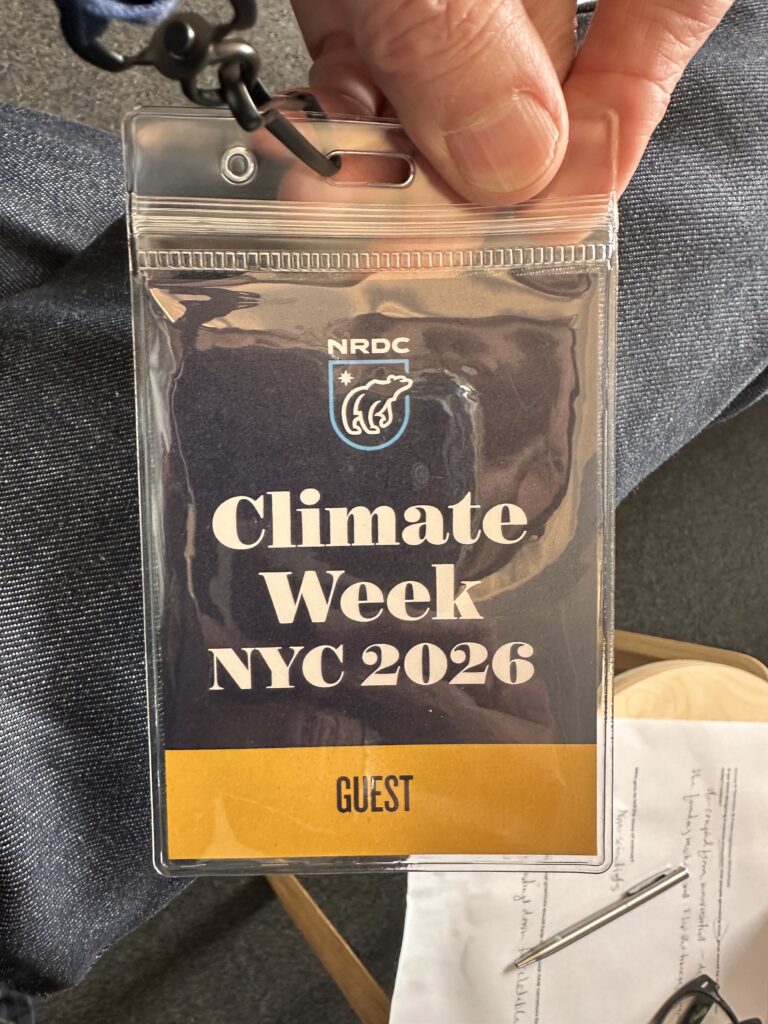
Passing observations from NYC Climate Week,  but from the Natural Resources Defense Council power panel I attended at NRDC on Thursday, Reimagining Science for All of Us: From Vision to Design

Luminaries on the panel featured leadership of the Environmental Defense Fund, Working Group Vice Chair of the IPCC, and the Founder/CEO of Stand Up For Science. Serious people who say things such as, “The climate movement is deeply unserious about a serious subject.” Shared in the context of ignoring indigenous expertise on climate threats. Accomplished, committed people who have thought long about climate issues, unabashed about equity and justice. Enough? No. But they speak frankly about blowing past 1.5º C of warming. That’s more than something. The subject of the panel opened up criticism of scientists, the careful language, fidelity to being experts not activists though knowledge is not inherently neutral. Scientists need to get political. Many won’t like this; none of their universities will.

But back to the status quo. It needs to be unpacked. En bref, after WWII, the U.S. was full throttle. You saw Oppenheimer (You did see Oppenheimer. C’mon. at least pretend. To keep up.) After that, we could do anything. It was the pre-advent of big budget Hollywood filmmaking in the shape of scientific discovery. Research on a massive scale, Cecil B could only dream. An army of extras, except PhDs. Just throwing money at a lot of things. And we did. We went to space. Silly. But okay.

But it was so successful, no one ever had to think much about it. We celebrated Ted Williams, not Jonas Salk. Batting 400 vs. polio? What. Poli-what? Look at how he rounded the bases, hopping like that. Did Jonas Salk round the bases? Did Polio? Yikes – we have measles again. Polio on line 2. No Don Draper, no “It’s Toasted.” No one knew. Multiple diseases fell in the woods and… don’t say it.

Without a need, science never developed a political machinery. Sounds cynical but it needed one, from the outset [remember, we’re de-constructing]. It’s a form of hubris, yes. But it’s hubris of all of ours. Did we just expect to defeat disease and move on to golf courses? Don’t answer that.

There is a need to talk about science to people who never think about science. The pHarmA (whatever) nonsense brand names aren’t helping either. Stop it. Start it.


Grrr… utilities

Investor-owned utilities, that is. It remains an outrage that power utilities continue to tout their efficiency in delivering us as much power as we want to use, when we want to use it. That’s it. That’s where the conversation is and that’s why nothing about our carbon output changes, except for its ever-upward trajectory. But there is much more they/we can do, because the government sets their rates and other guidelines. Charge us for using more. create incentives for power companies to get us to use less energy. Loosen Pry them/us from the reality that solar is bad for profits:

Solar panels have dropped in price by 80 percent in the past five years and can provide electricity at a cost that is at or below the current retail cost of grid power in 20 states, including many of the Northeast states. So why isn’t there more of a push for this clean, affordable, safe and inexhaustible source of electricity?

First, the investor-owned utilities that depend on the existing system for their profits have little economic interest in promoting a technology that empowers customers to generate their own power. Second, state regulatory agencies and local governments impose burdensome permitting and siting requirements that unnecessarily raise installation costs. Today, navigating the regulatory red tape constitutes 25 percent to 30 percent of the total cost of solar installation in the United States, according to data from the National Renewable Energy Laboratory, and, as such, represents a higher percentage of the overall cost than the solar equipment itself.

In Germany, where sensible federal rules have fast-tracked and streamlined the permit process, the costs are considerably lower. It can take as little as eight days to license and install a solar system on a house in Germany. In the United States, depending on your state, the average ranges from 120 to 180 days. More than one million Germans have installed solar panels on their roofs, enough to provide close to 50 percent of the nation’s power, even though Germany averages the same amount of sunlight as Alaska. Australia also has a streamlined permitting process and has solar panels on 10 percent of its homes. Solar photovoltaic power would give America the potential to challenge the utility monopolies, democratize energy generation and transform millions of homes and small businesses into energy generators. Rational, market-based rules could turn every American into an energy entrepreneur. That transition to renewable power could create millions of domestic jobs and power in this country with American resourcefulness, initiative and entrepreneurial energy while taking a substantial bite out of the nation’s emissions of greenhouse gases and other dangerous pollutants.

Meanwhile, Back at the Front

of the Curve, the Germans (and others) continue to cook, eat and run-off the lunch we presume to deny ourselves.

nu9D7

That’s a tremendous percentage of their power needs and will only increase as they continue to put the infrastructure in place to supplant fossil and nuclear energy. As the price per kWh of solar continues on a kind of Moore’s Law trajectory, the question of how cheap it can get is dwarfed by the one which asks, how long will it take us to begin cooking-lighting-gaming-blogging using this and other (any!) renewable resources? The two questions don’t seem to be informing one another in this country yet, and sure, the scale of the U.S. is prohibitive on this front for a while, just as it once was for paved roads, and remains for high speed broadband – which remains scandalously snail-ish compared to other places, largely thanks to “competition.” Hey, wait a minute…

Anyway, bravo Deutschland.

Interested Parties

It’s a big news day, many things with which to keep up, what with all the Oscar speeches and all.

But some events are not so fantastically immediate – or their impacts and causes are more indirect, slow moving and perhaps irreversible within the time frames we now perceive everything.

Take, for example, this green versus green pseudo argument, which is no doubt real, though perhaps over-articulated:

The legal tussle over putting large solar power plants in often-fragile desert landscapes underscores the difficulty of pushing forward projects crucial to fighting climate change and meeting California’s ambitious renewable energy mandates.

The five lawsuits currently pending against five solar thermal projects licensed by the state and approved for construction on federal land represent a multiplicity of interests.

Now, I might ask whether any landscape could be less often-fragile than a desert, but the fact is that big solar projects are dropping like final-consonant g’s in a Republican prime time Deebate. The same massive solar projects that desperately need to break ground because they take years to build instead spend their first couple of years of existence as a case in a court docket, doing no one any good except for those who don’t want solar projects or much of anything else to change and I’ll stop right there. Any aspersions cast are your own.
In other, perhaps related news, Juan Cole has the latest updates on the rapidly churning oilpacoplypse.

Windy names for fun

Why can’t the pharmaceutical companies

The United States is on the verge of a solar boom that could provide 4.3 percent of the nation’s electricity by 2020, according to a new report from Bloomberg New Energy Finance.

There’s just a 12-figure catch: Investors need to put $100 billion into the solar industry to keep the generation of solar electricity growing by 42 percent a year for the next decade to expand capacity from the current 1.4 gigawatts to 44 gigawatts

directly fund sponsor desert wind farms?

Federal prosecutors in Boston yesterday said British drug giant GlaxoSmithKline PLC agreed to pay $750 million to settle civil and criminal charges that it made and sold adulterated drugs, including the antidepressant Paxil, to Medicaid and other government payers

The settlement, one of the largest ever in a health care fraud case, burnished the reputation of the US attorney’s office in Boston as the premier federal office for investigating health care fraud. It has been responsible for recovering about $6 billion in health care fines and claims in the past decade, about 25 percent of all recoveries nationally.

If you think I’ve got it backwards, GlaxosmithKline’s share price only went down .14 (fourteen cents!) on news of the settlement.

Leverage

I thought it was something I had already mentioned, but this kinda makes sense: harnessing consumer power to help communities buy solar power. One Block Off the Grid, or 1BOG.

1bog

Cool logo. Check it out.

h/t Times Green blog.

Winding Us UP

How much does this have to do with the misdirection plays of the fossil fuel industry? In a way, it doesn’t matter. When we get down to studies involving just how much energy we need and how much we might supply with conventional renewable sources (in other words not urine-powered hydrogen engines or other exotica), we break into the clear about just what could be accomplished with prudent investment. But I guess this is exactly what puts the fossil fuel propaganda network on high alert.

Speaking of which, I did a similar piece on the potential for solar energy in this country some time last year. Complete with this short video.

Museum-ready

Years ago, when I was doing construction work and learning much about rehabbing old houses, we installed some enormous Photo Voltaic (PV) panels atop one Victorian-era manse that, if I’m not mistaken, were able to power a refrigerator of sufficient dimension for, I think, one frozen pizza. No lie. We all stood back and were like, man this is crazy. Talk about giving enlightenment a bad name – it was the hat trick – expensive, giant and ineffective.

Yesterday, an Israeli start-up unveiled PV technology at a kibbutz in Ashdod capable of harnessing 75 per cent of incoming sunlight. It looks like a modified parabolic trough but is actually a PV arrangement that uses mirrors to reduce the number of PV cells needed and has a water cooling system that increases efficiency and produces thermal energy.

The Monitor story also has a link to a video of a student project at MIT that concentrated the sun’s rays so intensely it was able to light a wooden 2 x 4 on fire.

The prospect of free energy in a region, or planet, dominated by the despotism of fossil fuel interests is quite a hopeful scenario – though it’s important to point out that we can become captives of hope just like anything else. Developing devices that track the sun, that work in shade, the abide by absolute requirements (clean, low cost, durable) we should demand of our energy technology at this point has nothing to do with hope. These are mere capabilities we should surround, master and set aside, and leave the old PV technology for museums that document the era of swell intentions and token investments in energy innovation and imagination.

An era already in the rear-view.