Deconstructing the status quo

There’s more to that than we think we know.

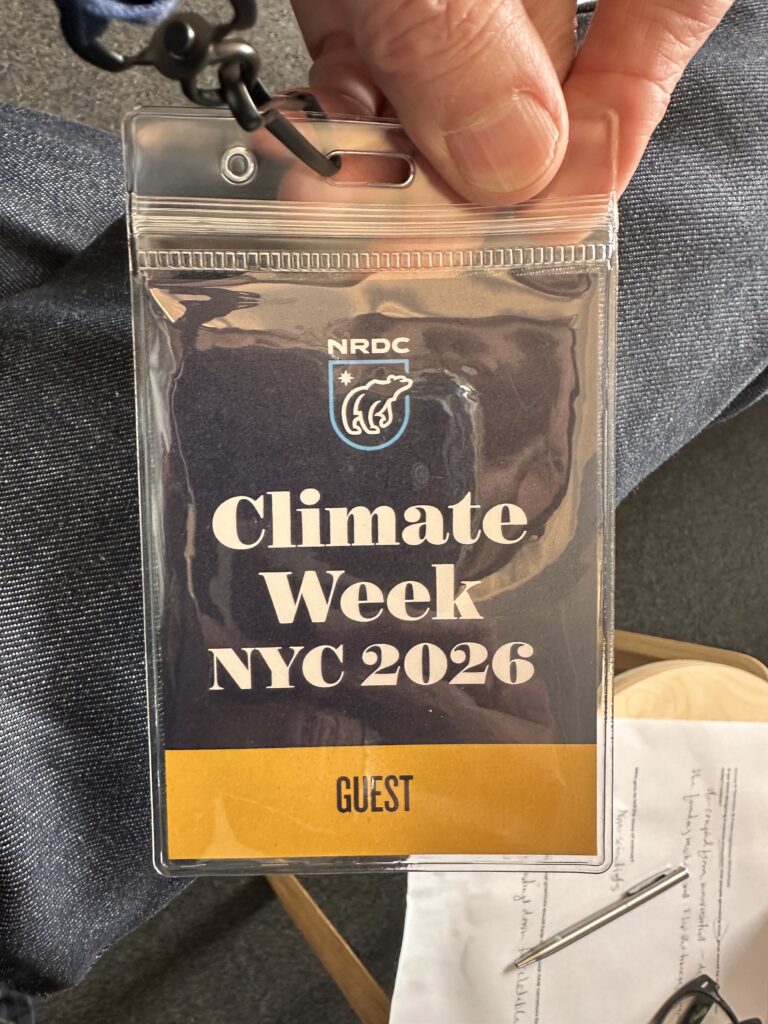
Passing observations from NYC Climate Week,  but from the Natural Resources Defense Council power panel I attended at NRDC on Thursday, Reimagining Science for All of Us: From Vision to Design

Luminaries on the panel featured leadership of the Environmental Defense Fund, Working Group Vice Chair of the IPCC, and the Founder/CEO of Stand Up For Science. Serious people who say things such as, “The climate movement is deeply unserious about a serious subject.” Shared in the context of ignoring indigenous expertise on climate threats. Accomplished, committed people who have thought long about climate issues, unabashed about equity and justice. Enough? No. But they speak frankly about blowing past 1.5º C of warming. That’s more than something. The subject of the panel opened up criticism of scientists, the careful language, fidelity to being experts not activists though knowledge is not inherently neutral. Scientists need to get political. Many won’t like this; none of their universities will.

But back to the status quo. It needs to be unpacked. En bref, after WWII, the U.S. was full throttle. You saw Oppenheimer (You did see Oppenheimer. C’mon. at least pretend. To keep up.) After that, we could do anything. It was the pre-advent of big budget Hollywood filmmaking in the shape of scientific discovery. Research on a massive scale, Cecil B could only dream. An army of extras, except PhDs. Just throwing money at a lot of things. And we did. We went to space. Silly. But okay.

But it was so successful, no one ever had to think much about it. We celebrated Ted Williams, not Jonas Salk. Batting 400 vs. polio? What. Poli-what? Look at how he rounded the bases, hopping like that. Did Jonas Salk round the bases? Did Polio? Yikes – we have measles again. Polio on line 2. No Don Draper, no “It’s Toasted.” No one knew. Multiple diseases fell in the woods and… don’t say it.

Without a need, science never developed a political machinery. Sounds cynical but it needed one, from the outset [remember, we’re de-constructing]. It’s a form of hubris, yes. But it’s hubris of all of ours. Did we just expect to defeat disease and move on to golf courses? Don’t answer that.

There is a need to talk about science to people who never think about science. The pHarmA (whatever) nonsense brand names aren’t helping either. Stop it. Start it.


Consequent antecedent

What if a climate report falls in the woods and no one is there to hear it read it write it?

The Trump administration has dismissed the hundreds of scientists and experts who had been compiling the federal government’s flagship report on how global warming is affecting the country.

The move puts the future of the report, which is required by Congress and is known as the National Climate Assessment, into serious jeopardy, experts said.

Since 2000, the federal government has published a comprehensive look every few years at how rising temperatures will affect human health, agriculture, fisheries, water supplies, transportation, energy production and other aspects of the U.S. economy. The last climate assessment came out in 2023 and is used by state and local governments as well as private companies to help prepare for the effects of heat waves, floods, droughts and other climate-related calamities.

On Monday, researchers around the country who had begun work on the sixth national climate assessment, planned for early 2028, received an email informing them that the scope of the report “is currently being re-evaluated” and that all contributors were being dismissed.

No presto-magic-o, no problem-o. Luckily for us, those pesky climate issues are no match for a brain genius who just does not want to hear about them. Solved.

Fantasy Winning.

Video: frères d’armes

Proof of a Common Goal

Via Informed Comment, Nelson’s Mandela’s declaration to the court as his trial began in pretoria at the Supreme Court of South Africa, April 20, 1964:

I am the first accused. I hold a bachelor’s degree in arts and practised as an attorney in Johannesburg for a number of years in partnership with Oliver Tambo. I am a convicted prisoner serving five years for leaving the country without a permit and for inciting people to go on strike at the end of May 1961.

At the outset, I want to say that the suggestion that the struggle in South Africa is under the influence of foreigners or communists is wholly incorrect. I have done whatever I did because of my experience in South Africa and my own proudly felt African background, and not because of what any outsider might have said. In my youth in the Transkei I listened to the elders of my tribe telling stories of the old days. Amongst the tales they related to me were those of wars fought by our ancestors in defence of the fatherland. The names of Dingane and Bambata, Hintsa and Makana, Squngthi and Dalasile, Moshoeshoe and Sekhukhuni, were praised as the glory of the entire African nation. I hoped then that life might offer me the opportunity to serve my people and make my own humble contribution to their freedom struggle.

Some of the things so far told to the court are true and some are untrue. I do not, however, deny that I planned sabotage. I did not plan it in a spirit of recklessness, nor because I have any love of violence. I planned it as a result of a calm and sober assessment of the political situation that had arisen after many years of tyranny, exploitation, and oppression of my people by the whites.

I admit immediately that I was one of the persons who helped to form Umkhonto we Sizwe. I deny that Umkhonto was responsible for a number of acts which clearly fell outside the policy of the organisation, and which have been charged in the indictment against us. I, and the others who started the organisation, felt that without violence there would be no way open to the African people to succeed in their struggle against the principle of white supremacy. All lawful modes of expressing opposition to this principle had been closed by legislation, and we were placed in a position in which we had either to accept a permanent state of inferiority, or to defy the government. We chose to defy the law.

We first broke the law in a way which avoided any recourse to violence; when this form was legislated against, and then the government resorted to a show of force to crush opposition to its policies, only then did we decide to answer violence with violence.