Fascination with numbers

It’s no stretch to suggest that quantifying life as we know it not in terms of quality but economic growth leaves everyone a bit empty, a bit lesser for the experience, such as it is.

Numbers are fine, can be fun, even. Inspiring. Take Clairaut’s Theorem, as just one example. Among the heights of the Enlightenment – there were several – the eighteenth-century French mathematicians/philosophers Alexis Clairaut and Pierre Louis Maupertuis led an expedition to Lapland in the Arctic Circle (in the 1730’s) in order to measure a single degree of the median arc. The goal was to calculate the shape of the Earth, and validate whether Newton was correct in his Principia where he theorized it was an ellipsoid shape.

In disagreeing with Newton’s theory, Clairaut suggested not only that the Earth is of an oblate ellipsoid shape, but it is flattened more at the poles and is wider at the center. You can imagine the controversial this unleashed among scholars of the day, and Clairaut leaned in, full tilt. He courted the fight and published work in the 1740’s that promoted Clairaut’s Theorem, which connects the gravity at points on the surface of a rotating ellipsoid with the compression and the centrifugal force at the equator.

Under the assumption that the Earth was composed of concentric ellipsoidal shells of uniform density, Clairaut’s theorem could be applied to it, and allowed the ellipticity of the Earth to be calculated from surface measurements of gravity. This proved Sir Isaac Newton’s theory that the shape of the Earth was an oblate ellipsoid. In 1849 George Stokes showed that Clairaut’s result was true whatever the interior constitution or density of the Earth, provided the surface was a spheroid of equilibrium of small ellipticity. [wikipedia]

Provides interesting context to our jokey notion about “views differ on the shape of the Earth.” There’s an amazing book about all of this and more that centers on Madame Du Châtelet, erstwhile mistress of Voltaire who translated Newton’s Principia.

Fascination may be in the eye of the beholder. However, a focus on economic growth beyond the point where it may be healthy, productive, even possible, disassociates us from even the power of numbers themselves. Growth becomes its own ends and we, captive to the destruction its portends, stand idly by and make nervous jokes about issues long settled, amidst our intellectual withering and spiritual decay.

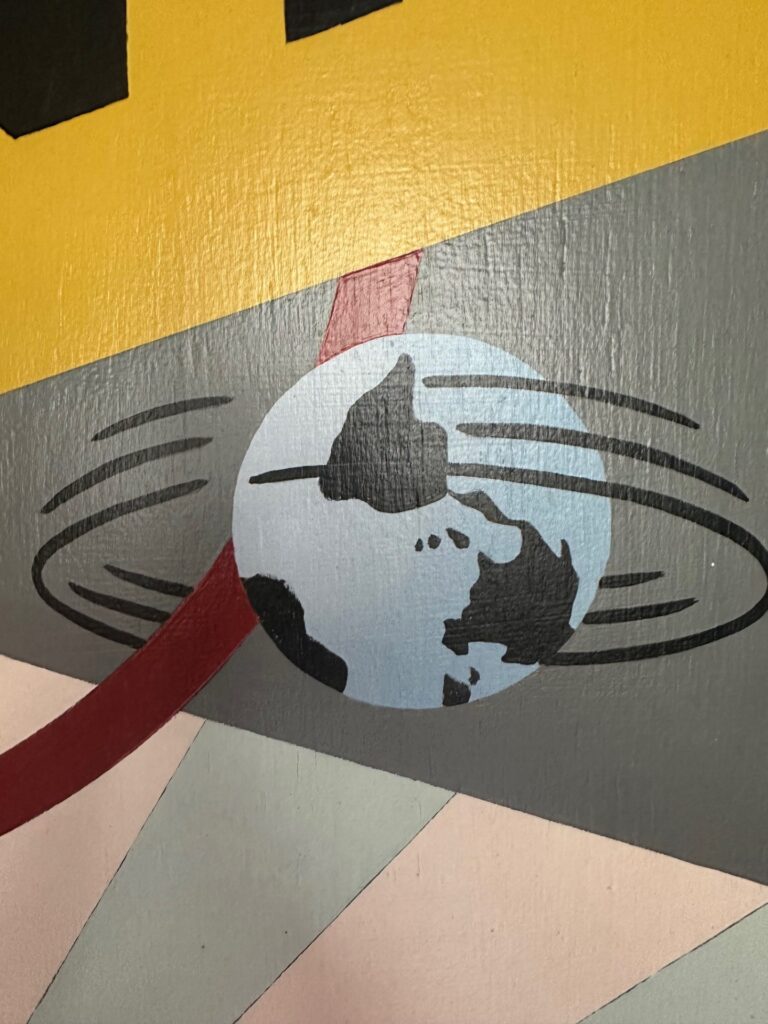
Image: [shiny)Detail of a painting by Lou Kregel.

Rich morons: still morons

This has been ably dispatched here, here and elsewhere, but you still may have missed it. Lou-weeeze:

“Acting like everyone who’s been successful is bad and because you’re rich you’re bad, I don’t understand it,” the JPMorgan Chase & Co. (JPM) CEO told an audience member who asked about hostility toward bankers. “Sometimes there’s a bad apple, yet we denigrate the whole.”

Dimon, 55, whose 2010 compensation was $23 million, joined billionaires including hedge-fund manager John Paulson and Home Depot Inc. (HD) co-founder Bernard Marcus in using speeches, open letters and television appearances to defend themselves and the richest 1 percent of the population targeted by Occupy Wall Street demonstrators.

If successful businesspeople don’t go public to share their stories and talk about their troubles, “they deserve what they’re going to get,” said Marcus, 82, a founding member of Job Creators Alliance, a Dallas-based nonprofit that develops talking points and op-ed pieces aimed at “shaping the national agenda,” according to the group’s website. He said he isn’t worried that speaking out might make him a target of protesters.

“Who gives a crap about some imbecile?” Marcus said. “Are you kidding me?”

So… who’s the imbecile? This is not even being tone deaf – I think they’re just dumb. Why would you ever feel it necessary to go on the war path about this? You’re tough enough to create all those jobs and bank all that dough but you can’t take criticism for being rapacious windbags and now must be called petulant, too? This is a gross extrapolation of the argument that people making $400K are barely getting by – and also that more money you make, the harder you work. Neither of these things is remotely true. Krugman’s right: get rich enough to surround yourself with sycophants and no one will tell you you’re being an asshole.

Camel through the eye of a needle and all – the real moral is: We all really need close friends.

Measures of Affluence

Is it how fat you are? Or how skinny? An iPhone or Samsung? Clothes, car, house… surely all of these. But like so many things, of course, it depends.

The consumption model flows from conspicuous to discreet, along a kind of progressive continuum, whereby once you achieve a certain stage or level of affluence and find momentary reprieve from keeping up, your benchmark then changes to reflect the new set of priorities of those directly above you. And the fun begins again.

So what if (!) other variables experienced a, um, shift, in their ability to reflect the wealth of their bearer? For example, let’s say that once upon a time only the rich could abandon the bustle of the city and afford lengthy commutes to far flung homes, to live out in the country and venture into town only on occasion. Even if they had to travel in everyday, this too was a sign of how much they could afford to spend on personal transportation. But then the dirty, dangerous city becomes more desirable for some reason, or life in the country less so (bears, Sasquatch) and a switch occurs wherein a long commute is suddenly a symbol of penury, while the short drive or the ability to even occasionally do without a car becomes IT among the fashionable set. Wow. That’s convoluted. You see what we’re up against. But is there another way to have get fancy trains and buses and trams and funiculars?

There’s no way to pull back on burning seas oil drilling without dramatically stepped-up conservation; and there’s no way, in this culture, to make conservation work without making it part and parcel of status and/or something people want. I guess we might at least look at this as something that can happen, however far-fetched it may seem.

The N-D Conundrum

What turns GREED to GREEN? What turns GREEN to GREED? We all assume a symbiotic relationship – it’s what this whole semantic notion is about. The hope for a magic, transcendental spell check that does the trick for us, changes one to the other (for a fee, of course) might be a nice idea for a conceptual art installation – The Syntax of the Hyper Real or some such – but little else.

In terms of planetary peril, it appears to be a irreconcilable symbol inversion in the alphabet. The Gaia Theory would appear to be promising, except for its implication for ‘we the people’. But we even have to accept this, if we’re willing to be so heedless about using the atmosphere as a free dumping ground. This interview with its originator is compelling in a gallows sort of way. He hates carbon trading and says its a scam, but is there another way to get the D to go N without taxing ourselves, without charging for the free dumping ground? While many understand the reasons why it will be better to transition away from this economic model and move radically toward renewable energy, the fossil fuel endgame remains viable because it is… cheaper. This is a compelling moral argument, though not one we should make or defend intentionally.

It’s unpleasant to think that we will be wont to change our behavior until we are compelled to do so, that we are in some sense the rich who won’t say they hate the poor but are nonetheless able to simply turn their backs on the suffering the poor endure. After all, for people whose primary motivation is green greed grrr, what makes us do anything?