Whither Philanthropy?

Uncomfortable proximity to double entendre notwithstanding, the heading of philanthropic fundraising and grant-making is very much in question, if not doubt. As we barrel into the climate crisis while finding out just how much representative democracy we can do without, who is funding what and how?

I spoke with Ellen Dorsey, executive director of the Wallace Global Fund last week following the fund’s announcement that it would spend down its endowment to zero in the face of urgent societal challenges. She hits many great points – among them, what is perpetuity in a burning world?

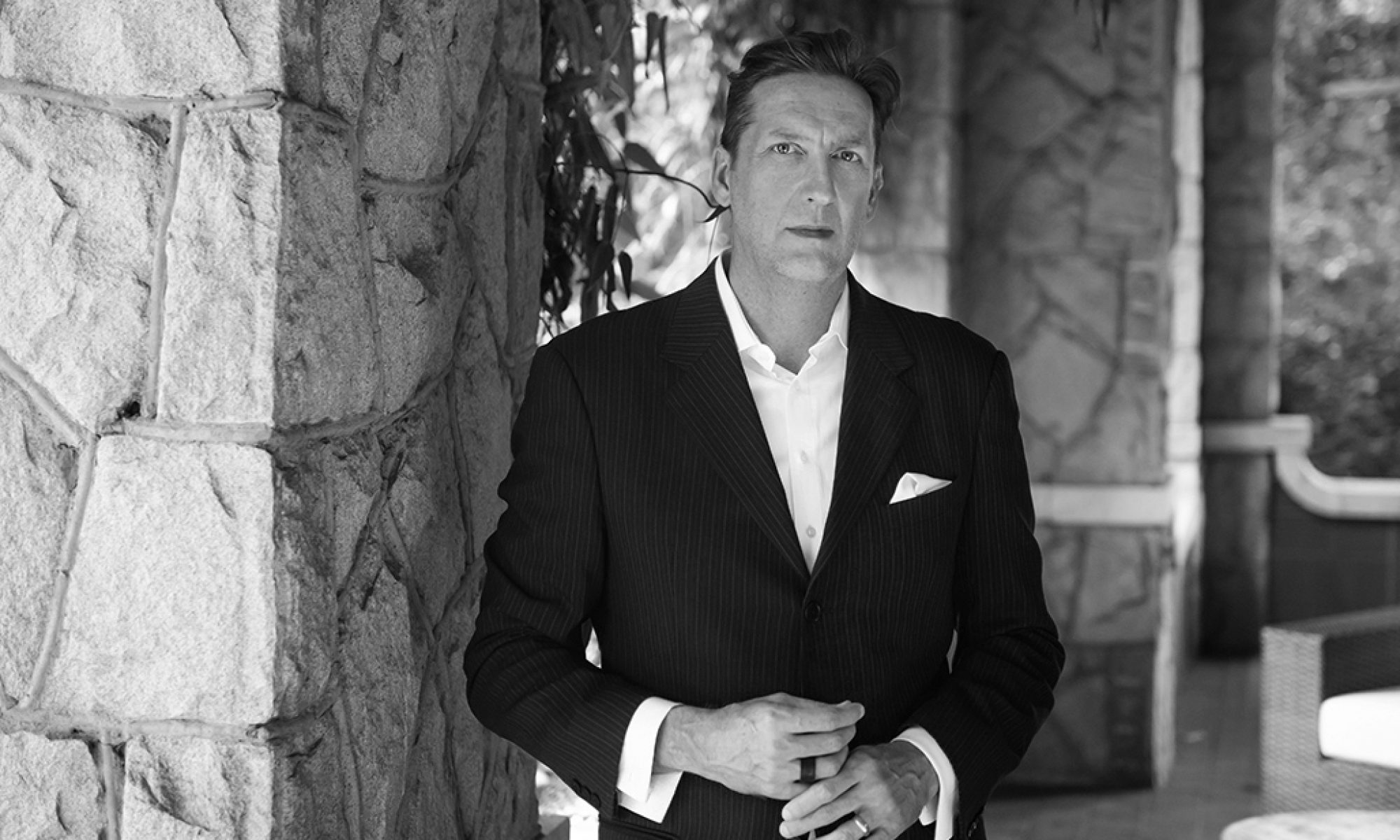
People in suits

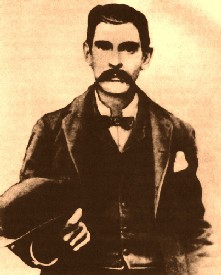
dochollidayMaybe like some, I’ve been reluctant to act on or even write much about my perspective on the recent election, beyond sharing brief descriptions. The compulsion to hold onto that anger for a while longer, allow it form something useful, while at the same time reaching out personally to many who instantly became more vulnerable, has seemed to me the better course. Doing this, however, we risk a certain changed countenance and I indeed do feel differently about several things in many ways, my naiveté about many of our fellow Americans prime among them. But about other things, I do not feel differently, and in fact, my convictions have only grown stronger, and they offer guidance on how to proceed, which led me back to something by the great John Gardner:

The poet-priest had two functions: lawgiver and comforter. He had to know what laws to give, what comfort to give, what comfort to withhold as false. The poet has far less power now, but the job hasn’t changed. He must affirm, comfort as he can, and make it stick. Let artists say what they know, then, admitting the difficulties but speaking nonetheless. Let them scorn the idea of dismissing as harmless the irrelevant fatheads who steal museums and concert halls and library shelves: the whiners, the purveyors of high-tone soap opera, the calm acceptors of senselessness, the murderers. It is not entirely clear that these people are not artists. They may be brilliant artists, with positions exactly as absolute as, say, mine. But they are wrong.It’s not safe to let them be driven from the republic by policemen, politicians, or professional educators. Officialdom would drive out all of us, which is one reason that when we come out shooting we should all talk with dignity and restraint, like congressmen, and wear, like Doc Holliday, vests and ties. Let a state of total war be declared not between art and society – at least until society starts horning in – but between the age-old enemies, real and fake.

The Nation’s Racial Divisions at the Time

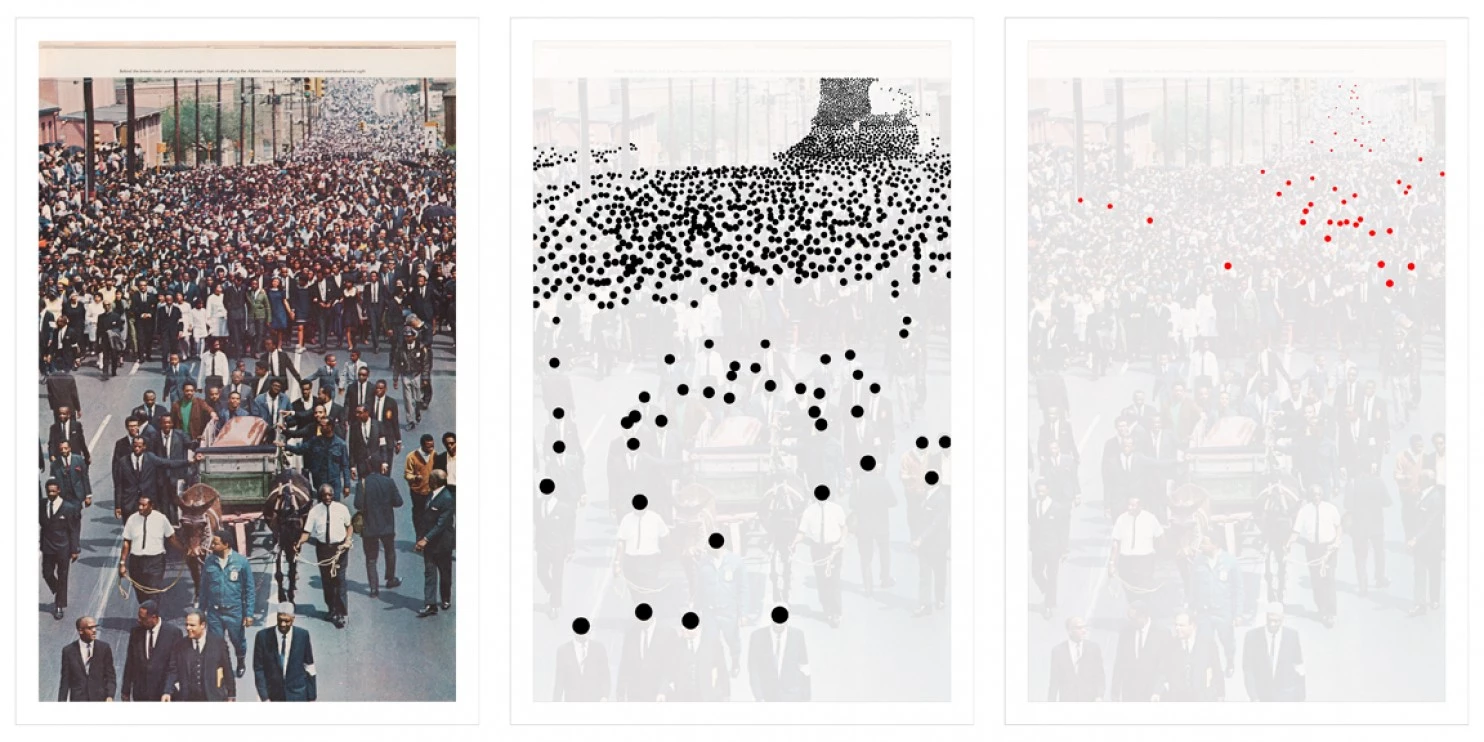
mlk01_JaarChilean artist Alfredo Jaar produced this work in 1995, and however it hits you will produce the best sketch of your feelings about where we stand as a country, right now, on our continuing struggles with race.

The artist found it unimaginable that so few whites would attend Dr. King’s funeral:

How could Americans of all racial backgrounds not have mourned the death of the great civil rights leader?

“When I started looking at the shocking absence of white faces, I couldn’t believe it,” Jaar said, “so I started looking for a way to represent this in a graphic and almost funny way. I did not want to preach to people. This was a way for me to express my outrage to what these images reveal.”

How, indeed. In too many ways, the distance between these dots has only grown, even if there are more of them.

Standard Future

An aside concerning the Away of the last week.

The green family spent last week in Northern California, a beautiful respite from the devilish heat that has HQ surrounded on all sides, now and especially then. We spent the American Independence Day in a certain city among many, many thousands of observant fellow Americans and I will report without irony that it was perhaps the most patriotically American-feeling Independence Day directly observed in some time. The context of that particular city, noted over the preceding days, perfectly foreshadowed this Independence Day sensation, and for one simple reason: it is the future of America. Allow me to explain.

The often-fraught, always divisive and currently repellant political culture of this country is predicated on the future being poor, uneducated, overweight, uninsured and underemployed like much of the South currently finds itself. But that’s not what the future looks like, and I don’t mean this as some kind of self-styled optimist, because, while occasionally hopeful, I’m not quite that. The future, I was reminded, is made up of a multi-generational diversity of people from all corners, educated and bottle-fed the same American go-getterism but rid, somehow, of the hate, fear and disdain that we seem to think naturally comes with it. Those things are an add-ons – they actually don’t come standard, as it turns out. Of course, this is the reason certain parties attach so much fear to the future. Without the add-ons, things are different, people care, congregate and relate as they get on with the business of the country, which is business, of course. But they vote in favor of things like health care and fast trains, know they might, just might, be able to affect the amount of energy people use with a few more options and some incentives.

The folks in the tricornes fetishize the past and we should take them at their word. It is the past. And the faster it turns into the future, and it is (I saw it), the louder the screaming will be.

We pedaled rented, two-wheel crafts hand-forged in the heartland through acres of Americans of all ethnicities, setting up their grills, beer coolers, card tables, FLAGS and volleyball nets in public spaces meant for viewing the fireworks over the Bay later that evening. Did I say flags? Not a surprise, of course, it was American Independence Day. But it was a good reminder and perhaps most other places than the American South you don’t need one, but people coming here want to be here for more reasons than to take your crappy stuff and whatever motivated their grandparents, three generations in, they are Americans, if not the country itself. It was inspiring and reassuring.

And of course, that city is also filled with the requisite amount of crazy people, many of them homeless. Why so, other than delightful weather? Upon closer investigation it seems that the city in question funds adequate services for all of its citizens, include the least among them, mainly because the people in it believe them all to be part of humanity and not some garbage island off of it.

So enjoy some independence from the idea of a threatening future for a while. It could be bad enough without being fully-equipped with all the racist fear-mongering that has traveled so well up to now. And keep in mind, in some places within our own borders, people are already finding ways to put it aside. Plus, all the new kids are coming with the standard model features anyway. So hold the add-ons.
Bill o’ Goods

Coming due to a waning superpower near you. To the Doghouse for your elucidification:

Medicare–it provides less than half the medical expenses of its beneficiaries, the elderly and the disabled–is13% of the Federal budget. Total Medicare spending in 2009 was $484 billion. In 2009 the total interest on the National Debt attributable to military spending was $390 billion. That’s the interest we pay on all things military (including VA costs and military pensions) for having acted, since 1946, as though it were perpetually 1944.

Our ten Nimitz-class supercarriers represent a $450 billion collection of holes in the ocean in construction costs alone; they’re scheduled to be replaced by 2040 by an equal number of Gerald Ford-class hulks at twice the cost, assuming you believe 2005 estimates, which you shouldn’t. That’s construction costs. Not development, nor maintenance, nor upgrades, attendant fleet, staffing, planes, aviation fuel, or the cost someone will eventually bear to do something with the twin reactors when we don’t need ’em anymore. That’s our supercarrier Navy. No one else in the world has any. Their role is to intimidate tenth-rate military powers, since we haven’t figured out how to invade any on the ground.

Which is distinct from figuring out why we need to invade any, since that answer is either too amorphous to pin down, or too brutally self-reflective to ever see the light of newsprint.

The Consumed Vertigo of Catastrophe

French theorist Jean Baudrillard (1929-2007) was a sharp critic of contemporary society who twisted philosophy, social theory and cultural metaphysics into a chaotic ball of illuminating knots. The snippet below is from his 1970, The Consumer Society: Myths & Structures. This section is titled The Miraculous Status of Consumption.

The usage of signs is always ambivalent. Its function is always a conjuring – both a conjuring up and a conjuring away; causing something to emerge in order to capture it in signs (forces, reality, happiness, etc.) and evoking something in order to deny and repress it. We know that, in its myths, magical thought seeks to conjure away change and history. In a way, the generalized consumption of images, of facts, of information aims also to conjure away the real with signs of the real, to conjure away history with the signs of change, etc.

Reality we consume in either anticipatory or retrospective mode. At any rate, we do so at a distance, a distance which is that of the sign. For example, when Paris-Match showed us the secret forces assigned to protect the general [De Gaulle] training with machine guns in the basement of Prefecture, that image was not read as ‘information’ i.e. as referring to the political context and its elucidation. For every one of us, it bore within it the temptation of a superb assassination attempt, a prodigious violent event; the attempt will take place, it is going to take place; the image is the forerunner to it, and embodies the anticipated pleasure; all perversions have their acting out. What we see here is the same inverse effect as in the expectation of miraculous abundance within the cargo cult. Cargo or catastrophe – in both cases, we have an effect of consumed vertigo.

We may, admittedly, say that it is, then, our fantasies which come to be signified in the image and consumed in it. But this psychological aspect interests us less than what comes into the image to be both consumed in it and repressed: the real world, the event, history.

What characterizes consumer society is the universality of the news item [le fait divers] in mass communication. All political, history and cultural information is received in the same – at once anodyne and miraculous – form of the news item. It is entirely actualized – i.e. dramatized by the spectacular mode – and entirely deactualized – i.e. distanced by the communications medium and reduced to signs. The news item is thus not one category among others, but the cardinal category of our magical thinking, of our mythology.

That mythology is buttressed by the all the more voracious demand for reality, for ‘truth’, for ‘objectivity’. Everywhere we find cinema verite’, live reporting, the newsflash, the high-impact photo, the eye-witness report, etc. Everywhere what is sought is the ‘heart of the event’, the ‘heart of the battle’, the ‘live’, the ‘face to face’ – the dizzy sense of a total presence at the event, the Great Thrill of Lived Reality – i.e. the miracle once again, since the truth of the media report, televised and taped, is that I was not there. But it is the truer than true which counts or, in other words, the fact of being there without being there. Or, to put it another way, the fantasy.

What mass communications give us is not reality, but the dizzying whirl of reality [le vertige de la realite’]. Or again, without playing on words, a reality without the dizzying whirl, for the heart of Amazonia, the heart of reality, the heart of passion, the heart of war, this ‘Heart’ which is the locus of mass communications and which gives them their vertiginous sentimentality, is precisely the place where nothing happens. It is the allegorical sign of passion and of the event. And signs are sources of security.

So we live, sheltered by signs, in the denial of the real. A miraculous security: when we look at the images of the world, who can distinguish this brief irruption of reality from the profound pleasure of not being there? The image, the sign, the message – all these things we ‘consume’ – represent our tranquility consecrated by distance from the world, a distance more comforted by the allusion to the real (even where the allusion is violent) than compromised by it.

means-as-medium

If we were truly the musical people that we think we are, there would be a growing discography based on the notion of a people who gorge themselves endlessly, yet are profoundly undernourished. But invariably, time from time someone leaves a door unlatched and a few bars or whole measure drifts out that is recognizable – how we have conditioned ourselves to think that we’re open to different ideas when that isn’t actually the case at all; that we’re already overtaxed with things to do and think about when we actually ask quite little of ourselves; how ‘the whole thing’ (whatever it is) is just too complicated when it’s often quite simple and only the onus of our choices which we find too troublesome to delve into.

The column this week touched on this idea in a very indirect way, via a coincidental example of an eco-themed art show. It’s greatly true that if you just keep in mind what it is that you’re doing, most situations tend to be navigable, that one included. In a timely NYT follow up (kidding), this article presents much the same take on a coincidental example, a review of a show by the recipient of the Solomon R. Guggenheim Museum’s Hugo Boss Prize.

When an artist uses her art to advance a political cause, how are we to judge the result? Should we evaluate the project by applying artistic standards or on the basis of its political or moral argument?

Consider Emily Jacir, who employs conventional devices of conceptualism and performance art to call attention to the plight of the Palestinian people.

This particular example of her work has a tertiary component that makes it even more suspect, but the point holds that even and especially with sympathetic subject matter, the basic premise of ‘art as means’ remains problematic.

However tragic and deplorable Mr. Zuaiter’s story may be, Ms. Jacir’s exhibition does not bring him to life sufficiently enough to elicit a strong emotional response. You may agree or disagree with her political goals and her use of the art exhibition system to further them. But the problem is with her unexceptional artistry, not her politics.

Just so.

Distorting the public conversation

It mostly goes without saying, for long gaps on this blog at least, that the reason Green is so compelling as a stand-in for sustainability is that it also happens to be highly useful slang for money. And has been for what’s going on an epoch, in any meaningful sense.

It’s the double-entendre that provides its edge – as divergent as the two meanings in one word are. Incoherent is more like it, but just enough to provide a little of each to lap over onto the other and provide some of the ambiguity that might pull us through the rough patch where our pursuit of money has outdistanced its effective ability to shield us from the consequences of its single-minded pursuit. Vagueness is a currency that itself can and will lose effectiveness as the clearly-spelled out cruelties of life re-assert themselves. We’ll hope for vague cover again, to attempt surreptitious movement toward better, more sensible pursuits. Because we can’t do it out in the open.

All this is to point up the way green as money has stepped to center stage again, becoming more precious as its gotten tighter, even more precious than the precarious fate of the planet on which it is spent, invested, given and taken. It’s pitiable but this is the way it is – the way we are. This mentality leads with ‘we will become more energy efficient/invest in new sources of renewable energy when we can afford to’. It ends up where? Like capitalism or any ism, it doesn’t care. Only we can show concern or guard special preferences. We have to decide some things. Like when we might be able to afford to become less wasteful, for one.

And as quickly as the massive financial losses spilled into the open this fall, the money is crawling back into its holes as fast as possible. It might even be able to provide the cover of vagueness again soon and enable us to return to making more (safely) ambiguous motions toward sustainability and ‘going green’. But we won’t be able to decide or allocate anything in any different way as long as this trend remains in tact.

What does Greece mean

This is slightly off topic, though not by much. The recent unrest in the other Athens and environs has been stealing my attention all week, and not just because we spent some time living there earlier this year. A friend from there e-mailed yesterday.

The “known/unknown” anarchists are destroying and burning cars, shops and classic buildings in the centre of Athens. The reason/pretense was the killing of the 15 year old boy by the police. However the deep cause of the situation is said to be the unemployment and the uncertain future of the youth of Greece, having the killing of the boy as just the icing on the cake. So this ignited all the young and restless Greeks to go out on the streets and start a destroying spree.

And the government is just standing there, without intervening, afraid of the social outcry, reluctant to take part… and solve the situation.

Her reference to the ‘deep cause’ has been bothering me, too. The level of disillusionment simmering just below the surface wasn’t readily apparent on the small island we were living on, but it also wasn’t difficult to put together after a few weeks there. The social order masks the lack of opportunity for just-out-of-school-age people on many levels. Everything that is good about that statement also hints at its tenuous nature. It’s not about the lack of crazy, American-style prosperity, per se, from which they are removed for other reasons, mostly by choice. For instance, Greeks I know are really proud that McDonald’s has never caught on there and (rightfully) take it as a sign of the importance of their food to them. The tangled question of opportunity is more about the fundamental way in which society is to move forward in a time of resource constraints coupled with high costs of modern living. It’s not obvious. And when people start taking up rocks and sticks, setting cars on fire, well, it means a pretty stark equilibirum is in sight.

The patriarchy in general is suffering a slow-motion roll into, not irrelevance but ambivalence on the part of the governed, which is saying a lot about an ancient culture that has survived as much turmoil as they have, being at the center of civilization for so long. But it doesn’t seem to be so much about Greece, or just Greece. It might just be one of the places where it’s happening first.

Institutions strained in this way remind me a lot of what Kunstler tries to keep on the radar. His vision is stark as well, but hints at what might be in the offing in the tone of a familiar tune:

The change actually coming will be much more than they bargained for, namely our transition from a wealthy society to a hardship society. The sharp break is a product of our years-long failure to reckon with the energy realities of our time. We’re still confused about that, but it’s hard, otherwise, to ignore the massive disappearance of capital, asset values, livelihoods, domiciles, comforts, and necessities.

Again, it’s not obvious how a society, or society, continues on its arc where the everything but especially our worth as a people is predicated on growth as we know it. What if it’s not? What is it predicated on, then? The need to understand events as they happen is key to dealing with their aftermath and avoiding repeat disasters, however we characterize them. There is choice to examine these times, how we got here and try to regain the upperhand on ourselves or just brush the whole thing off as something beyond our control and change the channel.

Actually, that doesn’t sound like much of a choice.