
Revolution is a much more disorderly and much more difficult subject; and the very crowdedness and jaggedness of Michelet’s treatment of it are the signs of a determination to lay hold of a complex reality which had been simplified to make texts for many sermons, revolutionary and reactionary alike. It was with justice that Michelet claimed that, though there had been royalist and Robespierre histories of the Revolution—both “monarchist” versions, he insisted—he had written the first republican history. Yet in the volumes which deal with the centuries preceding, where Michelet has a clear stretch of slow developments, the great rhythmic recurrences of history are interwoven with a cumulative force and a symphonic effect which surely represent the extreme limit of the capacity of the artist to use historical fact as material. Michelet manipulates his themes, dropping them and picking them up at intervals, as if he were braiding a rope: the periodical assemblies of the States-General, gradually acquiring a new significance; the progressive sterilization and incompetence of the Court; the technical development of warfare; the books that mark the dawn of the Enlightenment; the episodes of the Protestant persecution; the series of witchcraft trials which show the decay of Catholicism in the convents. Yet the plaiting of a rope is too coarse an image. No image except that of life itself can convey the penetrating intelligence and the masterly skill of presentation with which, in the volumes on Louis XIV, for example, Michelet interrelates the intrigues of the Court, the subjects of Moliere’s comedies and the economic condition of France; or the completeness of the volume on the Regency—Michelet groans over his travail with this in his letters: “Nothing more difficult, more dispersed, more arduous to reconstructl”—in which the good intentions of the liberal Regent are so subtly shown to prove ineffective by reason of his inextricable entanglement with the dying class to which he belongs—a story ending with one of those sharp incidents which Michelet is so good at finding to nail down a situation: the Due d’Orffians, his reforms come to nothing and with only the solace of dissipation left, exclaiming bitterly, “Poor damned country, governed by a drunkard and a pimp!”
From To the Finland Station, by Edmund Wilson. There remains much ruin in a nation.
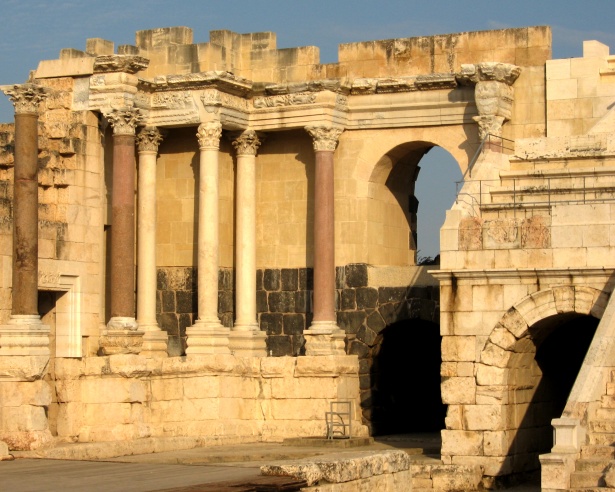
Image: Ruins of Roman amphitheater because, per Wilson, the plaiting of a rope is too coarse an image.