Disastrophe

When I started writing this blog back in 2008, it included no small measure of wise-acre impatience with how green sustainability was quickly becoming just another fashion in marketing trend. Sure, ‘sustainable’ is an unimaginably low bar, but it had a kind of odd staying power – people though they understood it, even if they ignored it. Maybe it allowed them to ignore the greater crisis, so thoroughly did it couch the entire concept in ‘meh’. Why be alarmed? You/they didn’t come up with an alarming word. Sustainable. It seemed to infer, ‘We’ve got plenty of time.’
Well, now that the alarm has taken the shape of an iridescent human, it has brought with it a slew of other factors that must be ignored first, before we get back to ignoring the great existential thing we’ve been trying to ignore all along. Excusing and thus normalizing racism, sexism, homophobia, classicism, fascism and treason have now re-presented as the ante quod nihil of dealing with any of this planetary crisis business.

Remember, Tking-tides-globeides,
global warming is a hoax.
Exemplary measures,
equaling at most
a dollop
of time. Before we wade and watch.
Instead of just watch.

On Bullshit

a-burial-at-ornansOne week from the election, disagreement as political argument has taken a very wide arc around the truth:

Why should we remain beholden to facts? They are, as etymology tells us, not some sort of raw material that we simply find, but rather are the sort of thing that must be actively made — or, to use the Latin past participle, factum. Propagandists, whether Jesuit, Bolshevik, or Rovean, are those people who understand that facts, or at least social facts, are the result of human activity, in part the activity of inserting new ways of thinking and talking into the public realm — and that when this is done effectively, the public, sometimes, can come to a new understanding of the truth.
This, again, is not what Trump is doing. He is a mere bullshitter, and what comes out of his mouth has more to do with pathologies of personality than with any real vision of how the world, or America, ought to be brought into line with some super-empirical truth to which he alone has access.

Trumpism is, however, being helped along by master propagandists who understand very well that, by treating facts as something to be actively made, one may eventually change the way truth is understood. (Let us not, here, consider the specter of social constructionism, of whether changing the way truth is understood is the same thing as “creating a new truth.”) The activists of the so-called alt-right have been working for years to change public discourse through a concerted campaign of internet trolling. Their goal has been the creation of “meme magic,” that moment when an idea that they have promoted online makes the leap from virtuality to reality.

Also, ensorcelled. Image: A Burial at Ornans, by Gustave Courbet, 1851

Descent in Joy

The continued protest by Native people against the DAPL leads me to Camus and his Myth of Sysiphus:

sisyphus

You have already grasped that Sisyphus is the absurd hero. He is, as much through his passions as through his torture. His scorn of the gods, his hatred of death, and his passion for life won him that unspeakable penalty in which the whole being is exerted toward accomplishing nothing. This is the price that must be paid for the passions of this earth. Nothing is told us about Sisyphus in the underworld. Myths are made for the imagination to breathe life into them. As for this myth, one sees merely the whole effort of a body straining to raise the huge stone, to roll it, and push it up a slope a hundred times over; one sees the face screwed up, the cheek tight against the stone, the shoulder bracing the clay-covered mass, the foot wedging it, the fresh start with arms outstretched, the wholly human security of two earth-clotted hands. At the very end of his long effort measured by skyless space and time without depth, the purpose is achieved. Then Sisyphus watches the stone rush down in a few moments toward tlower world whence he will have to push it up again toward the summit. He goes back down to the plain.

It is during that return, that pause, that Sisyphus interests me. A face that toils so close to stones is already stone itself! I see that man going back down with a heavy yet measured step toward the torment of which he will never know the end. That hour like a breathing-space which returns as surely as his suffering, that is the hour of consciousness. At each of those moments when he leaves the heights and gradually sinks toward the lairs of the gods, he is superior to his fate. He is stronger than his rock.

If this myth is tragic, that is because its hero is conscious. Where would his torture be, indeed, if at every step the hope of succeeding upheld him? The workman of today works everyday in his life at the same tasks, and his fate is no less absurd. But it is tragic only at the rare moments when it becomes conscious. Sisyphus, proletarian of the gods, powerless and rebellious, knows the whole extent of his wretched condition: it is what he thinks of during his descent. The lucidity that was to constitute his torture at the same time crowns his victory. There is no fate that can not be surmounted by scorn.

Happy [reading] Friday.

Categorical Dissonance

hwy-80Not a Can’t be sure it’s not a GBV song but, one of the most visible business news outlets tisk-tisks environmental groups in Washington State opposing the upcoming carbon tax ballot initiative,

Those groups haven’t put their own proposal on the ballot, so they’re saying it’s better to do nothing than vote for Initiative 732. This position is absurd. Curbing carbon emissions is, or ought to be, the primary goal, and the plan would do that. In addition, it’s an opportunity to prove the viability of the carbon-tax approach and set a valuable example for the rest of the country.

While climate change goes all but unmentioned at all three four presidential debates

But none of the moderators asked about global warming at all. Not in the first presidential debate. Not in the vice presidential debate. Not in the second presidential debate.* Not in the third presidential debate. Hillary Clinton name-checked the topic, occasionally, but that was it. Humanity is departing from the stable climatic conditions that allowed civilization to thrive, yet the most powerful nation on Earth can’t set aside five minutes to discuss.

It’s possible the debate moderators don’t understand what’s at stake. It’s possible they don’t care. Or it’s possible they’re afraid that any question on the topic might seem too partisan. After all, Clinton thinks the issue is pretty serious and has a bunch of proposals around it, whereas Trump says it’s all a hoax invented by the Chinese. Under the circumstances, even a halfway intelligent question about climate policy would sound “biased.”

Here we go, looking for validation from the business press – even the single-bottom line thinkers are acknowledging reality, but it’s still okay not to ask prospective leaders anything related, for fear of seeming partisan simply because they still claim not to believe it’s a real thing. The folks on Tybee will be relieved to know.
Image: Weather.com photo of Hwy 80 to Tybee Island, Georgia

What does Henry Green mean?

h-greenGetting back to our actual life, I’ll be reading “Concluding” now and finding out more about this now-obscure mid-century wonder:

At the time, Green was in his late forties and the author of nine novels, including “Living,” “Party Going,” and “Loving,” and a memoir, “Pack My Bag.” His stock was high among fellow-writers. In a 1952 Life profile, W. H. Auden was quoted calling him “the best English novelist alive.” The following year, T. S. Eliot, talking to the Times, cited Green’s novels as proof that the “creative advance in our age is in prose fiction.” But Green had never been a popular success. In 1930, Evelyn Waugh had reviewed “Living,” Green’s novel about Birmingham factory life, under the headline “A Neglected Masterpiece.” It was the first of several dozen articles that bemoaned Green’s lack of acceptance and helped bind his name as closely to the epithet “neglected” as Pallas Athena is to “bright-eyed.”

Waugh blamed philistine book reviewers, but he knew that Green’s image hadn’t helped. “From motives inscrutable to his friends, the author of Living chooses to publish his work under a pseudonym of peculiar drabness,” he wrote. Green was born Henry Vincent Yorke, to a prominent Gloucestershire family, and he worked as the managing director of H Pontifex & Sons Ltd., a manufacturing company purchased by his grandfather; he presented himself as a Sunday writer. (Where other novelists might serve as secretary of pen, Green did a stint as chairman of the British Chemical Plant Manufacturers’ Association.) He claimed that he wrote under an assumed name in order to hide his writing from colleagues and associates. The Life profile, “The Double Life of Henry Green,” had the subtitle “The ‘secret’ vice of a top British industrialist is writing some of Britain’s best novels.” But Green’s first book, “Blindness,” was published in 1926, while he was at Oxford, and a desire for privacy characterized much of his behavior. After a certain point, he refused to have his portrait taken. Dundy had first recognized him from a Cecil Beaton photograph that showed only the back of his head.

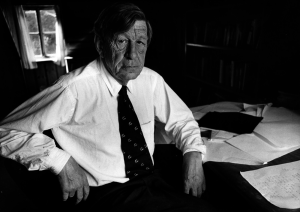
As a fan of Auden, I take the above characterization with great seriousness. The undermining of omniscience on the part of the narrator is also serious business, to which I will attend.

PHOTOGRAPH BY CECIL BEATON / CONDÉ NAST

Learning from the Greeks

5760This is what compassion for refugees looks like:

Pulitzer Prize winning photojournalist Daniel Etter, whose images from Kos touched the hearts of millions last year, returned to Greece this September to photograph the islanders who feature in the new documentary short Ode to Lesvos, created by Johnnie Walker® to shine a light on the inspirational acts of compassion shown in response to the refugee crisis.

Everyone who cringes from fear and/or accuses refugees should be embarrassed by the empathy and compassion of the people of Lesvos. But only for a moment. Then you should do the same.

How a Bill becomes a Law

un-apNo, not that one – but I love that one. This one, directed at Earthlings, named for our universe’s cultural heart and designed to avoid the worst:

the Paris climate agreement had passed a critical milestone toward adoption. At a UN General Assembly meeting in New York this morning, 31 nations officially signed onto the accord, making it very likely that the deal will enter legal force this year.

You may remember that the Paris agreement—an international pledge to limit us to 2 degrees Celsius of global warming, by weaning every nation off fossil fuels—was adopted at an international summit in December 2015. But before it can go into effect, it needs to be formally ratified by 55 countries that together account for 55 percent of global carbon emissions.

The accord received a major boost earlier this month, when the United States and China, two carbon behemoths that together account for nearly forty percent of global emissions, jointly announced their intention to ratify the deal. Before today, 27 other nations that collectively represent some 2 to 3 percent of global emissions had also signed on.

This is the tipping point we were looking for, to try to put off that other one. So many other wires have been tripped in setting off the renewable energy cascade, we might as well formalize the shift. Many difficulties still afoot and Team Fossil is going to fight even harder, but this is continued progress to be promoted and echoed.

Tilting a Unlevel Playing Field

exxon-cardChoose your metaphor, but on the other side of decades-long collusion charges, professional climate change deniers in Congress want answers about the groups, people and states with the temerity to seek answers:

Following a months-long standoff between the House Science Committee and state attorneys general conducting an investigation into Exxon over climate change denialism, Chairman Lamar Smith (R-TX) has called a hearing to affirm his right to subpoena the state officials overseeing criminal investigations.

Smith, a noted climate change denier, has made repeated demands that the attorneys general and several environmental groups turn over their communications about Exxon, accusing them of embarking on an “unprecedented effort against those who have questioned the causes, magnitude, or best ways to address climate change.” The attorneys general, as well as the activist groups, have refused to comply with the committee’s requests, setting up a battle over subpoena power.

In a June statement, the committee’s ranking member, Rep. Eddie Bernice Johnson (D-TX), said that Smith’s demands were “not about legitimate oversight,” but that the committee was “harassing” attorneys general investigating Exxon.

While Smith has previously conducted investigations into the executive branch and scientists funded by Congress, now the chairman has issued subpoenas to two state attorneys general conducting a criminal investigation. He made a wide-ranging request for communications the states had with each other, environmental groups, and the federal government about an “investigation or potential prosecution of companies, nonprofit organizations, scientists, or other individuals related to the issue of climate change.”

Can you say protecting the rights of the accused not to even be accused? Check the fine print in the Bill of Rights, I think we missed something. Oh, and Smith – chairman of the House Science Committee. Orwell was piker.

Back At The Front, The Next Generation

NRG freedomI think if I was setting a new story in Florida, inventing a needlessly fictional version of Florida Man, he would work in a [solar-powered] cabinet pull plant in Even, Florida:

So did the legislators underestimate the popularity of Amendment 4? Did they think they’d assuage public opinion by putting it on the ballot, getting points, and then it wouldn’t pass? Or have the green energy entrepreneurs begun out-lobbying the utilities and Big Oil? Whatever it is, something big has changed. That Amendment 4 was put before the public at all, and that the public trounced the lobbyists, announces a sea change in which sordid deals in back rooms by the Carbon Moguls with fresh-facced and clueless state senators are no longer determinative. The people are getting a say, and they want to make it easier and cheaper to go solar.
The next big item on which voters will get a say is Amendment 1, this fall. It seeks to punish those who opt for solar power on the specious argument that non-solar customers shouldn’t have to bear the burden of upgrading the electricity grid or other infrastructural changes that will come with the extra solar energy.

Who knows? Maybe it’s a bit different with that rising tide gently lapping at your chamber door.

Image: I can’t believe that image actually exists.

What does the Treaty of Guadalupe Hidalgo mean?

ghmapjpgFor the better part of a century, the southern US border was open, more or less, and people moved back and forth as need or desire dictated. From our friends at Balloon Juice, two maps and a few more words:

You’ll notice that on both the map prepared for the negotiations of the Treaty of Guadalupe Hidalgo and the Rural Health Information’s map of Hispanic or Latino population of the US based on the 2010 Census that the area that the US would get from Mexico in 1848 is still where the largest percentage of the Hispanic or Latino population of the US live. This doesn’t count south Florida, which has a different historic pattern of Hispanic settlement. What the patterns of settlement shown on the maps show us is that the border was moved on the map, but the pattern of settlement remained largely unchanged.

Reckoning with the reality of steady demographics in this vast region despite changing borders or enforcement regimes is a prerequisite to sustainable immigration policy. It will come as a great surprise to many people that we can have a population that loves the land even if they call it something different and/or the name changes from time to time. I know: shocking.