
Income inequality slowing growth

QE4PRight. Water is wet. Mud, muddy. Dirt, still dirty. In other news, when people don’t have money to buy things, people that make things aren’t able to sell things. This model is fully scalable to the global economy:

Think of an economy as a large network of individuals and firms who make and use things, interact and exchange with one another. Any party can, in principle, transact with any other, buying and selling, the only constraint being the budget of the buyer. Economists have studied network models of this sort — called random exchange economies — to explore how normal trading activity might (or might not) make an economy approach equilibrium.

Now some European physicists have used such a model to examine a different question: How does a significant change in inequality affect the overall level of exchange? Their study makes use of some fairly abstruse mathematics coming from physics, developed precisely for messy network problems of this kind. What they find is troubling, although not all that surprising — rising inequality tends to undermine exchange.

The reason is quite simple. As inequality gets more pronounced, a larger fraction of the population faces more stringent budget constraints, and the spectrum of possible economic interactions open to them narrows. Fewer people have the wherewithal to engage in economic activity. This mathematical economy actually demonstrates a sharp transition, akin to the abrupt freezing of a liquid, as the level of inequality exceeds a certain threshold. Worryingly, the wealth distribution in the U.S. over the past few decades has been moving ever closer to this critical edge.

When will it sink in that you don’t have to be a dirty socialist or believe that everyone should have exactly the same income (and color VW in the garage) to understand that beyond some point, income inequality becomes poison for the entire system. Capitalism can’t work without broad participation, without a diversity of exchange, without the possibility that people may rise into the sphere of [at least] middle class consumption. The 1% idea is not just rhetoric; it’s unhealthy economically as well as politically.

A Climate Change is here

planet warmiIf a climate changes and there’s not news about it, is a climate really changing?

2015 was a banner year for climate news. February, June, October, November, and December were each their respective hottest months on record, and 2015 shattered the record for hottest year. The pope delivered a climate encyclical. Investigative journalists at Inside Climate News discovered that Exxon knew about the dangers of human-caused global warming while it funded a climate misinformation campaign, and the New York attorney general launched an investigation into the company’s behavior. President Obama’s Clean Power Plan went into effect, and he rejected the Keystone XL pipeline. And most importantly, 195 countries agreed to cut carbon pollution as much as possible to stem global warming.

Despite all these critically important stories, as in the presidential debates, climate change was largely absent from US broadcast news. Climate coverage fell in 2015.

And even despite that, the answer of course is yes. And now scientists at the National Academy have confirmed that climate change and weather events can be connected. It’s as if now you know.. So what will you do?

Peak Demand?

Mount_McKinley_and_DenaliRemember PEAK OIl? I wrote about it many times, and heard about it even oftener. It seems the great malevolent equalizer that would be a de facto end to eh way we had run things for 100 years. What happened?

In summer 2014, Citigroup’s Edward Morse noticed that Saudi Arabia was offering its oil at lower prices than usual. Others reported the same, and it was inferred that, as OPEC’s leader, Saudi Arabia was suddenly out to push down the global price. And that is where it went—inexorably down. It was not clear how low it could go, although Morse had been forecasting for some time that it would average in the range of $65 to $80 a barrel by the end of the decade; now the plunge he foresaw seemed to be coming much, much sooner.
In effect, the Saudis had declared war on US shale. Then, in November 2014, the situation bode worse for the US-produced oil: The Saudis, meeting with fellow OPEC cartel members in Vienna, declared that US and other non-OPEC oil had to be driven out of the marketplace—the cartel as a whole had to go on a war footing. So it was that, led by the Saudis, OPEC, along with Russia, flooded the market with oil, leading prices to as low as $27 a barrel in January, a 77% drop from their peak in June 2014.

At least that. The pressure from renewables that would have seemed a pipe dream in 2004 has already mutated into something even stronger and perhaps more positive, as the technology cheapens individual investments in solar and wind. An enormous reckoning remains on the issue how far you live from work, groceries and schools, the 20-to-30-minute-drive-each-way on which our society and many of its problems are based. The fact that people didn’t see this coming, and that the Saudi’s are willing to sink the entire enterprise to stop shale oil should be instructional. How much of the environmental assessment from 2004 remains operable is an interesting point to ponder.

Lego my LIGO

Congratulations to the scientists at the Laser Interferometer Gravitational-Wave Observatory for the discover that confirms a fundamental premise of how gravity operates:

Albert Einstein’s Theory of General Relativity predicted gravitational waves 100 years ago. The theory states that gravity—the warping of space and time by mass—would manifest as ripples.
The waves detected by LIGO came from the collision of two black holes more than 1 billion years ago.
Physicists have long had indirect evidence that such infinitely tiny waves exist, but never had technology capable of detecting and measuring them. A gravitational wave is about 10,000 times smaller than the width of a proton.

You could say that the real work begins now, plotting out the next moves in this new direction. But that unnecessarily plays down the magnitude of this accomplishment. It took real work to get this far. 100 years later, Einstein was right. Now there’s a ripple.

Image: impression of a gravitational wave generation, via the BBC.

Too Solar to Fail

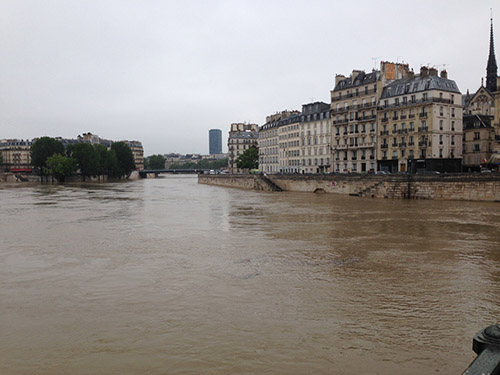
Following on the news that Paris is spending €1bn to revamp/fix/heal Les Halles comes more news that the City Of Light is getting even more serious about where that light gets it power:

paris

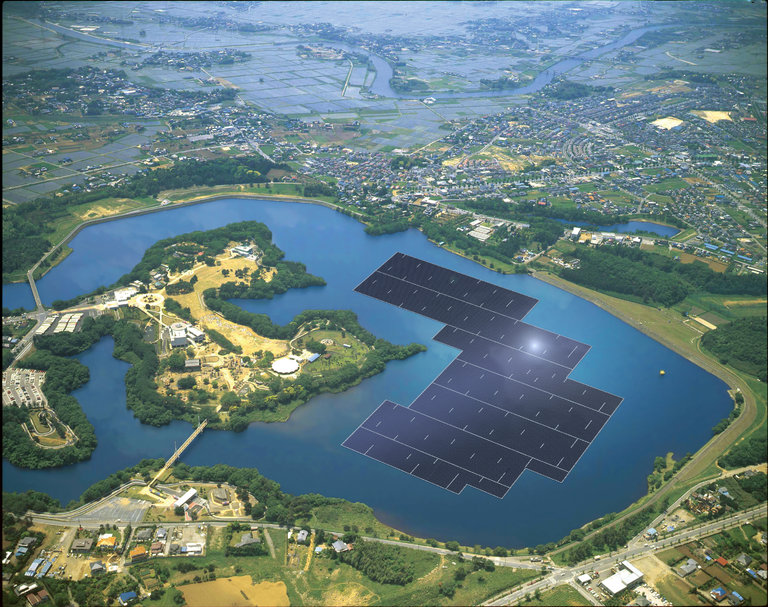
The French government plans to pave 1,000 kilometers (621 miles) of its roads with solar panels in the next five years, which will supply power to millions of people.

“The maximum effect of the program, if successful, could be to furnish 5 million people with electricity, or about 8 percent of the French population,” Ségolène Royal, France’s minister of ecology and energy, said according to Global Construction Review.

La route photovoltaïque indeed. 14 feet of solarized roadway would be enough to supply the electrical needs of one household. Way to go, Republique Francaise. Here,  take this road.

The Oscars’ Lack of Diversity

oscar_0Not exactly a punchy title but… my own reaction to the monochromatic handing out of the little gold guys doesn’t feel so cheeky.

Is it the lack of good movies with stars of color? Decent roles for any other than white actors? The more questions you attempt to formulate, the more perverse this choosy reality seems. I will agree that it is positive that consensus seems to be congealing around the fact that something is wrong with this picture these pictures. But still, why is it that in 2016 only white actors are being recognized for their efforts in mass-marketed motion pictures? Even writing that sounds intentional and stupid.

Are we putting too much on the Academy?

“We absolutely are. This is not really about the Academy. The Academy is a reflection and a symptom of a very deep problem in Hollywood and, I would say, in American popular culture generally. I am fortunate enough to do a lot of my work in Los Angeles. I go to many meetings at studios in L.A. and you see, by and large the decision makers at the top of departments and organizations are almost uniformly white and largely male as well. The demographics are not the only story. The key there is not just the color of people sitting behind important desks, it’s the thought process. It’s what are deemed important stories. It’s what are deemed merely entertaining stories. I think when ‘Straight Outta Compton’ was green-lit and produced, people saw it only as an entertaining movie, not as an important movie because it was only about a hip-hop group. As opposed to seeing it as telling a story about a defining chapter in recent American history, which it actually does. It’s not just about hip-hop, which is important in and of itself, but it’s about the Rodney King riots, racial conflict and police brutality and all of these things make it important. Same with ‘Creed’.”

SMH, as the kids say (walking out of the theatre).

Trivialized media

Compter-sur-les-mains-en-ChineIranian blogger Hossein Derakhshan was sent to prison in 2008 for what he had written and advocated for online. When he was released in 2014, the internet had greatly changed:

There’s a story in the Qur’an that I thought about a lot during my first eight months in solitary confinement. In it, a group of persecuted Christians find refuge in a cave. They, and a dog they have with them, fall into a deep sleep and wake up under the impression that they have taken a nap: in fact, it’s 300 years later. One version of the story tells of how one of them goes out to buy food – and I can only imagine how hungry they must have been after 300 years – and discovers that his money is obsolete now, a museum item. That’s when he realises how long they have been absent.

The hyperlink was my currency six years ago. It represented the open, interconnected spirit of the world wide web – a vision that started with its inventor, Tim Berners-Lee. The hyperlink was a way to abandon centralisation – all the links, lines and hierarchies – and replace them with something more distributed, a system of nodes and networks. Since I got out of jail, though, I’ve realised how much the hyperlink has been devalued, almost made obsolete.

The piece is full of pull quotes, so read the whole thing. How little we notice just how much social media sites and our use of them has changed is a tribute to the ingenuity of engineers in Silicon Valley. They think about this stuff all the time, so we don’t have to! But the punchline is… we do have to. Derakshan’s perspective is a stark reminder of just how limited the use of social media has made our world – all beneath the aegis of connecting, sharing and informing. Frogs eventually do notice the water boiling. It’s crucial to set the irony aside, and reset the way online convenience has conditioned us already.

There’s a resolution. Happy 2016.

Image: Count on your hands in Chinese

Grey Lady Blushes, Again

pointsourcepollutionThis will not get enough attention, but the source pollution problem at the New York Times, as Cholly Pierce so precisely put it, is a devious issue of national proportions:

As is now obvious, somebody fed the paper bad information on San Bernardino murderess Tashfeen Malik’s social media habits. It was said that she was posting jihadist screeds on Facebook. The Times hyped the scoop by stating pretty clearly that the government—and the administration running it—slipped up. It was the inspiration for endless bloviating about how “political correctness is killing people” at Tuesday night’s Republican debate. Then comes FBI director James Comey to say that, no, there were no public Facebook posts that the government missed because there weren’t any at all.

More than a few people have noted that two of the three reporters who were fed this story also had their bylines on the notorious (and thoroughly debunked) piece about how the FBI had launched a “criminal inquiry” into Hillary Rodham Clinton’s alleged mishandling of classified materials in her e-mails.

Of the Clinton emails non-story, she wasn’t a target, it wasn’t a criminal referral and the emails weren’t classified. Other than that, great story! And the thing is, even pointing out this makes one sound like an HRC apologist, but nevermind.

The broader issue is, this is the problem if we’re only going to allow ourselves one national paper. The purchase of the major Las Vegas daily by its hometown casino magnate-cum-Republican kingmaker is further symptomatic of this self-replicating double-bind. The news as business, scandal as profit generator, reporters trained in the finer arts of the same and quaint rules of journalism secure under glass at the few J-schools left all equal an untenable republic. Remember: No Checks = No Balances.