
 Interesting op-ed on a longitudinal study on religion and family life in America, which added the non-religious to observant and produces interesting findings that also come as no surprise:
High levels of family solidarity and emotional closeness between parents and nonreligious youth, and strong ethical standards and moral values that had been clearly articulated as they were imparted to the next generation.
“Many nonreligious parents were more coherent and passionate about their ethical principles than some of the ‘religious’ parents in our study,” Bengston told me. “The vast majority appeared to live goal-filled lives characterized by moral direction and sense of life having a purpose.”
My own ongoing research among secular Americans — as well as that of a handful of other social scientists who have only recently turned their gaze on secular culture — confirms that nonreligious family life is replete with its own sustaining moral values and enriching ethical precepts. Chief among those: rational problem solving, personal autonomy, independence of thought, avoidance of corporal punishment, a spirit of “questioning everything” and, far above all, empathy.
Again, this is only interesting and not a great surprise, unless you were convinced that heathens are, by nature, evil (one study-aid among many provided to you by one flavor of good book or another). And speaking of which, contrast this with the good-natured white nationalism of strong christian and Iowa congressman Steve King. How (rhetorical) does an adult human living in this country in 2017 believe in some kind of civilization that relies on demographic purity? Might it be a view emanating from, if not sanctioned by, very strong beliefs in Judeo-Christian tradition? Forgive the broad brush but come on – it almost seems like too much to be able to withstand such certainty. And no, there is no convincing this person or others otherwise. But there is calling them out as pathetic and racist, and that we must resolve to do.
 No need to resist this. From an interview with W.H. Auden, published in
 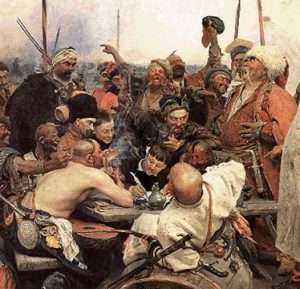 So… who ever thought The Cossacks Work for the Czar would become a literal trope? If you are keeping score at home, and really should be, the
  For a long time, I’ve thought that living in Republican-dominated states, especially in the South, was a form of being on the front lines – of racism, of anti-union sentiment, of hostility to immigrants and civil rights broadly construed. Even the lesser evils of being among people who feel over-taxed, persecuted for their (in every sense dominant) religious beliefs, sub-par infrastructure (no mass transit and the promotion of personal automobiles as priority transportation concerns) and general discomfort with the world as more people deservedly take their places in it, you are confronted with this it all up close. You know what it’s like and grow accustomed to fear and self-loathing as it leaks out everywhere among the shiny automobiles and neat, though increasingly sad [and appropriately named] subdivisions. After not too long, you begin to sense among the dominant political persuasion an uneasiness that borders on paranoia. The lack of confidence about the way things are going, despite the fact that they are in charge, is unmistakable and results in all kinds of frantic attempts
  There exists a misunderstood or mischaracterized mantra, if we will, that you cannot really succeed without the possibility of failure. And it would seem to make sense, though it is often enough forgotten how much trouble the very rich have over-compensating for the fact that they don’t feel legitimate in their own eyes. (There is a very good novel idea in there somewhere, and you get to it before me, good on you). There is also a specific case of sometimes, if green means that you win even if you lose, how were you
  How long will this last? How much can you take? Do you have a line that won’t be crossed? Do you have a budget for direct action?
 First of all Happy New Year and apologies for going blank for a while. We were hacked! And I’m not naming