
 In early September 2008, I drove down to Charleston to visit a cousin who had recently suffered a terrible accident. Throughout the drive I listened to extended public radio reports on an evolving calamity: the collapse of Lehman Brothers financial services firm. The horror that the government was going to allow such a large firm to go under was decorated with the baroque gadgetry of terms that would become more familiar in the coming years: credit default swaps, subprime mortgage lending, tranches, CDOs. The gore and detail of the cover that had been constructed around scams and fraud at the broadest level was audible in the voices of interviewers and guests. There was a tinge of disbelief within their attempts to explain what these terms meant and how they had gotten us all (!) into so much peril. It was as close to 1929 as we had come and potentially far worse – so extensively had the giant vampire squid of financial engineering welded its tentacles to every sector. Housing, banking, investing, construction, debt, bonds… this is business America now, and every other activity is vulnerable to its caprice. It was the stretch run of a presidential election as well; one candidate tried to suspend the campaign, the other fortunately tried to hold things together.
And he did mange to hold things together, despite rather obvious at the time challenges he personally faced. But the Lehman moment got everyone’s attention, everyone who mattered. $700 billion for Troubled Asset Relief (TARP), $250 billion for Capital Purchase(CPP), in addition to billions more in government-backed guarantees to individual banks. And eventually, in July 2010, the Dodd-Frank Wall Street Reform and Consumer Protection Act was enacted. It seemed the public assistance required to save the vampire from itself had sealed the argument in favor of financial reform.
Yesterday, the Republican House of Representatives passed the Financial Choice Act and can you guess what it does? Right! Overturns Dodd-Frank. And not only is it a bad idea to weaken a law that requires stronger banks,
The bill also offers the wrong kind of relief. During the last crisis, all kinds of financial activity — including insurance, money-market funds and speculative trading at banks — depended on government support. That’s why Dodd-Frank placed limits on banks’ trading operations and provided added oversight for all systemically important institutions, and why regulators require them to have enough cash on hand to survive a panic.
Those provisions aren’t perfect — simpler and more effective options exist — but the Choice Act just scraps them. What’s more, it would eliminate the Office of Financial Research, created to give regulators the data they need to see what’s going on in markets and institutions. The law would leave regulators in the dark, and taxpayers implicitly or explicitly backing much of the financial sector.
If you didn’t click, that’s coming from fcking Bloomberg. The financial industry doesn’t even think it’s a good idea. In trying to undo more Obama-era legislation, the know-nothings in Congress are re-setting the table for our financial catastrophe guests. Sure, certain things could make Dodd-Frank unnecessary. But unfortunately, none of the thousands of people, firms, funds and frauds who populate this sector care about a stronger financial system or its being more competitive. It’s the logic of business – the democracy, whiskey, sexy of fools.
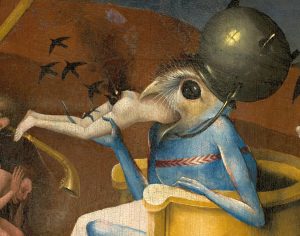
Image: Detail from The Garden of Earthly Delights, by Hieronymus Bosch, ca. 1500
 The stupidity of millions, millions of individually stupid decisions, has brought a spiteful revolution to its denouement. Or a screaming kid to its mall, whichever you prefer.
 In tribute to the great
  “That’s right, Robin.”
 Like smartphones teach us to be dumb – to not know things, to not be able to find our way except by using the device – we are also learning how to forget the past. Or how to remember it inaccurately, disconnected from the forks in the road where our path darkened and we lost something irretrievable, something we did not make nor deserve but that came from us and birthed us, was us, the best and the worst, that pushed us in the right direction because we were scared to go on our own until we learned we could pull ourselves there if we could just join enough hands.
 Interesting op-ed on a
 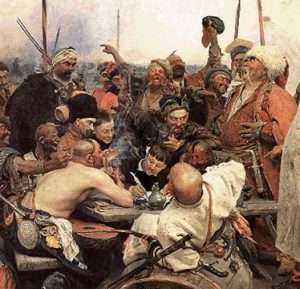 So… who ever thought The Cossacks Work for the Czar would become a literal trope? If you are keeping score at home, and really should be, the
  For a long time, I’ve thought that living in Republican-dominated states, especially in the South, was a form of being on the front lines – of racism, of anti-union sentiment, of hostility to immigrants and civil rights broadly construed. Even the lesser evils of being among people who feel over-taxed, persecuted for their (in every sense dominant) religious beliefs, sub-par infrastructure (no mass transit and the promotion of personal automobiles as priority transportation concerns) and general discomfort with the world as more people deservedly take their places in it, you are confronted with this it all up close. You know what it’s like and grow accustomed to fear and self-loathing as it leaks out everywhere among the shiny automobiles and neat, though increasingly sad [and appropriately named] subdivisions. After not too long, you begin to sense among the dominant political persuasion an uneasiness that borders on paranoia. The lack of confidence about the way things are going, despite the fact that they are in charge, is unmistakable and results in all kinds of frantic attempts
  There exists a misunderstood or mischaracterized mantra, if we will, that you cannot really succeed without the possibility of failure. And it would seem to make sense, though it is often enough forgotten how much trouble the very rich have over-compensating for the fact that they don’t feel legitimate in their own eyes. (There is a very good novel idea in there somewhere, and you get to it before me, good on you). There is also a specific case of sometimes, if green means that you win even if you lose, how were you
  How long will this last? How much can you take? Do you have a line that won’t be crossed? Do you have a budget for direct action?