Good for Business

According to a non-profit that runs a global disclosure system for investors, companies, municipalities and even regions, companies taking strong climate action rose 46% just in 2020. Those rated highly by the nonprofit for their climate disclosures gained 5% more in the stock market than their peers over the past seven years.

And yet, the Nature Conservancy has gone old-school Papal, selling indulgences to companies to absolve them of their climate sins:

The Nature Conservancy recruits landowners and enrolls its own well-protected properties in carbon-offset projects, which generate credits that give big companies an inexpensive way to claim large emissions reductions. In these transactions, each metric ton of reduced emissions is represented by a financial instrument known as a carbon offset. The corporations buy the offsets, with the money flowing to the landowners and the Conservancy. The corporate buyers then use those credits to subtract an equivalent amount of emissions from their own ledgers.
The market for these credits is booming, according to BloombergNEF, a clean-energy research group. In the first 10 months of this year, companies used more than 55.1 million carbon credits to offset their emissions (equivalent to the pollution from 12 million cars), a 28% increase from the same period in 2019. While some of these credits are paying for projects that are truly reducing emissions, an unknown number represent inflated claims.
Few have jumped into this growing market with as much zeal as the Nature Conservancy, which was founded 69 years ago by a small group of ecologists seeking to preserve the last unspoiled lands in the U.S. In the seven decades since, the nonprofit in Arlington, Va., has grown into an environmental juggernaut, protecting more than 125 million acres. Last year its revenue was $932 million, which eclipsed the combined budgets of the country’s next three largest environmental nonprofits.

“For the credits to be real, the payment needs to induce the environmental benefit,” says Danny Cullenward, a lecturer at Stanford and policy director at CarbonPlan, a nonprofit that analyzes climate solutions. If the Conservancy is enrolling landowners who had no intention of cutting their trees, he adds, “they’re engaged in the business of creating fake carbon offsets.”

Barbara Haya, research fellow at the University of California at Berkeley, has studied these types of carbon projects for almost two decades. “We just don’t have time for false offsets that take credit for reductions that were already happening anyway,” she says.

Trees are extraordinarily important, but selling protected forests multiple times as carbon offsets is a phony practice. The wordplay around potential de-forestation and the urgency of doing more about a burning planet create a perfect field for corporate skullduggery. An environmental ledger, per se, that allows for continual stacking on both sides does little other than perpetuate the tried-and-false bottom-line thinking by corporations. They/we are going to actually have to do the hard stuff – slow boats, sun-powered planes, more density, more trains – to reduce net emissions. Real reductions, not carbon deals. Carbon offsets may once have been an easy way toward ‘doing’ something about climate change, but it is time to move away from them.

For I can raise no money by vile means*

Nobody has more contempt for Republican voters than professional Republicans:

The Trump campaign has been unrelenting in recent days with its all-caps, bold font, exclamation-point-ridden fundraising appeals: “THE DEMOCRATS WANT TO STEAL THIS ELECTION!” “We can’t allow the Left-wing MOB to undermine our election.”

They urge supporters to make donations to President Donald Trump’s election integrity defense, to ensure he has the “resources” he needs to keep the election from being “stolen.”

In the fine print of the fundraising blasts, it lays out that 60 percent of the contributions will first go to the new PAC, up to the maximum contribution of $5,000. The remaining 40 percent goes to the RNC up to the maximum $35,500. If that first 60 percent of the donation exceeds $5,000 the remnants go to the campaign’s “recount account”; if the 40 percent exceeds the $35,500 RNC maximum, only then does it go to the RNC’s legal defense fund.

That story was three weeks ago. By now they have raised more than $170m and it’s difficult to characterize as anything other than a nice haul. It can also be a struggle to sympathize with the donors, as it has always been:

The new NRA disclosures appear to constitute a formal admission of financial mismanagement, which the gun group had denied under months of mounting pressure. In August, following a lengthy investigation, Letitia James, the Attorney General of New York, filed a civil suit seeking to dissolve the organization, alleging the NRA had grown rotten from “a culture of self-dealing, mismanagement, and negligent oversight.” To James’s mind, LaPierre’s repayment represents a drop in the bucket. She told the Post that the $300,000 is “just a fraction of the millions he personally profited from,” and she accused LaPierre and his deputies of having raided “NRA coffers to fund lavish lifestyles that included private jets, pricey vacations, expensive meals and no-show contracts.” The Wall Street Journal recently reported that LaPierre is being investigated by the IRS for “possible criminal tax fraud related to his personal taxes.” LaPierre declined to comment to the Post.

We might call this Green brutality, because nothing reveals the vulnerable like the willingness to sell their fears back to them.

* For I can raise no money by vile means.
By heaven, I had rather coin my heart
And drop my blood for drachmas

Shakespeare, Julius Caesar, Act IV, Scene III

Kangaroo Democracy

Republican office holders and the people who support them do not want a functional country, much less a functional constitutional democracy. We can keep asking them if this is their final answer, they will keep voting for con men and flimflam artists.

The country they want, indeed the country they made sure we would have four years ago, had 148,302 COVID-19 cases two days ago, more then 130,000 each of the two days prior. This is what they wanted, this is what we have.

Now what do they want? Go back to normal, Pandemic be gone, don’t steal the election they lost, celebrate your positive test… the idiocy knows no bounds. It does know an end. We are at the beginning of that end now with Trump’s countdown to disinfection at 1600 Pennsylvania Ave.

The people in our lives who seek to continue to be part of this dysfunctional cohort – wanting it all to continue, wanting some of it (the mask parts) to end – what do we do with them? Ignoring this malignancy does not work; ignoring their part in it may keep the peace at the holidays… but we won’t have the usual Thanksgiving this year. They made sure of that. This current episode was avoidable, they made sure we didn’t, no siree. There is a direct consequence to selling out your vote and your country to a racist ignoramus not interested in anything outside of his personal benefit. This is one of them; unfortunately, there are also many more.

We can take heart in the events of the last week, but we’ve got to remember all of them. Republican voters have put us all in their boat, even if it feels like we finally have enough oars in the water to row to a better shore. Remember this effort, all the work it takes, and that they want it to fail. Unless or until they prove otherwise, they must be considered a danger to themselves. They must be considered in favor of a country that ignores recognized standards of law and justice, one that holds no standing outside of fearful, closed minds. They have warned us. They want a kangaroo republic – to leap over the facts and people they don’t like, to live a fantasy yesteryear, reciting incantations to conjure divine rights.

Meanwhile, let’s get more oars in the water. Everybody row.

Who’s the sucker?

Or, in the case of facebook, if you can’t tell what the product is – it’s you:

Facebook is the prime online, global incubator of racist, quasi-fascist propaganda, conspiracy theories, state-run psyops and agit-prop operations, even in at least one case actual state-backed programs of population transfer and arguable genocide. But to really understand the problem with Facebook we need to understand the structural roots of that problem, how much of it is baked into the core architecture of the site and its very business model. Indeed much of it is inherent in the core strategies of the post-2000, second wave Internet tech companies that now dominate our information space and economy.

Facebook is an ingenious engine for information and ideational manipulation. Good old fashioned advertising does that to a degree. But Facebook is much more powerful, adaptive and efficient. That’s what all the algorithms do. That’s why it makes so much money. This is the error with people who say the fact that people do bad things with Facebook is no different from people doing bad things with phones. Facebook isn’t just a ‘dumb’ communications system. It’s not really a platform in the original sense of the word. (The analogy for that is web hosting.) Facebook is designed to do specific things. It’s an engine to understand people’s minds and then manipulate their thinking. Those tools are refined for revenue making but can be used for many other purposes. That makes it ripe for misuse and bad acting.

As Josh says, fB is in the middle of another round of bad publicity and they deserve every bit of it. Obviously also another meaning of being green, but we CAN learn, get older and [a bit] wiser.

And speaking of TPM and green, find some good media you trust and pay for it. Support it. Help it exist. TPM is a good one that I’ve read for many years now. But don’t believe me, go check it out for yourself. Hit ’em up.

Image via.

Record melt of Greenland ice sheets in 2019

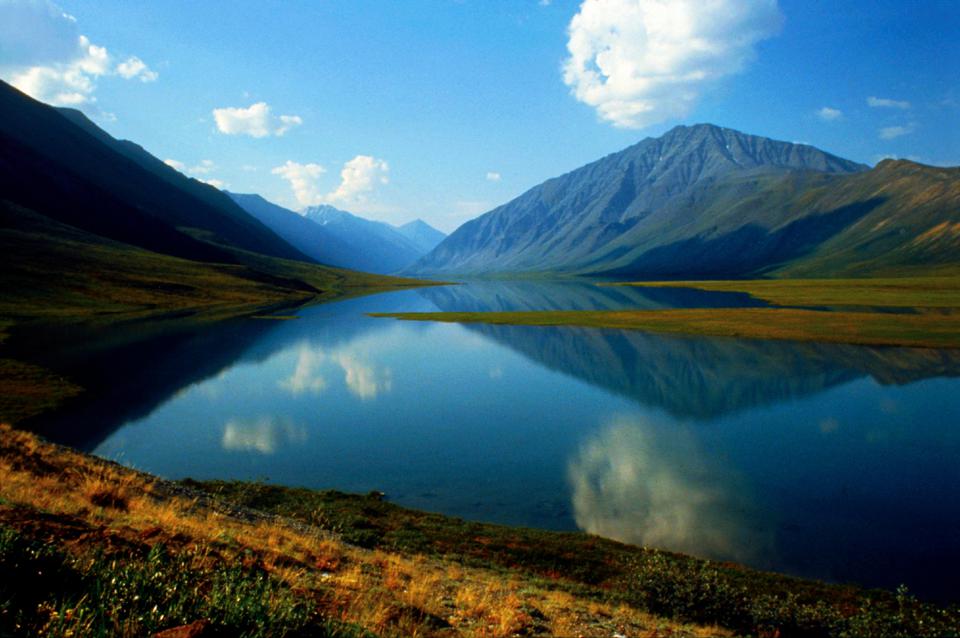
Alaska, Arctic National Wildlife Refuge, ANWR, the Narrows from Schrader to Peters Lake.

After a two-year slowing period through 2018, Greenland’s ice sheet lost a record amount of mass last year, according to a study published on Thursday:

That loss of 532 gigatons of ice – equivalent to about 66 tons of ice for each person on Earth – was 15% more than the previous record in 2012.

Greenland’s ice melt is of particular concern, as the ancient ice sheet holds enough water to raise sea levels by at least 20 feet (6 meters) if it were to melt away entirely.

The study adds to evidence that Greenland’s icy bulk is melting more quickly than anticipated amid climate warming. Another study last week indicated the island was no longer getting enough annual snowfall to replace ice lost to melting and calving at the glaciers’ edges.

“We are likely on the path of accelerated sea level rise,” Sasgen told Reuters. “More melting of the ice sheet is not compensated by periods when we have extreme snowfall.”

The study, published in the journal Communications Earth & Environment, used data collected by satellites to the gravitational force of the ice mass, which scientists can use to calculate how much snow and ice is locked within.

Other research has shown the melting is being helped by water pooling atop the ice and at meltwater streaming between the ice sheet and the bedrock beneath.

These studies are helping scientists refine their projections of how climate change will impact the Arctic, and how quickly. Sasgen compared the sobering process to getting difficult news from a doctor.

“It’s always depressing to see a new record,” Sasgen said.

But the studies offer insight into “where the problem is, and you also know to some extent what the treatment is,” Sasgen added.

Emphasis added, good grief. We know what we need to do, and if we reduce CO2 to limit global warming, then all these other concerns including sea level rise and ocean acidification can also be reduced.

But of course,

the Department of Interior approved plans to open ANWR, the Arctic National Wildlife Refuge, for leases to drill for oil

Event though, “At current and foreseeable oil prices, the industry’s appetite to drill in ANWR will be exceptionally low and quite possibly will be zero.” So we know what we need to do. Vote – by mail, carrier pigeon, with your honey, whatever it takes.

Image: Via Getty Images.

Never having to say you’re sorry

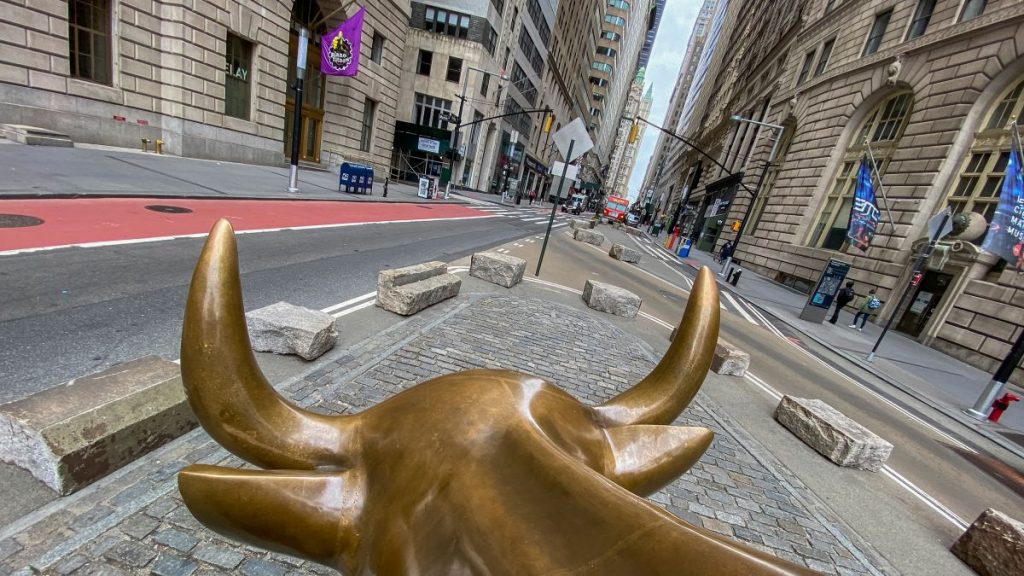
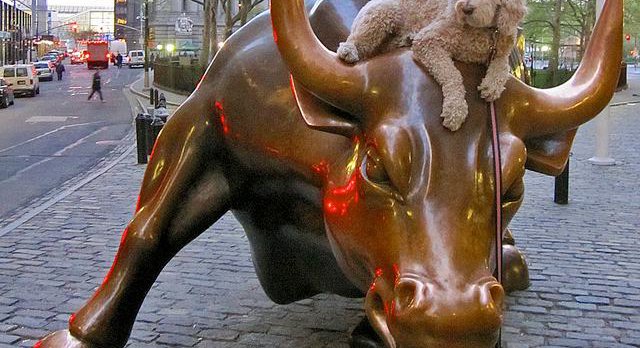
bull's eye view photo

For Wall Street, that’s what it means apparently. Torn over whether a Biden win brings joy or misery. Really.

Those with the rosier outlook point to Biden’s mostly pro-business inner circle, his significant campaign contributions from the financial industry and his longtime support of credit card companies located in his home state of Delaware. Plus, a Biden victory would likely be driven by U.S. voters seeking change because they believe the country is a mess. Wall Street thinks it has a strong argument to make that reining in lenders would be a fatal mistake when unemployment is sky-high and the economy remains ravaged by the coronavirus pandemic.

The enthusiasm, however, is tempered by fears over how much sway Biden will give progressives and their firebrand leaders, including Senators Elizabeth Warren and Bernie Sanders. That’s especially true when it comes to picking appointees to run the powerful agencies that police banks and securities firms, jobs that the activists are mobilizing to fill with industry critics. At a minimum, progressives want to ensure that the days are long over when Democrats appointed officials like Robert Rubin, Timothy Geithner and Lawrence Summers, who is a key Biden adviser.

The stakes for Wall Street couldn’t be higher. Centrist regulators would be less likely to overturn rule rollbacks approved under Trump that have saved financial firms tens of billions of dollars. Progressive agency heads, on the other hand, could pursue what the C-suite calls the “shame and investigation agenda.” Policies like taxes on trading, curbs on executive pay and even breaking up behemoth banks would be back on the table.

To wonder whether ‘Wall Street’ has some understanding of our current morass, much less the words ‘joy’ or ‘ misery,’ is to weep. Of course they do. Always check the business press if you’re wondering at all about the soul of a consumer society. Mantra for post-2016 world: it’s always worse than you think.

Image: Replica golden calf. Subtlety is NOT their strong point.

Patience or patients

The good news wrapped in the bad: COVID-19 seems to mutate slowly enough that a vaccine could be available by yearend or early 2021.

Opening schools for in-person instruction, at every level, would seem best AFTER that time. Do we have the ability/courage/wisdom to wait it out? Only complete answers accepted. Show your work.

Image: Plants listening to Puccini in Barcelona, via the Guardian.

Powering Down

Necessarily ambitious climate targets to meet the Paris Agreement goals earlier must actually be designed to surpass them. As we’ve said often these efforts are results of broad collective action, by governments:

The centerpiece of Leonore Gewessler’s plan is a radical revamp of Austria’s public transportation networks, giving residents nationwide access to buses, trains and subways for a flat yearly fee that works out at 3 euros ($3.38) a day, encouraging citizens to leave their cars at home. Austria’s minister for climate, energy and transportation policy, is drafting new laws that’ll redistribute billions of euros toward more ecologically-friendly activities in the euro area’s sixth biggest economy.

“That’s the project that is very dear to my heart,” said Gewessler in her first interview in her ministry since the outbreak of the Covid-19 pandemic. Road traffic remains a “key concern” for Austria to meet its goal of reaching climate neutrality by 2040—a decade earlier than the target set by the European Union.

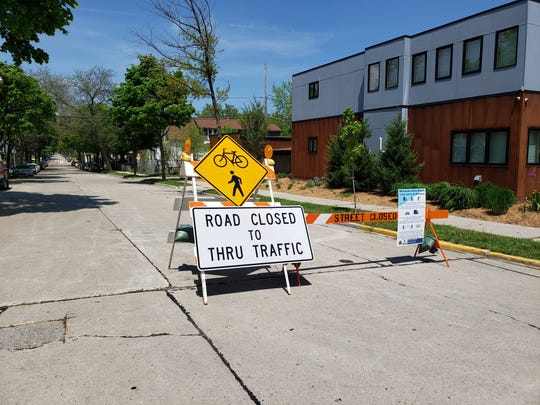
Note when this is happening – now. Even and especially during the pandemic. The localities we’ve heard about where streets have been restricted to pedestrian-only traffic requires another couple of steps to complete the process. Paired with (cheap!) alternative transportation options, this will seem like another thing we just had to do. (Narrator: Because. It. Is.)

Image via the Milwaukee Journal Sentinel

[Night on] Earth Day

Let’s just take a look back at this little episode, shall we? Yes, we shall:

A massive deepwater oil spill is nearly as likely today as it was in 2010, experts warn, 10 years after the disastrous explosion of BP’s rig in the Gulf of Mexico that caused an environmental catastrophe.

The blowout killed 11 workers and spewed 4m barrels of petroleum into the ocean for 87 days before it could be capped, devastating marine life and polluting 1,300 miles of shoreline. Thousands were put out of work in oil, fisheries and tourism.

But experts say an incident of similar scale could happen again and has been made more likely by the Trump administration’s decision to loosen Obama-era safety rules. Those standards had grown from an independent commission’s damning findings of corporate and regulatory failures leading up to the spill.

Frances Ulmer, who served on the commission and is a visiting fellow at Harvard’s Kennedy School, said the government and industry have not made sufficient changes to prevent or respond to another mammoth spill.

Sufficient changes. Just what might those those be? It isn’t me walking to work (I do), or building a solar charging station for the car (we are). Those things are those things and they make my life better as they ease some pollution in my local community. But they’re not going to save anything – only collective action will do that. Governments working together to re-assert control that has been systematically ceded to corporations for the purpose of pillage and profit. Reigning in the unaccountable and including the costs of externalities in the price of everything we can buy are the things that will begin make a difference. The reduced economic activity of the past six weeks should give us a little hint of what is required if we had to cram for the test. If we [all] decided to start studying a little everyday, it would mean different political leaders, building codes, transportation alternatives, land development regulations, and prices than the ones we have today. How many of these are possible in the near term?

There’s an election in November.

Image: A man lays oil-absorbent boom as oil from the Deepwater Horizon oil spill impacts Cat Island in Barataria Bay, Louisiana, in 2010.
Photograph: Gerald Herbert/AP

Also possible without needing a pandemic

NASA and European Space Agency (ESA) pollution monitoring satellites have detected significant decreases in nitrogen dioxide (NO2) over China. There is evidence that the change is at least partly related to the economic slowdown following the outbreak of coronavirus.

At the end of 2019, medical professionals in Wuhan, China, were treating dozens of pneumonia cases that had an unknown source. Days later, researchers confirmed the illnesses were caused by a new coronavirus (COVID-19). By January 23, 2020, Chinese authorities had shut down transportation going into and out of Wuhan, as well as local businesses, in order to reduce the spread of the disease. It was the first of several quarantines set up in the country and around the world.

The maps on this page show concentrations of nitrogen dioxide, a noxious gas emitted by motor vehicles, power plants, and industrial facilities. The maps above show NO2 values across China from January 1-20, 2020 (before the quarantine) and February 10-25 (during the quarantine). The data were collected by the Tropospheric Monitoring Instrument (TROPOMI) on ESA’s Sentinel-5 satellite. A related sensor, the Ozone Monitoring Instrument (OMI) on NASA’s Aura satellite, has been making similar measurements.

“This is the first time I have seen such a dramatic drop-off over such a wide area for a specific event,” said Fei Liu, an air quality researcher at NASA’s Goddard Space Flight Center. Liu recalls seeing a drop in NO2 over several countries during the economic recession that began in 2008, but the decrease was gradual. Scientists also observed a significant reduction around Beijing during the 2008 Olympics, but the effect was mostly localized around that city, and pollution levels rose again once the Olympics ended.

It doesn’t take a disaster or even an emergency – beyond the one we have already created with the usual emissions levels. Reductions are possible. Disasters and loss are not mandatory, though we do make them inevitable to some extent by doing nothing. Still, these dramatic images should be instructional about what’s possible. It would be interesting to know the near-term implications of these reductions. You know, science.