Whither Philanthropy?

Uncomfortable proximity to double entendre notwithstanding, the heading of philanthropic fundraising and grant-making is very much in question, if not doubt. As we barrel into the climate crisis while finding out just how much representative democracy we can do without, who is funding what and how?

I spoke with Ellen Dorsey, executive director of the Wallace Global Fund last week following the fund’s announcement that it would spend down its endowment to zero in the face of urgent societal challenges. She hits many great points – among them, what is perpetuity in a burning world?

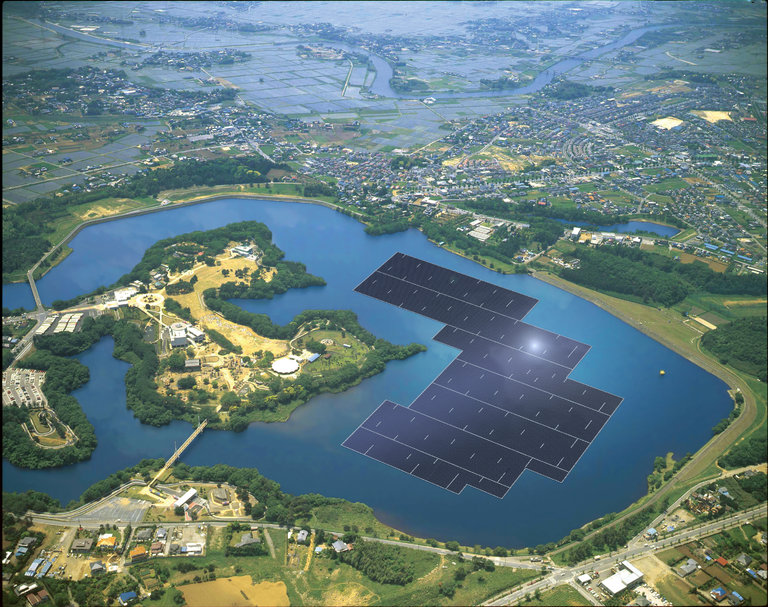
Floating Solar

SOLAR-masterThe next innovation in solar power capture is here there:

But floating solar arrays are becoming more popular, with installations already operating in Australia and the United States, and more planned or under construction.

The growing interest is driven in part by huge growth in the solar market in recent years as the cost of the technology has dropped quickly.

Floating solar arrays — they are often referred to as “floatovoltaics,” a term trademarked by one company — also have advantages over solar plants on land, their proponents say. Renting or buying land is more expensive, and there are fewer regulations for structures built on reservoirs, water treatment ponds and other bodies of water not used for recreation. Unlike most land-based solar plants, floating arrays can also be hidden from public view, a factor in the nonprofit Sonoma Clean Power Company’s decision to pursue the technology.

The floating arrays have other assets. They help keep water from evaporating, making the technology attractive in drought-plagued areas, and restrict algae blooms. And they are more efficient than land-based panels, because water cools the panels.

“The efficiencies are what motivated us to look at this,” said Rajesh Nellore, the chief executive of Infratech Industries, which has completed the first section of a floating solar plant in Jamestown, Australia, that will eventually cover five water treatment basins.

And evidently, fish love them. The anti-evaporation properties alone are the worth the ticket. Plus: energy. Let’s rip up the freeways, build spill ways and fill ’em up with PV cells.

Too Solar to Fail

Following on the news that Paris is spending €1bn to revamp/fix/heal Les Halles comes more news that the City Of Light is getting even more serious about where that light gets it power:

paris

The French government plans to pave 1,000 kilometers (621 miles) of its roads with solar panels in the next five years, which will supply power to millions of people.

“The maximum effect of the program, if successful, could be to furnish 5 million people with electricity, or about 8 percent of the French population,” Ségolène Royal, France’s minister of ecology and energy, said according to Global Construction Review.

La route photovoltaïque indeed. 14 feet of solarized roadway would be enough to supply the electrical needs of one household. Way to go, Republique Francaise. Here,  take this road.

Two Invisible Hands Clapping

Even scienticians agree: the modest new goals of the new EPA plan for clean power are only making official what the invisible has been waving through like a naked [invisible] traffic cop:

_CLAPOur best hope for carbon reduction is steep price drops in the cost of generating electricity by wind and solar; in the cost of installing wind turbines and solar panels; and in the cost of storing energy in batteries. If those price drops are achieved, we’ll head toward vast reductions in emissions regardless of what the EPA does. No one is going to pay 12 cents a kilowatt hour for electricity (our current national average) if it can be had for 2 cents a kilowatt hour, all other things being equal.

Coal-use as the source of electricity has been trending downward for a while, for many reasons, and as long a modest rule-making [see Cole’s discussion above] keeps sending signals to the invisible hand, it will continue to do so. But, crappy analogy aside, the bigger news in the in the new rules is the commitments to clean energy R & D. That, coupled with reductions for carbon emissions from power plants will leverage even more research and new businesses to sprout. Even silicon itself will be replaced with cheaper alternatives that bring the price down for solar panels. I remarked to my passengers on a recent road trip down a super bright hot interstate highway that I couldn’t believe we weren’t using all of that glarea [get it?] to generate electricity and connect every city along the way with the power it soaks up on a daily basis. The same goes for the waves that pushed us around along the shore over a clear, windy weekend. Whatever the technological difficulties in doing either of these, let you remind me that we just saw pictures from a space probe we sent to Pluto ten years ago.

That was a year before the first iPhone.

Teaser image: The Beach, Sunset, Gustave Courbet, 1867

Disconnect on Energy

Back from the sunny Med. Where to begin? There is all kinds of stuff, but K at BJ had a really good post on local municipal utilities, even in conservative areas, breaking away from the nationalized ALEC propaganda about alternative energy, doing their own thing, saving money and generally moving ahead smartly:

Just 10 weeks after breaking ground, construction of Bryan Municipal Utilities’ solar generation project has been completed, and power is being supplied to Bryan’s electrical grid.
BMU broke ground for the $7.42 million solar array in early December 2011. By mid-January 2012, all 23,530 solar modules were in place, and by the first week of February, the solar plant was fully operational.
“The solar arrays are producing just as expected, and we have seen them perform up to the maximum capacity of 1.8 megawatts on sunny days,” said Steve Casebere, director of utilities.
As of February 13, the solar field has produced 100 MWh, which means it has also produced 100 solar renewable energy credits. BMU sold 2,500 solar RECs produced in 2012 to American Electric Power and Duke Energy for $606,500.
In addition to the power and energy credits, what the solar plant does not produce is valuable. With the energy produced to date, the solar field has saved 76 tons of carbon dioxide and 3.6 tons of methane gas emissions.

Meanwhile, as she says, conservative and libertarian lobbyists dig in against these and other success stories.

Solar power becoming cheaper than ______

So what does it mean when solar power generation starts to become cheaper than fossil fuel power? Via, Juan Cole, looks like we’re about to find out:

In a note this week in advance of the disruption report, Citi’s Jason Channell said that in many cases, renewables are already at cost parity with established forms of electricity sources.

The biggest surprise in recent years has been the speed at which the price of solar panels has reduced, resulting in cost parity being achieved in certain areas much more quickly than was ever expected; the key point about the future is that these fast ‘learning rates’ are likely to continue, meaning that the technology just keeps getting cheaper.

Below is a chart showing where “socket” or grid parity has already been achieved. (Grid parity is when a source of power becomes cost competitive with other sources.) The lines represent the pattern of expanding solar power in a given year — so at peak solar exposure, parts of the southwest U.S. are now already capable of meeting their electricity needs via solar panels.

Check out the graphs at both of those links. Cole also notes that important new research shows that hybrid power plants that have both solar and wind turbines dramatically increase efficiency and help with integration into the electrical grid. So while TV viewers have been distracted by herrings like Solyndra, utilities and leaders in other countries have been racing this technology to market. This is the dull edge of being led by a media-politico complex beholden to corporate paymasters, of having a nation that thinks of themselves as consumers instead of citizens. We have debates on the causes of global warming that are completely beside the point. Our giant corporations aren’t even acting like good capitalists, but rather fearful protectors of dying industries – maybe that’s the same thing. But they’re perfectly willing to string along as much of the public as possible for as long as they can, by sowing as much doubt as is possible about changing the ways we light up the night, drive to the store and cool our heels. Meanwhile, in other parts of the world: lower bills, lower carbon emissions, now types of manufacturing and careers… But not here – not just yet. And all just to wring every last bit out of the old ways of doing business. It’s beyond pathetic.

But this is what we have handed over to America, Inc. This is their leadership, and instead of innovation, we will begin to are hearing about how we need to protect fossil utilities when demand from their product collapses. Not kidding. They see renewable energy as a threat. so as this happens, the expected reaction of the fossil power industry resembles some version of the 5 stages of mourning.

So can we get on with the anger and bargaining, please?

Solar all night

I’m usually pretty hard on CNN, and they always deserve it, despite the many fine people in their employ. So here’s an attaboy, CNN.

Gooooaaaaaalllll!

brazil-wind-turbines

A new national 10-year plan from Brazil shows that the country will triple its use of renewable energy by 2020 and that a lot of that energy will be wind energy.

Going from 9 GW of wind, biomass and small hydropower in 2010, the country intends to hit 27 GW by 2020. It wants to have 16% of its electricity supply coming from renewables in 10 years.

On wind energy, the country hit the 1 GW milestone in May but plans to get to 12 GW by 2020. Last year’s 10-year plan only had the country getting 6 GW from wind by 2019, so you can see that the country is really stepping up its wind energy goals.

Source: Clean Technica (http://s.tt/12CMD)

By comparison, renewables met 8% of total energy demand in the U.S. during 2009 and 10% of total electricity generation. We don’t expect to hit the 17% mark until 2035. Which is not a goal, but more like a foul.

Photo-voltaic Impasse

Might have been broken.

Photovoltaic (PV) efficiency is a significant problem for today’s commercial solar panels, which can collect only a theoretical maximum of about 30 percent of available light. Now, a team that includes a University of Missouri engineer is developing a flexible solar film that can theoretically capture more than 90 percent of available light. Prototypes could be produced within the next five years.

Patrick Pinhero, an associate professor in the MU Chemical Engineering Department, says energy generated using traditional photovoltaic methods of solar collection is inefficient and neglects much of the available solar electromagnetic (sunlight) spectrum. The device the team is developing — essentially a thin, moldable sheet of small antennas called nantenna — is designed to harvest industrial waste heat and convert it into usable electricity. Their ambition is to extend this concept to direct solar facing nantenna devices capable of collecting energy broadly from the near infrared to the optical regions of the solar spectrum.

90% is much more like it. High-speed electrical circuitry. Inexpensive manufacturing processes. This is not being saved by technology so much as using engineering to break the problem down into manageable fragments until it’s no longer a problem and more of way to do what we want – harvest as much energy as possible for the sun.

Moving on to renewable energy sources can be done – and need not been seen or thought of a desperate last gasp/final hope but the natural of progression of technology and its uses that our subservience to fossil energy sources has for so long stymied. Departments of Energy whose first loyalty is to oil and gas industries will not provide the necessary R & D investments in replacing the same. This kind of research takes a lot of money, time and expertise – but the payoffs will be enormous. I’m looking at you, coal, in the rear view mirror.

Via IC.