Solar Eclipse

As seen from Yinchuan. Newscom/SIPA photo, via TPM

The Path of Totality

At sunrise on July 22, 2009, (the evening of July 21 PDT), the moon’s umbra—the cone-shaped part of the moon’s shadow—will fall on India’s Gulf of Khambhat. The shadow will sweep across Asia and the South Pacific before leaving the earth near the Marshall Islands about 3½ hours later. The path of totality will cover a distance of approximately 9,500 miles (15,200 km). The maximum duration of totality is an exceptionally long 6 minutes and 39 seconds, which will come while the shadow is over the Pacific.

Talk about your open source entertainment.

The Wow and the Now

New thematic posting alert, and I can’t promise this isn’t a slacker work-around to something a little more considered and original.

Nonetheless, two of the integrated sensations of living in our present age are the often-overlapping phenomena of “Wow, that’s amazing,” and “Now they tell us!” You can decide which is which.

Examples A-D:

A patent-pending device by which you can project your own bike lane.

Ant mega-colony has colonized much of the world, without becoming indifferent or uncivil to one another.

Having sex daily is the key to fertility.

A solar cell that can be tuned to the light of a particular latitude.

* * *

WDGM.net – combining exasperation with excitement since sometime last spring.

outta site

So here’s a nice idea from this guy in Norway about how to charge your batteries with the sun, complete with pictures. While the set-up is somewhat amateurish, I like the tone of we should be able to do this. Indeed we should. And not just this.

This was courtesy of this site, which was sent my way by mrs. green and is far more up our alley and not just because it’s in french. Poke around and see what you see. Don’t miss the two-year-old housekeeper.

Local motion

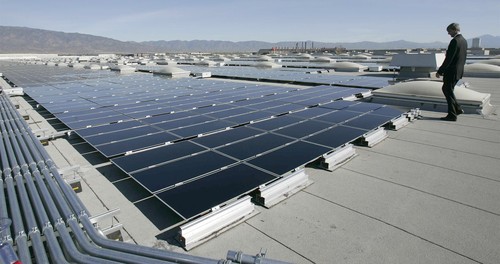
On the energy front, that is. LA Times lays out the situation of subsidized commercial rooftop solar vs. private investment. Much of the action is going to be on the regulatory front.

Consumer activists object. They say Edison should be looking to cheaper sources of renewable power, such as large solar and wind farms and geothermal plants. They contend that Edison International shareholders, not utility ratepayers, should finance the company’s huge bet on photovoltaic rooftop solar, one of the most expensive forms of clean energy.

An independent advocacy group has asked the Utilities commission to reject the ratepayer-financed plan, fearing unfair advantage over private sector entrepreneurs. But isn’t it the case that if the Edison plan creates demand for materials (and the power these materials generate), more materials and their power will appear? What is the uniqueness of renewable energy production that it will not obey or at least adhere to the rules of the marketplace? While not perfectly analogous to coal-fired power production, is it really exceptional?

Again, as much of this will be decided through sober, commission-type deliberations as will have to be amended later, as we learn more about and become familiar with the nature of distributed power generation. But the pre-conceived notions (free-marketeer or egalitarian) that guide these at the beginning will mean a lot.