Fascination with numbers

It’s no stretch to suggest that quantifying life as we know it not in terms of quality but economic growth leaves everyone a bit empty, a bit lesser for the experience, such as it is.

Numbers are fine, can be fun, even. Inspiring. Take Clairaut’s Theorem, as just one example. Among the heights of the Enlightenment – there were several – the eighteenth-century French mathematicians/philosophers Alexis Clairaut and Pierre Louis Maupertuis led an expedition to Lapland in the Arctic Circle (in the 1730’s) in order to measure a single degree of the median arc. The goal was to calculate the shape of the Earth, and validate whether Newton was correct in his Principia where he theorized it was an ellipsoid shape.

In disagreeing with Newton’s theory, Clairaut suggested not only that the Earth is of an oblate ellipsoid shape, but it is flattened more at the poles and is wider at the center. You can imagine the controversial this unleashed among scholars of the day, and Clairaut leaned in, full tilt. He courted the fight and published work in the 1740’s that promoted Clairaut’s Theorem, which connects the gravity at points on the surface of a rotating ellipsoid with the compression and the centrifugal force at the equator.

Under the assumption that the Earth was composed of concentric ellipsoidal shells of uniform density, Clairaut’s theorem could be applied to it, and allowed the ellipticity of the Earth to be calculated from surface measurements of gravity. This proved Sir Isaac Newton’s theory that the shape of the Earth was an oblate ellipsoid. In 1849 George Stokes showed that Clairaut’s result was true whatever the interior constitution or density of the Earth, provided the surface was a spheroid of equilibrium of small ellipticity. [wikipedia]

Provides interesting context to our jokey notion about “views differ on the shape of the Earth.” There’s an amazing book about all of this and more that centers on Madame Du Châtelet, erstwhile mistress of Voltaire who translated Newton’s Principia.

Fascination may be in the eye of the beholder. However, a focus on economic growth beyond the point where it may be healthy, productive, even possible, disassociates us from even the power of numbers themselves. Growth becomes its own ends and we, captive to the destruction its portends, stand idly by and make nervous jokes about issues long settled, amidst our intellectual withering and spiritual decay.

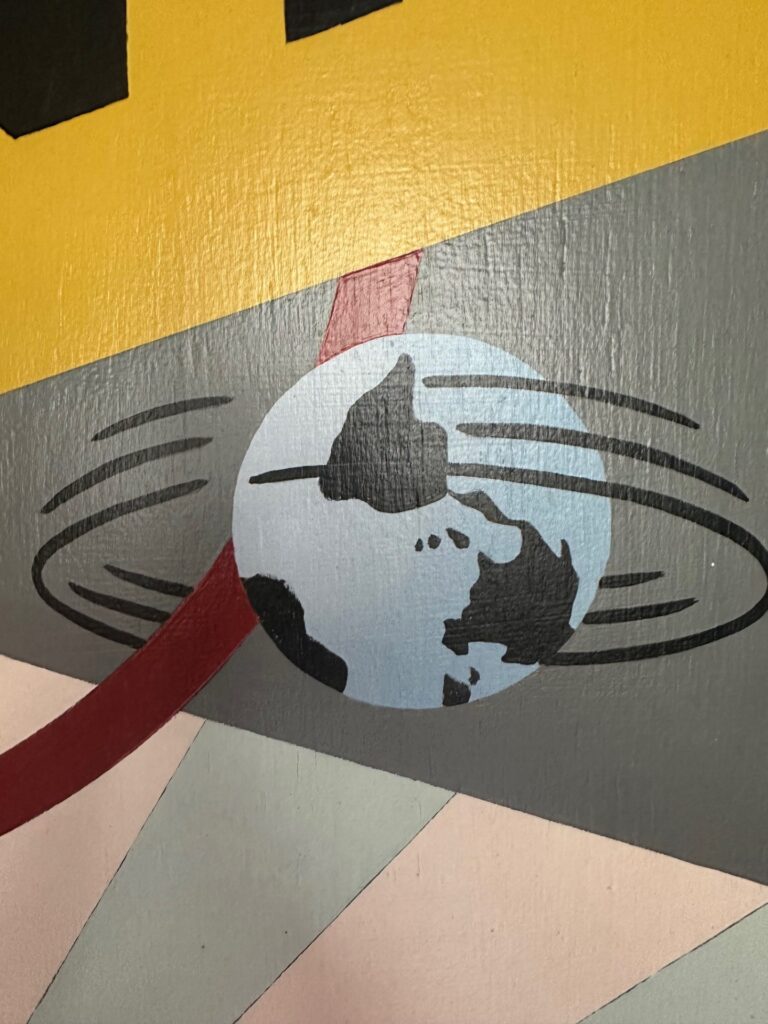
Image: [shiny)Detail of a painting by Lou Kregel.
The thing about GROWTH

Interesting digression from Joel Klotkin about a dilemma that continues to plague us, which is also wrapped tightly around all efforts to de-couple ever-growing returns in economic activity from energy-intensive work and employment:

The global phenomena of low economic growth and rising prices has sparked middle-class-led rebellion—what one Marxist publication describes as “a strike against the rising cost of living.” While the specific issues may vary in each instance, the new protests are motivated by middle- and working-class fears that slow and de-growth conditions will “proletarianize” their once decently comfortable living standards.

Many of the progressive gentry dismiss these movements as primitive populism, producing detestable things like Brexit and the election of Donald Trump. But the “great revolt” has since expanded to countries with liberal cultures and evolved welfare states, including France, Chile,  even Norway and the Netherlands. In most places these rebellions are led not by perpetually outraged students, laid off workers, or angry immigrants, but by solidly middle-income workers who feel their long-term prospects, and those of their children, are increasingly dismal.

These fears are particularly acute for workers in environmentally inconvenient industries, such as energy, manufacturing, or home-building, who are losing their jobs or have been explicitly targeted for unemployment by the green Left. Those who continue to work in unavoidably energy-intensive industries like agriculture continue to be saddled with ever rising costs for critical commodities like diesel fuel. These energy price rises particularly impact most Europeans who drive to work.

This is obviously not unrelated to the perpetual ‘make the miners into coders’ solution that is stupid on its face (we don’t need that many coders) and insulting by implication (they can just do something else!).

The need for ever-increasing growth needs some re-imagined parameters. Instead of successive generations wanting their kids to earn more and more, what if our dream was for them to work less and less? What else might they do? Do you mean we can’t think of or value anything else beyond work? Is that the actual problem? The idea/reality that it is blasphemy to consider the merits of working a 20-hour week, or that we have trouble imagining these merits says far more about us that we should be comfortable with.

Hmmm. What’s Green?

Image by author.

Fracticality

Too much of some things and not enough of others. Why do we lose the feel for and sight of the sensations we hold most dear? Are we misusing the words and concepts? The battle for our own personal attention spans, for example, in which to play is to lose, doesn’t do anyone much good. What do those words even mean that we allow this ‘span’ (do we need an attention suspension bridge?) to be up for grabs The degree to which we allow almost anything to pass into our heads, refusing to rule and watch over this domain as we might a plot of land where our children sleep, contributes to the loss. As well, connectivity; we’ve bought lock-and-stock the idea that we should never (much less need to) be out of the reach of electronic beeps and chirps. Then there’s the wireless scourge. Harmless and helpful on its own, though at essence and by definition opposed to any efforts at moderation. So, how do you pan out, and if we manage, how do we make sense of what see?

One place to start making sense again, this essay on the misunderstandings of art and science by James Elkins, The Drunken Conversation of Chaos and Painting

Within mathematics, there is no question of the importance of the new discoveries. The “new geometry”
knows itself to be fundamental: “Euclid,” Benoit Mandelbrot announces in The Fractal Geometry
of Nature, will be “used in this work to denote all of standard geometry.” The unexpected efflorescence
of geometry, so difficult to follow through its growing associations with physics, biology, astronomy,
geology, medicine, and economics, already has wide experimental support and applications as diverse
as the threebody problem, population dynamics, the neurobiology of hearing, and the contractions
of heart muscle. It has, in addition, serious philosophic and experimental implications for the scientific
method itself.
In this context the “new geometry” is most interesting because it knows itself to be beautiful,
though the nature and extent of that knowledge are open to question. Mandelbrot quotes an article in Science
that makes a parallel between cubism, atonal music and modern mathematics beginning with “Cantor’s
set theory and Peano’s spacefilling curves.” He sees a rococo phase in mathematics before the modern
era, followed by a visual austerity. When it comes to art, he makes a poorly articulated and unconvincing
historical and aesthetic reading of his own fractal inventions, according to which the extravagant,
ebullient forms he has visualized are “minimalist art”—a most unlikely identification. There is also an
unwillingness on Mandelbrot’s part to mix art and science: when computer printouts are to be judged aesthetically,
he gives them selfparodistic titles such as “The Computer ‘bug’ as artist, Opus 1,” thereby publishing
aesthetic results as mistakes, “bugs” in programs. Part of the meaning of such titles resides in
Mandelbrot’s mimicry of contempory painting styles; “Opus 2” is like an angular Clifford Still or Franz
Kline. He also thinks his polychromic computer printouts are “austere.” The reason is they have simple
mathematics behind them, and so his misidentification with minimalism is an example of non-visual
thinking—what a mathematician would call “analytic” rather than “synthetic” reasoning. More plausibly,
he thinks a Mies van der Rohe building is a “scalebound” throwback to “Euclid” since it has only certain
classes of forms, while—in a particularly strange juxtaposition of cultures—“a high period Beaux Arts
building is rich in fractal aspects.”

Download and the read the whole thing. On purpose.