
Of straits and traps

A mental ill patient in a straight jacket and strapped into a chair. Photograph after a wood engraving by E. Tritschler, 1908.

What if war isn’t viable? And rather than being merely hopeful or any nod to a peacenik Shangri-La at last, what would remain in the balance – TBD comme on dit – is somehow assuring that the entire globe doesn’t become a failed state. That we don’t default to a Hobbesian existence on a planetary scale – yes, very much including our bumblionaires who have so sagely guided marked the territory to this place. But as [this] war increasingly results in an escalation trap, can we must become dissuaded of ts benefits:

Once started, a major regional war with Iran was always likely to be something of a ‘trap,’ – not in the sense of an ambush laid by Iran – but in the sense of a situation that, once entered, cannot be easily left or reversed.

The trap, of course, is the Strait of Hormuz and the broader Persian Gulf. The issue is that an enormous proportion of the world’s shipping, particularly energy (oil, liquid natural gas) and fertilizer components (urea) passes through this body of water. The Gulf is narrow along its whole length, extremely narrow in the Strait and bordered by Iran on its northern shore along its entire length. Iran can thus threaten the whole thing and can do so with cheap, easy to conceal, easy to manufacture systems.

So once the strait was closed, the United States could not leave until it was reopened, or at least there was some prospect of doing so.

The result is a fairly classic escalation trap: once the conflict starts, it is extremely costlyfor either side to ever back down, which ensures that the conflict continues long past it being in the interests of either party. Every day this war goes on make both the United States and Iran weaker, poorer and less secure but it is very hard for either side to back down because there are huge costs connected to being the party that backs down. So both sides ‘escalate to de-escalate’ (this phrase is generally as foolish as it sounds), intensifying the conflict in an effort to hit hard enough to force the other guy to blink first. But since neither party can back down unilaterally and survive politically, there’s practically no amount of pain that can force them to do so.

I’ve mentioned multiple times how the brakes on the carbon-based economy have been located – No! Not that way! – and the screeching we hear is actually the metal backing plate contacting the metal rotor, recommending immediate inspection and repair.

A dumb, so very dumb war presents this metaphor for appraisal.

Image via Wellcome Collection..
Brown ocean effect

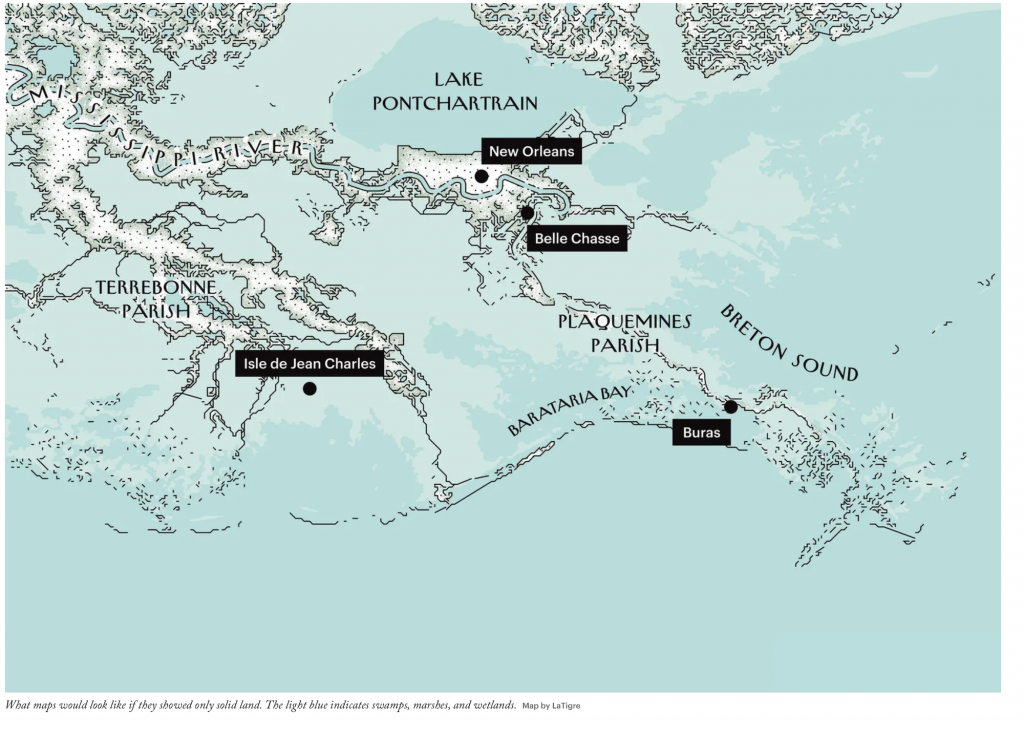
What maps would look like if they showed only solid land. The light blue indicates swamps, marshes, and wetlands.

Hurricane Ida grew quickly powerful after just a couple of days before roaring ashore and inundating people who have seen it before and likely will again:

By the time Hurricane Ida made landfall in Port Fourchon, La., on Sunday, it was the poster child for a climate change-driven disaster. The fast-growing, ferocious storm brought 150-mile-per-hour wind, torrential rain and seven feet of storm surge to the most vulnerable part of the U.S. coast. It rivals the most powerful storm ever to strike the state.

“This is exactly the kind of thing we’re going to have to get used to as the planet warms,” said Kerry Emanuel, an atmospheric scientist at the Massachusetts Institute of Technology who studies the physics of hurricanes and their connection to the climate.

And the recent UN Climate report aside, scientists have been talking about this for years:

previous NASA-funded research by Theresa Andersen and J. Marshall Shepherd making the case that a “brown ocean effect” — evaporation from moist warm soils — can energize tropical systems.

A NASA news release on the 2013 research explained:

Before making landfall, tropical storms gather power from the warm waters of the ocean. Storms in the newly defined category derive their energy instead from the evaporation of abundant soil moisture – a phenomenon that Andersen and Shepherd call the “brown ocean.”

“The land essentially mimics the moisture-rich environment of the ocean, where the storm originated,” Andersen said.

The map above says it all, and when we look at the photos from Sunday-Monday, listen to what we tell ourselves about what we see.

Image via the New Yorker

This Is Not A Plan

This is hope, which everyone seems to agree, is not a plan. So what is hope?

Well, that depends on whether Your Hope is just hoping something happens, or hoping what you are doing will work. Which, again, neither plans, but they do part ways, fundamentally. There’s a difference, one from the other, in tone and tenor.

Research into building a quantum computer, for example. Not much of a plan; hopeful, maybe. Breakthroughs in encryption excites the NSA some people. But I think it is the off-shoot consequences of trying to hit balls into this cup from 90 yards out, day after month after year, that will be the real dividends of this kind of research. Of this kind of hope.

In its way, the same goes for hydrogen storage and electricity storage from wind, sun and wave. In these cases, we’re not hitting around the mark so much as increasing the volume of balls being chipped at the hole.

So, Bill Gates doesn’t care for efficiency, or cap-and-trade, for that matter. Fine. It’s a questionable signal to send, but fine. In a $ green culture, the billionaires get listened to the most. Sigh. You might as well have listened to Warhol about painting. That wasn’t was he was ever talking about – but I’ll save that for another time.

But Gates’ views are no more or less likely to be compromised by conflicted interests than anyone else’s. Just something to keep in mind. Especially of late, when hope is such an easy target for relentless pummeling. Go ahead, take that away and replace it with the best of the best laid plans ever devised.

What would we have?