Nostalgia for Normal

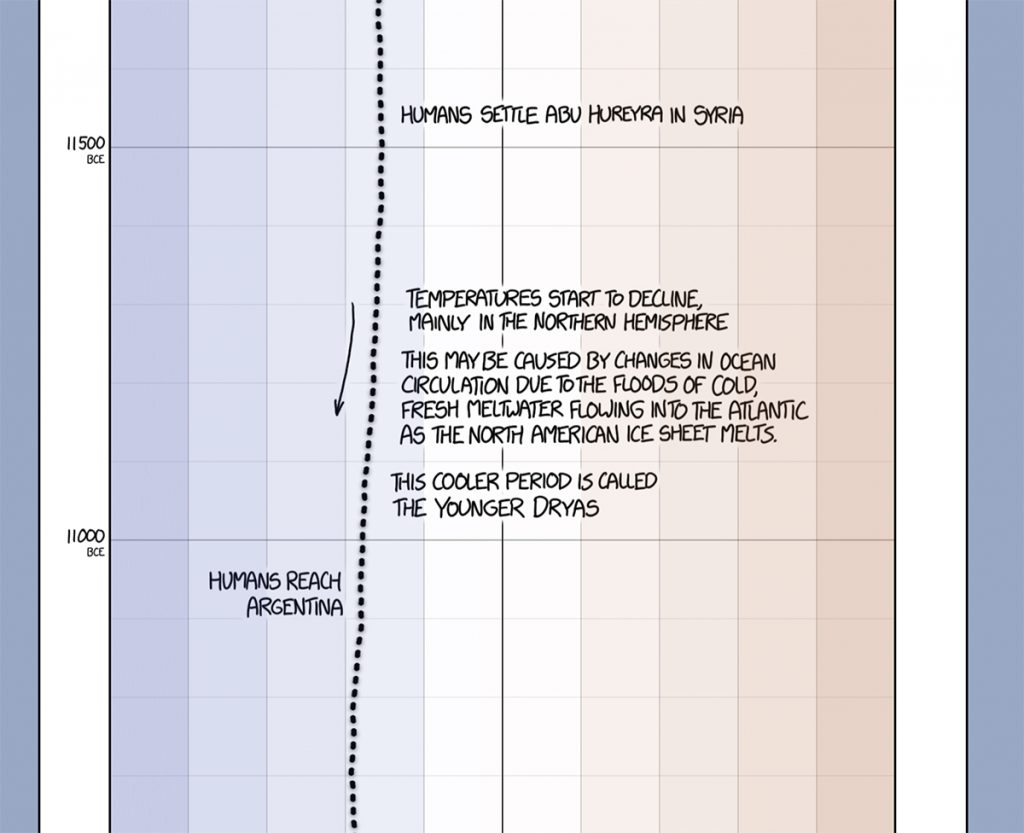
Lots of talk/pixels about ‘getting back to normal,’ the ‘new normal,’ and returning to a time when things/life were somehow better because they were usual. Primarily related to the pandemic, it’s also an opportunity to unpack a sympathetic but highly questionable sentiment. So this interesting tweet, highlighted by Bloomberg, serves as a good remedy for that nostalgia for normal:

Happy talk about way-back-when presents recklessness on many fronts – political, racial, economic – but it is also woebegone in terms of environmental devastation and the slow thoughtlessness that has brought us to exactly here. No one* wants to go back to Jim Crow and no one should want to go back to the normal, daily burning rates of our fossil-fueled civilization. As the article demonstrates, and this is a note to hit over and over again, the [high] costs of slowing down and reversing the effects of climate change are actually a bargain. Slice it however you want – we’ve already gotten far closer to the tipping point of better and cleaner far faster than imagined. Looking away and ignoring now requires more effort. That normal is depressing – and it should be. Our calculations of the impacts of the burning have become far less abstracted, to the point of easily transposing the impacts of the Deepwater Horizon disaster onto methane well leakage and carbon emissions just by looking at the numbers.

Unfortunately, our numbness to the staggering total of COVID deaths resembles our shruggy attitude to climate-related externalities. We get used to them, consider that state ‘normal,’ and long for the days.

But we shouldn’t, and we can’t go back, the comforting but perilous blindness of ‘normal’ notwithstanding. Instead of normal, how about a different better? As our friend says, Don’t Be Afraid.

*Admittedly, sometimes my optimism overwhelms
Re-Tooling Demand

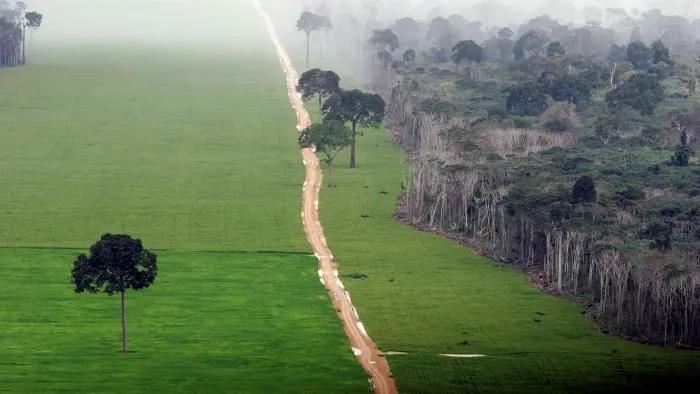
This Financial Times article (subscription req’d) pulls back the curtain on rain forest destruction in Brazil to let us see what – and who – it’s all for:

At the recent UN climate summit in Glasgow, more than 100 national leaders committed to halt deforestation by 2030, and 30 financial institutions, including Storebrand, promised to eliminate the harmful practice from their portfolios by 2025. However, the signatories, including Brazil, Russia and Indonesia, did not indicate how it would be implemented or tracked, and environmental campaigners remain sceptical.

ADM and Bunge are among the world’s largest traders moving Brazilian soyabeans around the world. The increase in production of the commodity, largely used for livestock feed, has been a leading cause of deforestation of the Amazon rainforest as well as the destruction of Cerrado savannah.

The scale of soyabean production on deforested land and differing standards about what qualifies as acceptable activity makes tackling its presence in supply chains challenging for companies.

Both Bunge and ADM strengthened their deforestation policies last year in response to calls from shareholders. Storebrand, together with US fund manager Green Century, tabled a proposal at Bunge’s annual meeting asking it to tighten its policies, which was backed by 98 per cent of shareholders. Bunge has said it is committed to not having soyabeans from illegally deforested land.

As much as even the big fund managers and many governments get on board with divestment and ESG priorities in managing portfolios, this really points up the issue: the companies – and countries – who burn and mine for profit just aren’t going to give it up as long as it’s profitable. The whole ‘fiduciary responsibility to shareholders’ is baked into our ethos, as long as there is money to be made, dividends to be paid, stock to buy back, whatever.

For allies in COP26 and elsewhere, the approach has to include the goal to dismantle, and then re-assemble, the demand side. It’s worth being realistic about this – otherwise, we remain [eternally? That’s optimistic – ed.] captive to supply-side economic logic. As the ADM example highlights, the companies will never lead anywhere besides mining, digging, clearing, and burning.

Image via FT.com © Ricardo Beliel/Brazil Photos/LightRocket/Getty Images

Water in Holy Lands

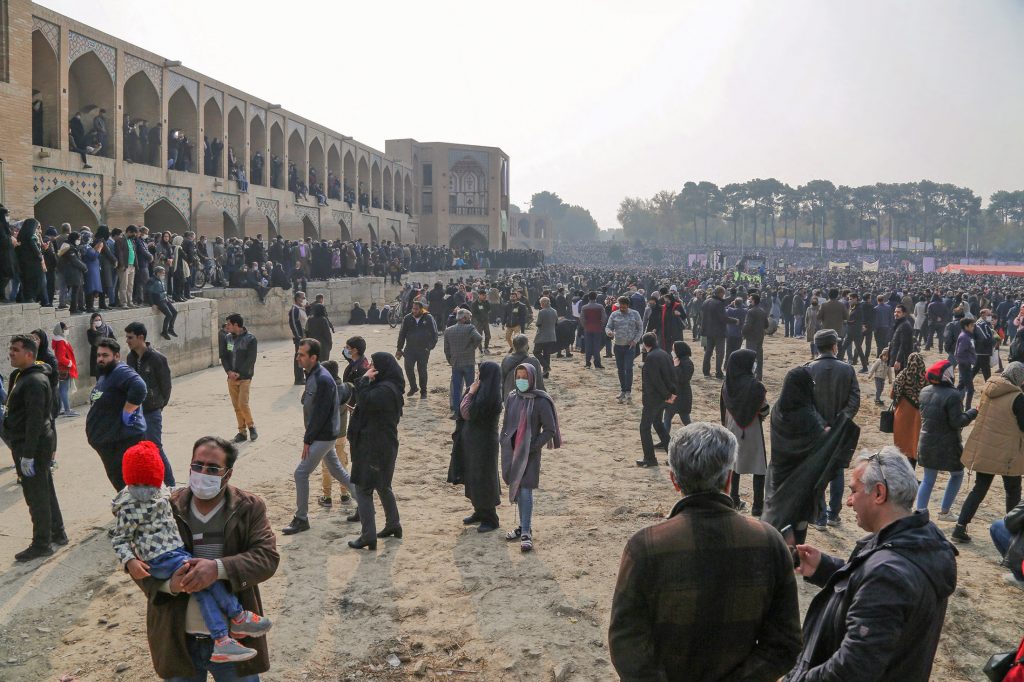
The Khaju Bridge (above) is one of the five historical bridges on the Zayanderud, the largest river of the Iranian Plateau, in Isfahan, Iran. Both a bridge and a weir, it links the Khaju quarter on the north bank with the Zoroastrian quarter across the Zayanderud.

The Khaju Bridge was built around 1650, under the reign of Abbas II, the seventh Safavid king (shah) of Iran, on the foundations of an older bridge. The existing inscriptions suggest that the bridge was repaired in 1873. There is a pavilion located in the center of the structure, inside which Abbas II would have once sat, admiring the view.

Beneath the archways are several sluice gates, through which the water flow of the Zayanderud is regulated. When the sluice gates are closed, the water level behind the bridge is raised to facilitate the irrigation of the many gardens along the river upstream of the bridge. Because of a sustained drought, and of course related management issues, the sluice gates and riverbed are now the site of gatherings of people worried about these many gardens, as well as crops and more general concerns about sustenance. Compare and contrast

Pictures, 1000’s of words, etc. 2022 is on the way and we need to do better. Soon.

Luxury, re-imagined

At the risk of sounding like some past (and very likely coming to screen near you in the adjacent soon) Mercedes Benz and/or other brand advertisement, the luxury of being in a position to do something about climate change is also a handy rationale to not do that something. Worry over the future of polluting industries and their investors as equal to concerns about the planet implies a false choice. And we love those:

Sorry, but there is no Trump Light, or Trump without the fill-in-this-blank. It’s only a sleep walk into fascism, sorry. Listen to what they run on. Banning Beloved would only be a starting place.

Meanwhile in Scotland, some of our betters are engaged in the COP26 think-scussions:

Humm recently shifted Eleven Madison Park from an omnivore’s menu to one focused on plants, a change that took effect this summer after his restaurant reopened from the coronavirus pandemic shutdown. Hearst has focused much of her energy on reducing waste in the New York design house that bears her name, as well as at Chloe, the Paris-based luxury firm where she is creative director. In October, Chloe became a certified B Corporation, which means it meets independent standards for environmental and social performance, as well as transparency.

“It’s not only about climate change, but it’s also about what does luxury mean,” Humm says about their upcoming conversation in Glasgow. “I think we both realize that, you know, not everyone — or only a few people — have access to our restaurant or Gabriela’s clothes. But we do have these incredible resources and this incredible platform that people are actually paying attention to.”

“Some of the ideas of luxury are old ideas that have to be refreshed,” Humm continues. “For example, we are still celebrating caviar as a luxury ingredient … and there is nothing luxurious about caviar. It’s farm-raised. It’s flown in. It’s not rare at all. And it doesn’t even taste good. This is an old idea.”

A future is not THE future. Reckoning with the many complications of the actual problem of a warming planet caused by out-of-control carbon emissions will re-define luxury, and perhaps even put the concept out to pasture. We will realize that enjoying privations is not luxury but sociopathy. Basking in a scarce resource – whether it be time, security, clean water, or perceived reasonableness – has to be treated as wasteful, if not immoral. Like shrugging before you give your vote to a soft authoritarian. That’s a luxury you can’t afford.

I reckon

What’s the best way to get there? We need to start taking everything into consideration:

To help users find more sustainable travel options, Google launched a feature Wednesday that will show a carbon-emissions estimate for almost every flight in its search results. Now, along with price and duration, travelers will be able to use environmental footprints to compare and choose flights.

James Byers, a senior product manager on the Google travel team, said the emissions estimates are based on a combination of factors, such as the distance of a trip, the number of stops, the number and class of seats on board, the type of aircraft, and data from the European Environment Agency.

The feature, which follows another eco-friendly feature for Google’s hotel searches, could be valuable in the fight against climate change, suggests Katharine Hayhoe, director of the Climate Center at Texas Tech University.

It’s a shift in thinking, a pivot to including more of what has long been ignored. Will it catch on? Many right-wingers will surely choose the most rootin-tootin-pollutinest routes, rollin’ coal as much and for as far as they can. Many are certainly so inclined, and it may have just become easier to make them pay more for the pleasure.

For everyone else more sensible, this is potentially a good tool, allowing demand to push supply in a better direction.

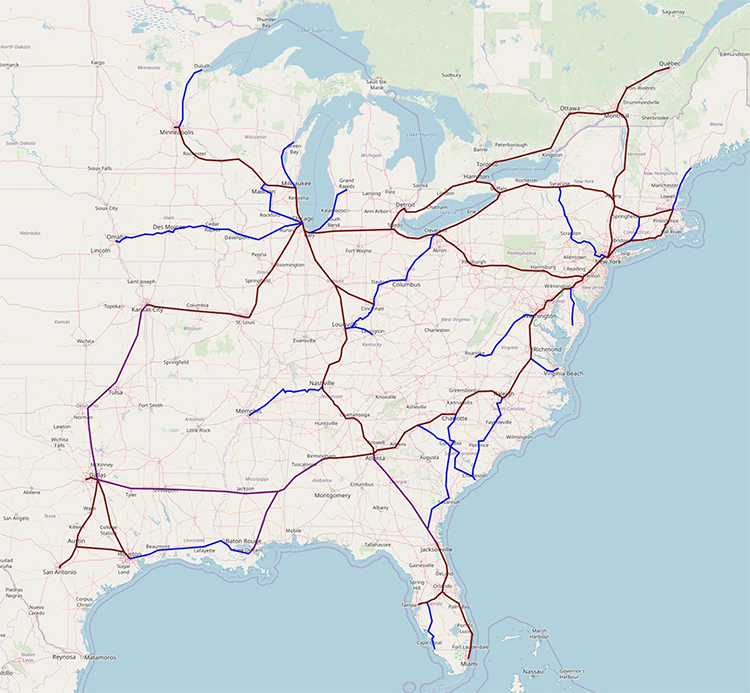
Image: proposed rail network. (Not pictured, how to get North Americans to Europe, Africa, Asia)

Brown ocean effect

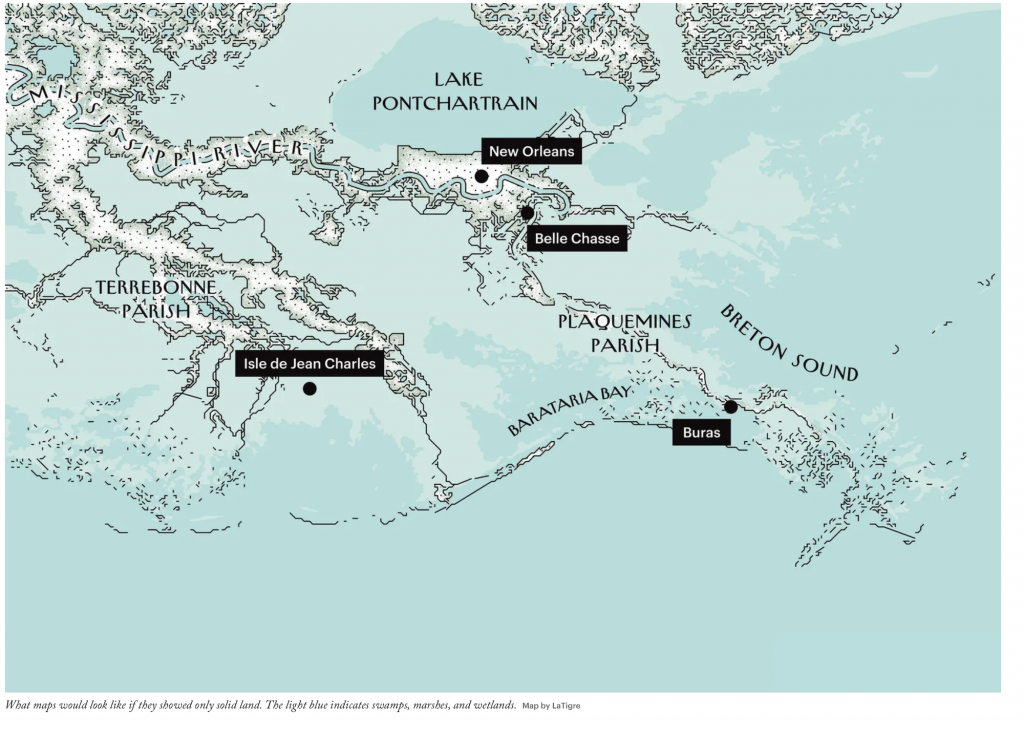
What maps would look like if they showed only solid land. The light blue indicates swamps, marshes, and wetlands.

Hurricane Ida grew quickly powerful after just a couple of days before roaring ashore and inundating people who have seen it before and likely will again:

By the time Hurricane Ida made landfall in Port Fourchon, La., on Sunday, it was the poster child for a climate change-driven disaster. The fast-growing, ferocious storm brought 150-mile-per-hour wind, torrential rain and seven feet of storm surge to the most vulnerable part of the U.S. coast. It rivals the most powerful storm ever to strike the state.

“This is exactly the kind of thing we’re going to have to get used to as the planet warms,” said Kerry Emanuel, an atmospheric scientist at the Massachusetts Institute of Technology who studies the physics of hurricanes and their connection to the climate.

And the recent UN Climate report aside, scientists have been talking about this for years:

previous NASA-funded research by Theresa Andersen and J. Marshall Shepherd making the case that a “brown ocean effect” — evaporation from moist warm soils — can energize tropical systems.

A NASA news release on the 2013 research explained:

Before making landfall, tropical storms gather power from the warm waters of the ocean. Storms in the newly defined category derive their energy instead from the evaporation of abundant soil moisture – a phenomenon that Andersen and Shepherd call the “brown ocean.”

“The land essentially mimics the moisture-rich environment of the ocean, where the storm originated,” Andersen said.

The map above says it all, and when we look at the photos from Sunday-Monday, listen to what we tell ourselves about what we see.

Image via the New Yorker

The Arrogance of Power

With apologies to the accusers working hard to hold their abusers to account, the impacts of human activity on global warming are taking center stage this week:

The world’s leading climate scientists on Monday delivered their starkest warning yet about the deepening climate emergency, with some of the changes already set in motion thought to be “irreversible” for centuries to come.

A highly anticipated report by the U.N.’s climate panel warns that limiting global warming to close to 1.5 degrees Celsius or even 2 degrees Celsius above pre-industrial levels “will be beyond reach” in the next two decades without immediate, rapid and large-scale reductions in greenhouse gas emissions.

To be sure, the 1.5 degrees Celsius threshold is a crucial global target because beyond this level, so-called tipping points become more likely. Tipping points refer to an irreversible change in the climate system, locking in further global heating.
At 2 degrees Celsius of global warming, the report says heat extremes would often reach critical tolerance thresholds for agriculture and health.

U.N. Secretary-General, António Guterres described the report as “a code red for humanity.”

“The alarm bells are deafening, and the evidence is irrefutable: greenhouse gas emissions from fossil fuel burning and deforestation are choking our planet and putting billions of people at immediate risk,” Guterres said.

Every previous supposed estimate had been watered down to re-assure the consensus that all of this was far enough away in time not to worry about. A little tweak here or there was all that was needed, and no time soon. Well guess what? It’s no time – soon. What are we doing and how much more can we do must be the only questions. The Earth will change and re-establish some equilibrium, and humans may or may not be a part of that. We don’t seem to understand that last part, and we’re warning ourselves that we are running out of time.

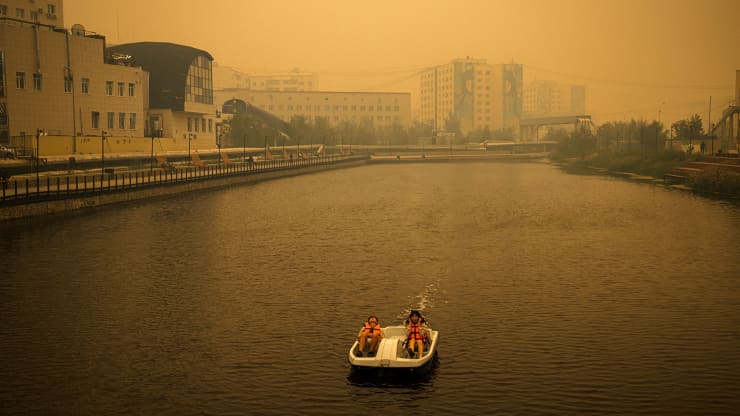
Image: A couple rides a pedal boat as smoke from nearby forest fires hangs over the city of Yakutsk, in the republic of Sakha, Siberia, on July 27, 2021.
DIMITAR DILKOFF | AFP | Getty Images

Boring work of staggering effectiveness

Right along the lines of super unexciting infrastructure fixes to crucial bridges, railways, pipes and water mains is the capping of methane-spewing oil wells, of which we have a leaky and abundant surplus:

Curtis Shuck calls the well a “super emitter,” one of many in a wheat field not far from the Canadian border, a part of Montana known as the “golden triangle” for its bountiful crops. Aside from the scattered rusty pipes and junked oil tanks, the field is splendid and vast, its horizon interrupted intermittently by power lines and grain bins. On these plains, Shuck says, you can watch your dog run away for a week.

He is a former oil and gas executive who nowadays leads a small nonprofit — the result of a personal epiphany — and is tackling global warming one well at a time. That is the approach of his Well Done Foundation, plugging this and then other orphaned sites and trapping the methane underground. The effort started in Montana in 2019 but will expand to other states before the fall.

“When we’re done, it will be like this well was never here,” Shuck said, standing upwind as cement was pumped hundreds of feet down, through a series of pipes stuck in the 7½-inch-wide hole like a straw in a juice box.

30K to cap a well. Well done, Well Done. Plant trees, install solar farms, wind farms, stop dumping sewage, limit runoff, cut back on steaks (sorry! but do), refurbish the train lines, live close to work. Listen to ‘Trane while you walk. Live a little.

What’s it going to take? All of it, every last all of it. Everything.

Image: Abandoned oil storage tanks left behind in Montana. (Adrián Sanchez-Gonzalez for The Washington Post)

World world

A theme park, opening soon along the gulf coast of Arkansas, promises visitors – and investors – more than just memories and a fun time with family.

Luring adventurers to the Land of All Time-themed playground, guests enjoy lily pad accommodations floating throughout the 38-square-mile park, on water and undulating, recycled “terrain.”

“It all started here – everything is from the closed loop, after all. So we just call it all natural,” said Stan Brimmingway, mastermind of the park and keeper of its honorary specimens. Modestly dressed in a smart Tyvex onesie, Stan pets a miniature bull before shepherding the creature back to its keeper. “Back when land was still bought and sold, people were fine with trading money for all of this,” he said and gestured broadly. “So we were glad to just get as much as we could – people thought they were losing land, but look at that view. The water is so much more alluring when its closer to the mountains anyway.”

And it’s unmistakable. A kind of Mediterranean vista, nestled in the Ozark foothills. Whether technology saved this landscape or invented it, it has definitely changed. “And that’s not new – and kinda the point,” Brimmingway said with a glint of enthusiasm not entirely absent of P.T. Barnum. “What is fitness after all other than the result of the effort it takes you to do normal things – otherwise it can be really hard to see this.”

Impossible, he means. Living in a moment most often means being defined by it. Unless you can imagine the Land of All Time, seeing today in context can be simply too much work. But that’s where the park comes in.

“It’s true that we brought ourselves to this place – totally our fault,” he said. “But imagine a glacier sitting on New York, or the invention of writing 3,500 years ago.” His voice trails off, galloping after his ow, quite visible sense of wonder.

“The thing about this is, it’s not only possible. It all happened. Check it out.”

Battery Plants

Saw a friend yesterday whose water business took a tumble thanks to the plague shutting down business offices in our small burg. And though that sounds like the plot for another episode of ‘Your Dystopia,’ he said things were looking up, thanks to a new battery plant opening up outside of an even smaller burg a half hour away. Fossil fuels are not ending, but largely over, we agreed. Electric vehicles are very much the present, I may have said, sitting in a late-model guzzler. My water friend went back to his not-so-late model pickup, but the battery plants hung in the air a little longer, walled gardens of Babylon, with added strife and wi-fi.

What if battery plants were literal? Plants are already perfect energy storage dynamos – we just don’t know how they do it. We understand, but it’s still largely alchemical to us. I looked it up:

Imagine if farmers could grow batteries in their fields. Researchers are taking steps towards at least partially making that green dream a reality by using plant materials to make key components of energy storage devices. Pen-Chi Chiang and colleagues at the National Taiwan University review developments in this adventurous ambition in the journal Materials Today Energy.

“We consider the state-of-the-art challenges and issues for using plant-derived biomass materials for various energy storage applications, such as batteries and supercapacitors,” says Chiang.

Energy storage is an essential requirement for modern life. Without it, we couldn’t have cellphones, laptops, or electric vehicles. From consumer electronics to transportation, electrical energy must be stored and be available at the flick of a switch. Current systems, such as the lithium-ion batteries common in many devices, are made from limited resources, and bring environmental problems associated with their disposal.

Chiang points out that a sustainable future will increasingly depend on replacing existing technologies with those using renewable materials that can readily be recycled without damaging the environment.

One of the most promising approaches towards sustainable energy storage devices is to convert plant biomass into a material called “porous carbon”. This is a form of carbon that can be fabricated into three-dimensional ordered “nanostructures” with a variety of useful electrochemical properties.

I guess nanostructures are going to be our best tickets to being able to produce the capacities of plant lignin. It’s the inverse of why biomass is so hard to breakdown, in efforts tap its energy by making fuel. Seems a folly when you think about it like that. Instead of making fuel, figure how they work as batteries – which we seem to already grasp.

As is so often the case, a matter of which word we emphasize. Thinking big does not have to only mean going to Mars. Maybe if ‘Native American’ were two of the words represented by NASA, we might have already figured this out, not to mention a few other things.