Nostalgia for Normal

Lots of talk/pixels about ‘getting back to normal,’ the ‘new normal,’ and returning to a time when things/life were somehow better because they were usual. Primarily related to the pandemic, it’s also an opportunity to unpack a sympathetic but highly questionable sentiment. So this interesting tweet, highlighted by Bloomberg, serves as a good remedy for that nostalgia for normal:

Happy talk about way-back-when presents recklessness on many fronts – political, racial, economic – but it is also woebegone in terms of environmental devastation and the slow thoughtlessness that has brought us to exactly here. No one* wants to go back to Jim Crow and no one should want to go back to the normal, daily burning rates of our fossil-fueled civilization. As the article demonstrates, and this is a note to hit over and over again, the [high] costs of slowing down and reversing the effects of climate change are actually a bargain. Slice it however you want – we’ve already gotten far closer to the tipping point of better and cleaner far faster than imagined. Looking away and ignoring now requires more effort. That normal is depressing – and it should be. Our calculations of the impacts of the burning have become far less abstracted, to the point of easily transposing the impacts of the Deepwater Horizon disaster onto methane well leakage and carbon emissions just by looking at the numbers.

Unfortunately, our numbness to the staggering total of COVID deaths resembles our shruggy attitude to climate-related externalities. We get used to them, consider that state ‘normal,’ and long for the days.

But we shouldn’t, and we can’t go back, the comforting but perilous blindness of ‘normal’ notwithstanding. Instead of normal, how about a different better? As our friend says, Don’t Be Afraid.

*Admittedly, sometimes my optimism overwhelms

Re-Tooling Demand

This Financial Times article (subscription req’d) pulls back the curtain on rain forest destruction in Brazil to let us see what – and who – it’s all for:

At the recent UN climate summit in Glasgow, more than 100 national leaders committed to halt deforestation by 2030, and 30 financial institutions, including Storebrand, promised to eliminate the harmful practice from their portfolios by 2025. However, the signatories, including Brazil, Russia and Indonesia, did not indicate how it would be implemented or tracked, and environmental campaigners remain sceptical.

ADM and Bunge are among the world’s largest traders moving Brazilian soyabeans around the world. The increase in production of the commodity, largely used for livestock feed, has been a leading cause of deforestation of the Amazon rainforest as well as the destruction of Cerrado savannah.

The scale of soyabean production on deforested land and differing standards about what qualifies as acceptable activity makes tackling its presence in supply chains challenging for companies.

Both Bunge and ADM strengthened their deforestation policies last year in response to calls from shareholders. Storebrand, together with US fund manager Green Century, tabled a proposal at Bunge’s annual meeting asking it to tighten its policies, which was backed by 98 per cent of shareholders. Bunge has said it is committed to not having soyabeans from illegally deforested land.

As much as even the big fund managers and many governments get on board with divestment and ESG priorities in managing portfolios, this really points up the issue: the companies – and countries – who burn and mine for profit just aren’t going to give it up as long as it’s profitable. The whole ‘fiduciary responsibility to shareholders’ is baked into our ethos, as long as there is money to be made, dividends to be paid, stock to buy back, whatever.

For allies in COP26 and elsewhere, the approach has to include the goal to dismantle, and then re-assemble, the demand side. It’s worth being realistic about this – otherwise, we remain [eternally? That’s optimistic – ed.] captive to supply-side economic logic. As the ADM example highlights, the companies will never lead anywhere besides mining, digging, clearing, and burning.

Image via FT.com © Ricardo Beliel/Brazil Photos/LightRocket/Getty Images

Tales from the crypt(o)

NBA commentator Jeff Van Gundy’s well-placed, near-extemporaneous “back at the crypt” comment notwithstanding, ubiquitous references to crypto currency range from annoying to cloying. Everything about digital money is either scammy or… that seems to be mostly it. Scammy neatly encompasses the over-hyped, Ponzi-schemed, last-one-in nature of the the collection of binary data that necessarily requires us to put all the usual finance-related terms in quotes: “ownership” “collateral” “token” “transaction.” You could go on.

And besides the obvious downsides of NFT’s – from terrific money-laundering possibilities to the proliferation of really bad art – we’d be remiss in not noting crypto’s climate impacts:

Crypto’s overall climate impact remains massive, with certain currencies swallowing up entire nations’ worth of processing power from individual computing units and data centers—much of whose power comes from fossil fuels. The most common form of cryptocurrency mining, proof of work, requires a massive amount of processing power. Alternative mining methods have a mixed track record so far, with some ostensibly “sustainable” mining systems still requiring significant amounts of dirty or clean power. And transacting any tokens across the blockchain, whether an NFT or a Litecoin, sucks up the collective energy feeding into the transaction, no matter the product at hand. One estimate claims that a single NFT trade across the much-used Ethereum blockchain uses enough energy that could power an entire house for several days. And this is all so the buyer can have bragging rights about “owning” an image.

Celebrities who are selling NFTs and also claim to care about the environment: What are you doing? Whatever it is, there sure are a lot of you. Here’s a list—surely incomplete—of luminaries who brand themselves as climate-conscious yet have also been hawking NFTs in some form or the other, ensuring this bizarre digital culture product will linger in the public discourse while possibly ruining the art world, the planet, and our collective sanity.

Not even-close-to-exhaustive list of scam-adjacent proponents at the link. Yes, engaging in yet another form of workaround for doing not the things we need to do about global warming: what are we doing? The climate question at the center of everything, that we’ve been needing to ask for decades, that we still need to answer.

Image: the crypt in question

Ruffling the kleptocracy

In other news – just started a subscription to the FT and wow, there ARE other stories out there. Boring, significant. Anyway, the U.S. is about to ban anonymous shell companies:

The Biden administration’s focus on corruption and money laundering may so far have attracted less notice than its other big policy decisions. But it is the most meaningful manifestation of the US president’s argument that making the economy work for ordinary Americans is intimately connected to US national security and foreign policy interests.

There are many reasons to cheer this turn in policy. First, it is an all-too-rare example of relative bipartisanship in a deeply polarised country. Days before the January 6 attack on the Capitol, the Corporate Transparency Act was passed by overwhelming majorities of the US Congress as part of the annual defence spending authorisation bill. This law will, when implemented, in effect ban anonymous shell companies in the US — a favoured conduit for the world’s corrupt to launder dirty money, as Yellen referred to in her remarks.

Second, the administration means it seriously. The Treasury has issued an implementation rule for the shell company ban. Too often, in the US or elsewhere, good laws on paper have been dead letters in practice, because of loopholes or a failure to put enough resources and political support behind enforcement. This time looks different.

So weird, and not to get/stay meta all the time, but this story even hits the mythical ‘bipartisan’ note somehow, and yet still never rises to the level of the local news. Sure, it was drowned out by a coup attempt, but as the article points out, corrupted government institutions are the very things that abet anti-democratic movements. So, striking back at corruption also strikes a blow in support of liberal democracy. Sounds so quaint, but that’s where we are.

Image: Nicobar spindle shell, typically not itself a threat to democracy.

Luxury, re-imagined

At the risk of sounding like some past (and very likely coming to screen near you in the adjacent soon) Mercedes Benz and/or other brand advertisement, the luxury of being in a position to do something about climate change is also a handy rationale to not do that something. Worry over the future of polluting industries and their investors as equal to concerns about the planet implies a false choice. And we love those:

Sorry, but there is no Trump Light, or Trump without the fill-in-this-blank. It’s only a sleep walk into fascism, sorry. Listen to what they run on. Banning Beloved would only be a starting place.

Meanwhile in Scotland, some of our betters are engaged in the COP26 think-scussions:

Humm recently shifted Eleven Madison Park from an omnivore’s menu to one focused on plants, a change that took effect this summer after his restaurant reopened from the coronavirus pandemic shutdown. Hearst has focused much of her energy on reducing waste in the New York design house that bears her name, as well as at Chloe, the Paris-based luxury firm where she is creative director. In October, Chloe became a certified B Corporation, which means it meets independent standards for environmental and social performance, as well as transparency.

“It’s not only about climate change, but it’s also about what does luxury mean,” Humm says about their upcoming conversation in Glasgow. “I think we both realize that, you know, not everyone — or only a few people — have access to our restaurant or Gabriela’s clothes. But we do have these incredible resources and this incredible platform that people are actually paying attention to.”

“Some of the ideas of luxury are old ideas that have to be refreshed,” Humm continues. “For example, we are still celebrating caviar as a luxury ingredient … and there is nothing luxurious about caviar. It’s farm-raised. It’s flown in. It’s not rare at all. And it doesn’t even taste good. This is an old idea.”

A future is not THE future. Reckoning with the many complications of the actual problem of a warming planet caused by out-of-control carbon emissions will re-define luxury, and perhaps even put the concept out to pasture. We will realize that enjoying privations is not luxury but sociopathy. Basking in a scarce resource – whether it be time, security, clean water, or perceived reasonableness – has to be treated as wasteful, if not immoral. Like shrugging before you give your vote to a soft authoritarian. That’s a luxury you can’t afford.

Theories about ESG investing

This is some serious inside baseball. But it IS October:

If your basic theory of ESG investing is “we will avoid bad-ESG stocks in order to drive up the cost of capital of bad-ESG things,” it seems to be working:

Years of awful returns and pressure from clients to exit from the oil-and-gas business have left fewer and smaller firms able to take advantage of rising prices and help boost production. The unwillingness of some banks to make energy loans has compounded the challenges to boosting energy supplies.

Those left are moving to increase production, but they are relatively small players who won’t be able to make a significant impact on output. Investors are steering capital away from fossil fuels and toward companies that rank high in environmental, social and governance, or ESG, measures.

“Oil-and-gas has seen the worst returns of any sector over the past five years; the returns are volatile and investors feel ESG pressures,” says Wil VanLoh, who runs Quantum Energy Partners, which manages $18 billion, making it one of the few remaining big energy private-equity funds. “There’s been a huge retreat in available capital.”

That’s from Matt Levine’s Bloomberg daily newsletter, talking game about the game. But the idea that ESG investing is maturing, as he says, is an interesting one. If companies and the courts are no longer going to just line up on the side of fiduciary responsibilities as a way to protect shareholders – and hence, the companies that may continue to pollute and spew for profit – that’s at least a change.

Image: Abraham Lincoln: Baseball Theme Currier & Ives Cartoon, 1860.

I reckon

What’s the best way to get there? We need to start taking everything into consideration:

To help users find more sustainable travel options, Google launched a feature Wednesday that will show a carbon-emissions estimate for almost every flight in its search results. Now, along with price and duration, travelers will be able to use environmental footprints to compare and choose flights.

James Byers, a senior product manager on the Google travel team, said the emissions estimates are based on a combination of factors, such as the distance of a trip, the number of stops, the number and class of seats on board, the type of aircraft, and data from the European Environment Agency.

The feature, which follows another eco-friendly feature for Google’s hotel searches, could be valuable in the fight against climate change, suggests Katharine Hayhoe, director of the Climate Center at Texas Tech University.

It’s a shift in thinking, a pivot to including more of what has long been ignored. Will it catch on? Many right-wingers will surely choose the most rootin-tootin-pollutinest routes, rollin’ coal as much and for as far as they can. Many are certainly so inclined, and it may have just become easier to make them pay more for the pleasure.

For everyone else more sensible, this is potentially a good tool, allowing demand to push supply in a better direction.

Image: proposed rail network. (Not pictured, how to get North Americans to Europe, Africa, Asia)

Swarms at the trough

The once-in-a-generation opportunity to repair and rebuild infrastructure across the country is also a once-in-a-not-soon-enough siren call to private equity to interrupt, disrupt and corrupt:

Legislation with the size and scope of the $4 trillion “Build Back Better” agenda is like a Bat-Signal for lobbyists, urging them to swarm Capitol Hill without delay. Literally thousands of companies, organizations, and trade groups have lobbied on one or more of the bills in this package. But one industry’s representatives keep showing up over and over again, whether in formal lobbying sessions in Congress or more informal meetings: private equity.

“At every point, private equity lines up at the trough,” said one observer close to the discussions. “There’s just somebody in every fucking meeting.”

Private equity lobbyists have multiple interests in the bills being discussed. They obviously want to keep any tax increases away from their industries, and successfully fought to keep tax hikes out of the $550 billion bipartisan infrastructure bill, which is slated for a House vote on September 27. Those tax hikes got shifted to the reconciliation package known in Washington as the Build Back Better Act, and private equity has kept up the pressure there.

But the industry has another reason to be involved in the reconciliation bill. The blueprint includes hundreds of billions of dollars in investments to expand home and community-based services for elderly and disabled people under Medicaid (initially set at $400 billion over ten years), and to provide subsidies for high-quality child care programs (set at $225 billion). Private equity happens to be deeply invested in both of these industries, with dozens of home care and child care companies in their portfolios.

So, people should just be aware. Like accounting gimmicks from the political opposition and in the media that will make $3.5T over ten years sound like too much in an +$20T per year country (narrator: it’s Not), also be advised about all the beaks dipping toward the puddle as it gets sliced and diced. Let’s not get distracted about who is doing what – or why they might be whining about it.

Like we say, a country that can drop a small SUV on Mars from a helicopter and watch it drive around in real time can afford to fix any problem – except where stupidity and corruption won’t allow it.

Fixing it

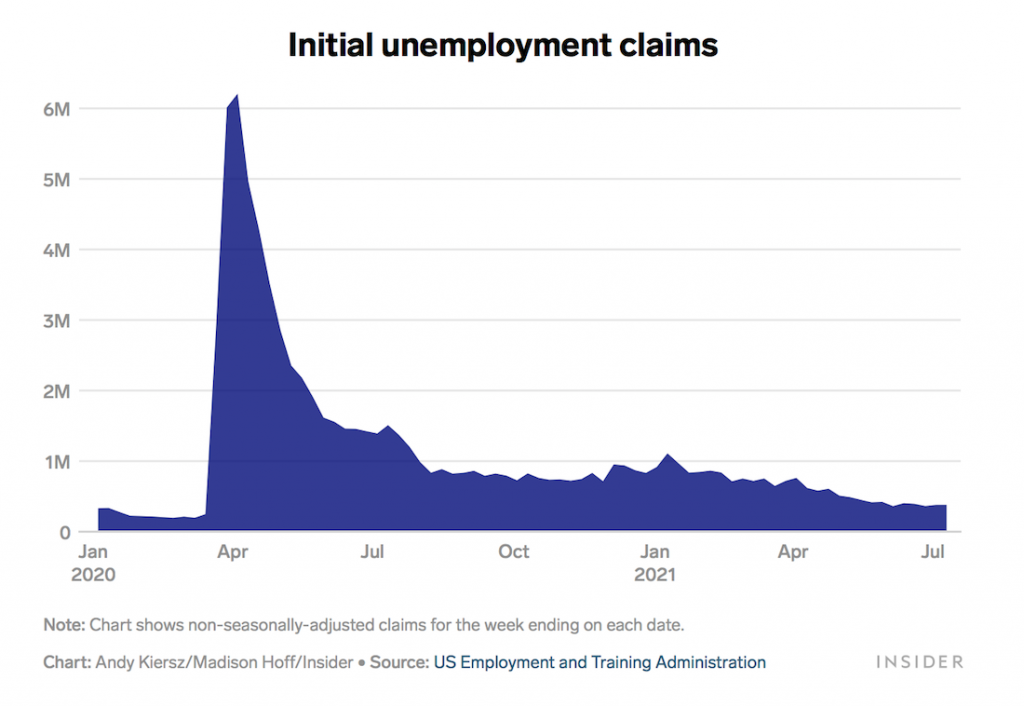
Notwithstanding the [late] reckoning with our very own special coup, the one we think we dodged and the very one over which Our Media is fascinated by exactly all the wrong details; the battle between Chicago and lake Michigan; and the new Gilded Age space flights for plutocrat tourists, the economy seems to have magically withstood a pandemic (Narrator: It’s not magic):

Initial unemployment claims came in at 360,000 for the week ending July 10, below the previous week’s revised read of 386,000. That reading matched the consensus forecast among economists, according to Bloomberg.

The decline in the seasonally adjusted number resumes the overall downward trend of the volatile data series after an unexpected rise in initial claims last week. The Labor Department noted that this marks a new pandemic-era low.

While the number of Americans newly filing for unemployment benefits tends to bounce around from week to week, it’s been on a general downward trend after spiking to record-shattering numbers amid the early days of the pandemic last spring. The return to that downward trend matches other data suggesting a steadily recovering labor market.

360K is still a very many lot of people, and yet you ask: after years of making sure our billionaires had enough nest eggs to color-coordinate their space suits, how was it possible to get through a year of very limited economic activity and still be able browse and sniff at the want ads and generally avoid most of the fascist tendencies on offer? Give. People. Money.

CARES and PPP run themselves out by design, which is helping people stay afloat. This is why we’re longing for vacations instead of standing in breadlines. And the infrastructure bill will bring more of this – not gifts and not luxuries – but investments in people and how we live, with recommendations for new arrangements for different needs that WE have made absolutely necessary (see Chicago example above and read the history). Move the monuments. Buy the trains. Pay the carpenters, or become one. As legend has it, the profession has a storied past.

Self-driving boats

Since he began scamming promising people – buyers and not just buyers, but BUYERS – that full self-driving would be available in six months (2016), Elon Musk has played a vital role in one of our great national pursuits. Yes, separating people from their money. But normalizing electric cars, even with the side auto-taxi fraud, is to be lauded. Tesla definitely got the other car makers to get some skin in the game.

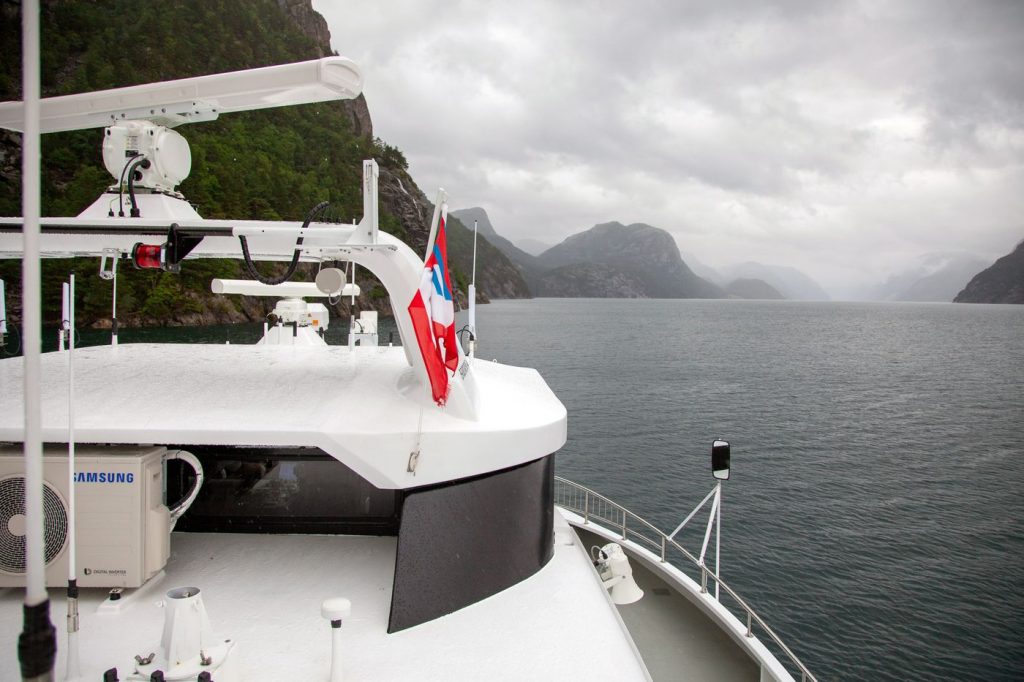
There are and long have been many obvious reasons behind the difficulty of self-driving cars that Musk is now copping to, but again the Overton window has been effectively shifted. Quiet electric vehicles are turning up all over the place – on land, on sea, even in the fjords:

But they’ve already made Norway the most electrified shipping nation in the world, thanks to an aggressive government push to cut maritime emissions. The country is home to almost three-quarters of the 274 vessels globally that run at least partly on batteries, according to a state advisory body. Its fleet of 31 fully-electric car ferries is expected to nearly double by the end of the year, says the Green Shipping Programme, a public-private partnership that supports the transition. Even the sightseeing ferries that cruise Norway’s famous fjords are transitioning to battery power.

On a Saturday morning in Stavanger, along Norway’s west coast, a new ferry, the Rygerelektra, is in the harbor preparing for a tour of some nearby fjords. Measuring 42 meters long with seating capacity of nearly 300, the ferry, is owned and operated by Rødne Fjord Cruises. It is among a group of vessels from several of Norway’s leading maritime companies that are driving a shift towards zero-emissions fleet and supporting Norway’s ambitious economic reinvention away from oil and gas to alternative energy source.

They acknowledge the challenges of large-scale fleet charging, though promising technology already exists. And then, they can’t resist the temptation:

“In Norway, we need to transition from oil exports to sustainable products and services, while still utilizing the competence we have gained from the oil industry, says Pia Meling, vice president of sales and marketing at Massterly, the autonomous shipping company. “We would like to compete on the renewables and in clean shipping in particular.” Massterly’s vision is one of zero-emission, autonomous vessels moving everything from passengers around Norway to containers across oceans.

Emphasis added because I guess they can’t help it. But really, who knows where the over-promise of auto-taxis might lead? Self-driving boats are certainly more possible, if not theoretically easier – at least until you get to a crowded harbor. But hey, in the open water? Sure. In six months, we’ll be…