The socialization of capitalism

New York Magazine takes us on a tour of what lays beyond, after the capitalism runs out. That may sound hippie and/or conspiratorial, but facts is facts and the entire game has changed:

Making matters even weirder, contemporary capitalism’s dominant shareholders have no direct interest in the success or failure of the firms they own. All returns on their holdings get passed down the investment chain to their clients — households, governments, and corporations. Asset managers make their money off of their clients’ fees, not their firms’ returns. This diagram may make the hydraulics of the system more legible:

[cool graphic]

Of course, an asset manager that delivered consistently poor returns would attract few clients. And asset managers’ fees are calculated as a percentage of the current value of their clients’ assets. Nevertheless, add a fee-based business model to asset managers’ universal portfolios, and their interest in the performance of any individual firm they own becomes extraordinarily attenuated — even when they are the single largest shareholder of that firm (which is very often the case)!

This is not how capitalism is supposed to work in theory. And it isn’t how corporate governance has ever before worked in practice. To the political economist Benjamin Braun, the contemporary structure of corporate ownership is so novel and consequential as to mark a new era in economic history, the age of “asset-manager capitalism.”

Braun’s papers on this subject are fascinating, and nerds will want to read them in full. Mere dorks, however, may be content to consider the following four ways the rise of asset managers challenges conventional wisdom about how capitalism functions — and how it might be changed.

Cool graphic and the rest at the link. Removing market competition from the equation renders many of the other legacy levers moot. Even the ESG stratagem takes on a different tenor – what does promoting efficiency even mean when the owners of the means of production no longer prevail – when/if we default (curious wording) to a dirigiste model. They, ESG pressure campaigns may become more effective. Because frankly, christian soldiers, that’s what they’re talking about.

Nostalgia for Normal

Lots of talk/pixels about ‘getting back to normal,’ the ‘new normal,’ and returning to a time when things/life were somehow better because they were usual. Primarily related to the pandemic, it’s also an opportunity to unpack a sympathetic but highly questionable sentiment. So this interesting tweet, highlighted by Bloomberg, serves as a good remedy for that nostalgia for normal:

Happy talk about way-back-when presents recklessness on many fronts – political, racial, economic – but it is also woebegone in terms of environmental devastation and the slow thoughtlessness that has brought us to exactly here. No one* wants to go back to Jim Crow and no one should want to go back to the normal, daily burning rates of our fossil-fueled civilization. As the article demonstrates, and this is a note to hit over and over again, the [high] costs of slowing down and reversing the effects of climate change are actually a bargain. Slice it however you want – we’ve already gotten far closer to the tipping point of better and cleaner far faster than imagined. Looking away and ignoring now requires more effort. That normal is depressing – and it should be. Our calculations of the impacts of the burning have become far less abstracted, to the point of easily transposing the impacts of the Deepwater Horizon disaster onto methane well leakage and carbon emissions just by looking at the numbers.

Unfortunately, our numbness to the staggering total of COVID deaths resembles our shruggy attitude to climate-related externalities. We get used to them, consider that state ‘normal,’ and long for the days.

But we shouldn’t, and we can’t go back, the comforting but perilous blindness of ‘normal’ notwithstanding. Instead of normal, how about a different better? As our friend says, Don’t Be Afraid.

*Admittedly, sometimes my optimism overwhelms

Re-Tooling Demand

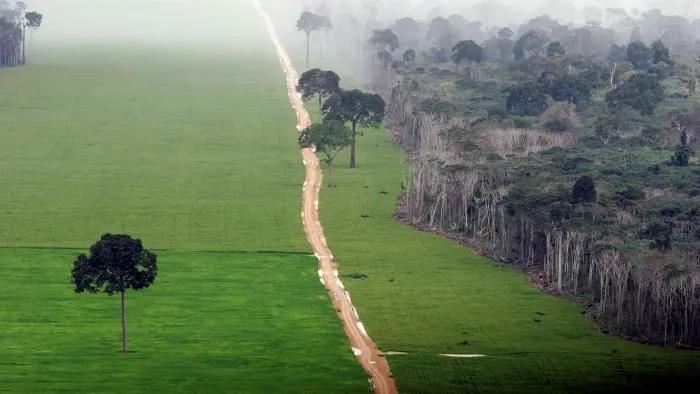
This Financial Times article (subscription req’d) pulls back the curtain on rain forest destruction in Brazil to let us see what – and who – it’s all for:

At the recent UN climate summit in Glasgow, more than 100 national leaders committed to halt deforestation by 2030, and 30 financial institutions, including Storebrand, promised to eliminate the harmful practice from their portfolios by 2025. However, the signatories, including Brazil, Russia and Indonesia, did not indicate how it would be implemented or tracked, and environmental campaigners remain sceptical.

ADM and Bunge are among the world’s largest traders moving Brazilian soyabeans around the world. The increase in production of the commodity, largely used for livestock feed, has been a leading cause of deforestation of the Amazon rainforest as well as the destruction of Cerrado savannah.

The scale of soyabean production on deforested land and differing standards about what qualifies as acceptable activity makes tackling its presence in supply chains challenging for companies.

Both Bunge and ADM strengthened their deforestation policies last year in response to calls from shareholders. Storebrand, together with US fund manager Green Century, tabled a proposal at Bunge’s annual meeting asking it to tighten its policies, which was backed by 98 per cent of shareholders. Bunge has said it is committed to not having soyabeans from illegally deforested land.

As much as even the big fund managers and many governments get on board with divestment and ESG priorities in managing portfolios, this really points up the issue: the companies – and countries – who burn and mine for profit just aren’t going to give it up as long as it’s profitable. The whole ‘fiduciary responsibility to shareholders’ is baked into our ethos, as long as there is money to be made, dividends to be paid, stock to buy back, whatever.

For allies in COP26 and elsewhere, the approach has to include the goal to dismantle, and then re-assemble, the demand side. It’s worth being realistic about this – otherwise, we remain [eternally? That’s optimistic – ed.] captive to supply-side economic logic. As the ADM example highlights, the companies will never lead anywhere besides mining, digging, clearing, and burning.

Image via FT.com © Ricardo Beliel/Brazil Photos/LightRocket/Getty Images

Tales from the crypt(o)

NBA commentator Jeff Van Gundy’s well-placed, near-extemporaneous “back at the crypt” comment notwithstanding, ubiquitous references to crypto currency range from annoying to cloying. Everything about digital money is either scammy or… that seems to be mostly it. Scammy neatly encompasses the over-hyped, Ponzi-schemed, last-one-in nature of the the collection of binary data that necessarily requires us to put all the usual finance-related terms in quotes: “ownership” “collateral” “token” “transaction.” You could go on.

And besides the obvious downsides of NFT’s – from terrific money-laundering possibilities to the proliferation of really bad art – we’d be remiss in not noting crypto’s climate impacts:

Crypto’s overall climate impact remains massive, with certain currencies swallowing up entire nations’ worth of processing power from individual computing units and data centers—much of whose power comes from fossil fuels. The most common form of cryptocurrency mining, proof of work, requires a massive amount of processing power. Alternative mining methods have a mixed track record so far, with some ostensibly “sustainable” mining systems still requiring significant amounts of dirty or clean power. And transacting any tokens across the blockchain, whether an NFT or a Litecoin, sucks up the collective energy feeding into the transaction, no matter the product at hand. One estimate claims that a single NFT trade across the much-used Ethereum blockchain uses enough energy that could power an entire house for several days. And this is all so the buyer can have bragging rights about “owning” an image.

Celebrities who are selling NFTs and also claim to care about the environment: What are you doing? Whatever it is, there sure are a lot of you. Here’s a list—surely incomplete—of luminaries who brand themselves as climate-conscious yet have also been hawking NFTs in some form or the other, ensuring this bizarre digital culture product will linger in the public discourse while possibly ruining the art world, the planet, and our collective sanity.

Not even-close-to-exhaustive list of scam-adjacent proponents at the link. Yes, engaging in yet another form of workaround for doing not the things we need to do about global warming: what are we doing? The climate question at the center of everything, that we’ve been needing to ask for decades, that we still need to answer.

Image: the crypt in question

Water in Holy Lands

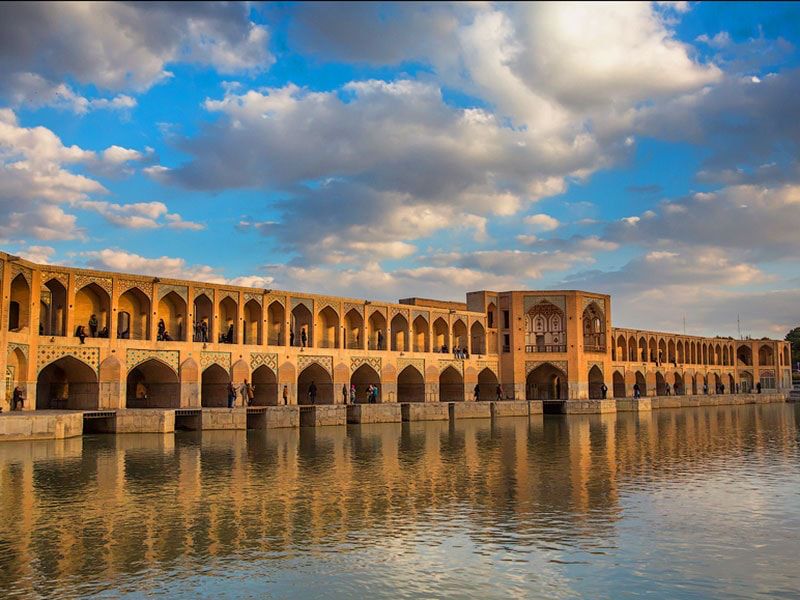
The Khaju Bridge (above) is one of the five historical bridges on the Zayanderud, the largest river of the Iranian Plateau, in Isfahan, Iran. Both a bridge and a weir, it links the Khaju quarter on the north bank with the Zoroastrian quarter across the Zayanderud.

The Khaju Bridge was built around 1650, under the reign of Abbas II, the seventh Safavid king (shah) of Iran, on the foundations of an older bridge. The existing inscriptions suggest that the bridge was repaired in 1873. There is a pavilion located in the center of the structure, inside which Abbas II would have once sat, admiring the view.

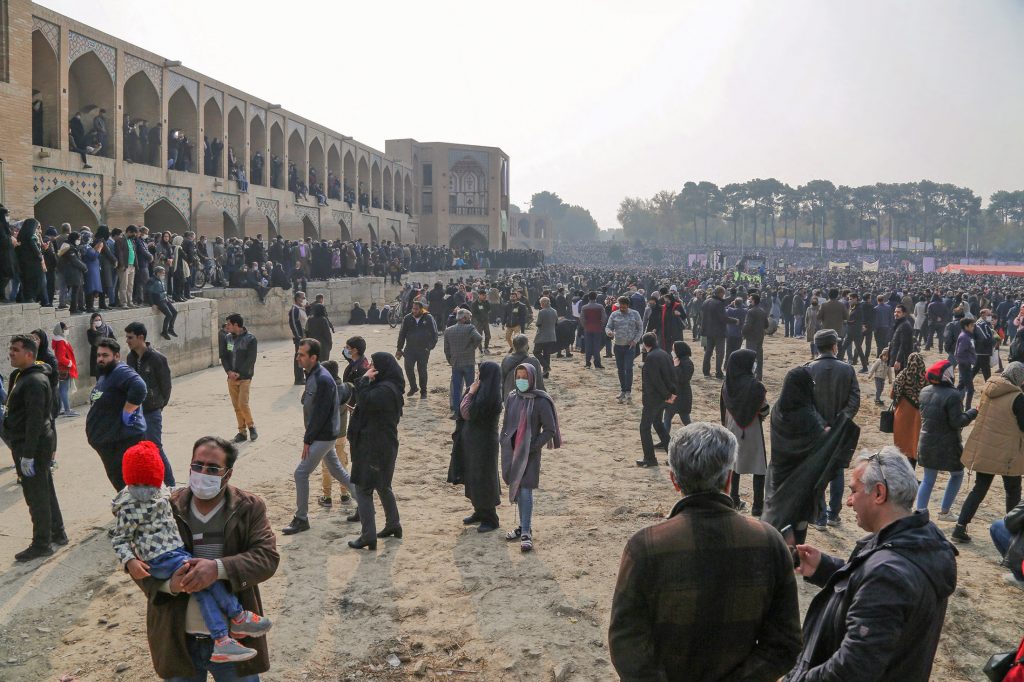
Beneath the archways are several sluice gates, through which the water flow of the Zayanderud is regulated. When the sluice gates are closed, the water level behind the bridge is raised to facilitate the irrigation of the many gardens along the river upstream of the bridge. Because of a sustained drought, and of course related management issues, the sluice gates and riverbed are now the site of gatherings of people worried about these many gardens, as well as crops and more general concerns about sustenance. Compare and contrast

Pictures, 1000’s of words, etc. 2022 is on the way and we need to do better. Soon.

EPA nixes ‘grandfathering’

Reporters and editors don’t especially like big, boring problems – they can be difficult to explain, taking up a lot of words and lacking dramatic photos and illustrations. So kudos to Slate for pulling out this new EPA rule nugget that actually matters – a lot.

But the new methane rule goes beyond merely undoing the damage of the Trump years. The proposal is broader than its Obama-era predecessors, and once finalized, will apply to hundreds of thousands of previously unregulated emission sources, like wells, storage tanks, and compressor stations. That is because unlike the prior standards, Biden’s rule will cover equipment of all ages. EPA thus avoids a key conceptual error that has undercut agency initiatives for over five decades under administrations of both parties: The old rules regulated only new facilities, while exempting older ones from emission limits. In contrast, Biden’s rule covers new and old emitters alike.

And methane, the primary ingredient in natural gas, is a big problem. The gas has a startlingly powerful greenhouse effect when released directly into the atmosphere, trapping 86 times more heat over a 20-year period than an equivalent amount of carbon dioxide. As a result, while methane accounts for only 16 percent of global greenhouse gas emissions, it is responsible for almost a third of current, human-caused warming. And here in the United States, oil and gas installations are the largest industrial source of methane, due both to leaks and intentional venting during the production process.

The Obama administration recognized the need to reduce methane emissions from the oil and gas sector back in 2016 and crafted regulations to do so. But those restrictions applied only to equipment constructed in 2015 or later, leaving the vast majority of the sector’s sources and emissions uncontrolled.

This story was troublingly familiar. Regulating new sources of pollution strictly and existing sources laxly or not at all is known as “grandfathering.” The EPA has engaged in the practice before, with disastrous results. Indeed, we wrote an entire book about the terrible consequences of exempting existing power plants from 1970s emission limits on soot- and smog-forming pollutants.

On the subject of other troublesome old mistakes, the EPA had no comment about toxic emissions emanating from all the crazy uncles still out there. Sources say they continue to study the issue.

Climate in the Weather Space

F*x news is preparing to channel (sorry!) the weather forecasting and reporting sphere when it launches a round-the-clock weather streaming service next week. Potential problems with this seems quite obvious and the WAPO is only so successful in getting network executives to talk about how (and whether) the service will cover climate change in the context of extreme weather events:

For Fox, which has seen sponsors inch away from its more polarizing political content, weather offers a potential way to hook viewers without turning away advertisers, analysts say. But questions linger as to how the streaming service will cover climate change, given Fox News’s history of questioning the seriousness of climate change and how much humans contribute to it. Asked in September whether human activity played a role in recent extreme weather, contributing Fox News meteorologist Joe Bastardi said that “at the very least, you can’t tell what CO2 is doing.”
A landmark U.N. climate report published in August details “unequivocal” evidence that human activity is warming the planet by emitting heat-trapping gases, primarily carbon dioxide.
Fox Weather declined a request for an interview with one of its executives but has indicated that it will treat climate science more seriously in its new endeavor. Echoing recent remarks from Fox News Media chief executive Suzanne Scott, Sharri Berg, the longtime Fox executive now heading Fox Weather told Variety, “If you’re asking about climate change, climate change is part of our lives. It’s how we live. It’s not going to be ignored,” adding, “we will be reporting facts.”

Okay, so… what are they? Wait – show, don’t tell, remember? But this might be the most revealing aspect of their devious plan:

But, she added, Fox Weather will be courting controversy however it covers climate change. If the service reports accurately on climate science, it could alienate core Fox News viewers, who have been primed to question it, Fisher said.
“There is a line that they are going to have to walk to keep advertisers feeling like their brand is safe there but not going too far away from their base,” she said. “If something major happens, like a hurricane or a heat wave, all eyes are going to be looking to them to see how they are characterizing it.”

Reassuring bullsh*t and attacking liberals in the face of climate catastrophes will not be helpful. So this venture will either be truthful and short-lived, or profitable and very harmful. Teach the controversy all you want, but – there’s no whether.

Image: Thomas Hart Benton, Spring Storm, 1958. Tempura on board.

Theories about ESG investing

This is some serious inside baseball. But it IS October:

If your basic theory of ESG investing is “we will avoid bad-ESG stocks in order to drive up the cost of capital of bad-ESG things,” it seems to be working:

Years of awful returns and pressure from clients to exit from the oil-and-gas business have left fewer and smaller firms able to take advantage of rising prices and help boost production. The unwillingness of some banks to make energy loans has compounded the challenges to boosting energy supplies.

Those left are moving to increase production, but they are relatively small players who won’t be able to make a significant impact on output. Investors are steering capital away from fossil fuels and toward companies that rank high in environmental, social and governance, or ESG, measures.

“Oil-and-gas has seen the worst returns of any sector over the past five years; the returns are volatile and investors feel ESG pressures,” says Wil VanLoh, who runs Quantum Energy Partners, which manages $18 billion, making it one of the few remaining big energy private-equity funds. “There’s been a huge retreat in available capital.”

That’s from Matt Levine’s Bloomberg daily newsletter, talking game about the game. But the idea that ESG investing is maturing, as he says, is an interesting one. If companies and the courts are no longer going to just line up on the side of fiduciary responsibilities as a way to protect shareholders – and hence, the companies that may continue to pollute and spew for profit – that’s at least a change.

Image: Abraham Lincoln: Baseball Theme Currier & Ives Cartoon, 1860.

I reckon

What’s the best way to get there? We need to start taking everything into consideration:

To help users find more sustainable travel options, Google launched a feature Wednesday that will show a carbon-emissions estimate for almost every flight in its search results. Now, along with price and duration, travelers will be able to use environmental footprints to compare and choose flights.

James Byers, a senior product manager on the Google travel team, said the emissions estimates are based on a combination of factors, such as the distance of a trip, the number of stops, the number and class of seats on board, the type of aircraft, and data from the European Environment Agency.

The feature, which follows another eco-friendly feature for Google’s hotel searches, could be valuable in the fight against climate change, suggests Katharine Hayhoe, director of the Climate Center at Texas Tech University.

It’s a shift in thinking, a pivot to including more of what has long been ignored. Will it catch on? Many right-wingers will surely choose the most rootin-tootin-pollutinest routes, rollin’ coal as much and for as far as they can. Many are certainly so inclined, and it may have just become easier to make them pay more for the pleasure.

For everyone else more sensible, this is potentially a good tool, allowing demand to push supply in a better direction.

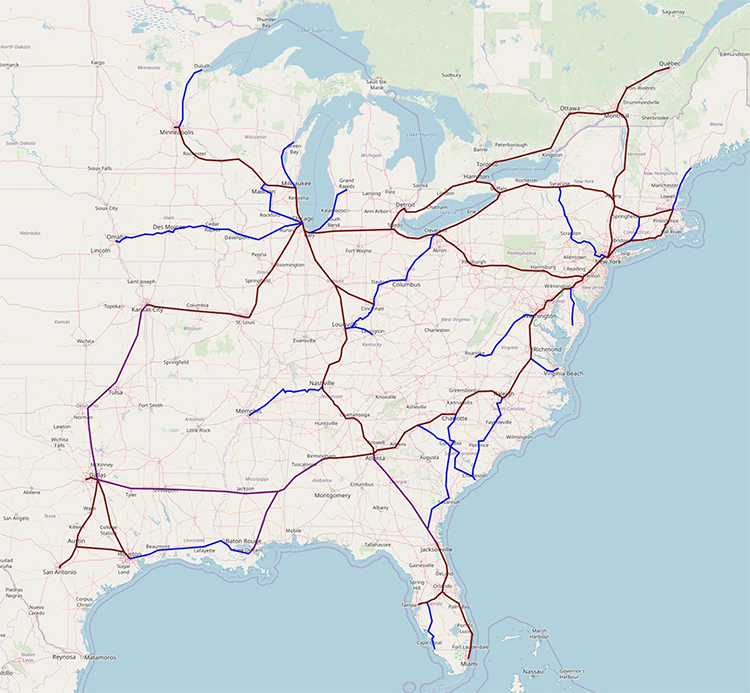
Image: proposed rail network. (Not pictured, how to get North Americans to Europe, Africa, Asia)

Leaderless democracy

No, not the kind that continues to bottle us up in debt-ceiling kabuki. The other kind:

What was the occupiers’ one demand? They never said. And as they practiced a leaderless form of democracy, there was no one to say. The movement did have a slogan, “We Are the 99 Percent,” informed by recent economics research exposing the gap between the top 1 percent and everyone else. Yet the occupiers didn’t seem particularly inspired by the technical solutions that economists proposed. When Joseph Stiglitz, the World Bank’s former chief economist and a critic of unregulated capitalism, came to Zuccotti Park to complain about how financial markets had “misallocated capital,” he looked adorably out of place in his collared dress shirt and khakis, surrounded by activists in kaffiyehs, baseball caps, and hoodies.

Journalists trying to understand this inchoate insurgency turned for answers to Graeber, a seasoned veteran of the global justice movements of the late 1990s and early 2000s and a central figure in Zuccotti Park. It helped that he was a witty commentator with a knack for summing things up crisply. He’d been the one to suggest the language of “the 99 percent,” which he’d adapted from an article by Stiglitz. Graeber was also, as some of his fellow occupiers were surprised to learn, a major anthropological theorist. Starting as an expert on highland Madagascar, Graeber had become a free-range thinker specializing in questions of hierarchy and value but interested in virtually everything. He’d recently written a 600-page ethnography of the protests against neoliberal globalization—protests he’d joined himself.

Leaderless decision-making is the route to the real possibility, messy and littered with threat and chaos though it is. And that’s just the point – Graeber was absolutely correct about the limited political horizons [most] people come to expect. And of course we are taught this, to make nice, to play well with others, even if they actively mean us harm. And make no mistake, there are actual antagonists in our midst and we’re definitely not talking about the horn-hatted, shirtless spear holders. These are people in suits, and many of the issues that stir madness within those impatient with a complicit media or corrupt pols are seen only as rounding errors by the faceless conglomerati.

No one will be allowed – that is, given permission – to do anything about climate change, income inequality or anything else. Some call it anarchy, but being stuck with oppressive systems is a refusal to re-imagine. It’s fear – fear of messes, fear of change, fear of losing security – as if. Meanwhile, tides are lapping. Leave the grand historical narrative to Marx.